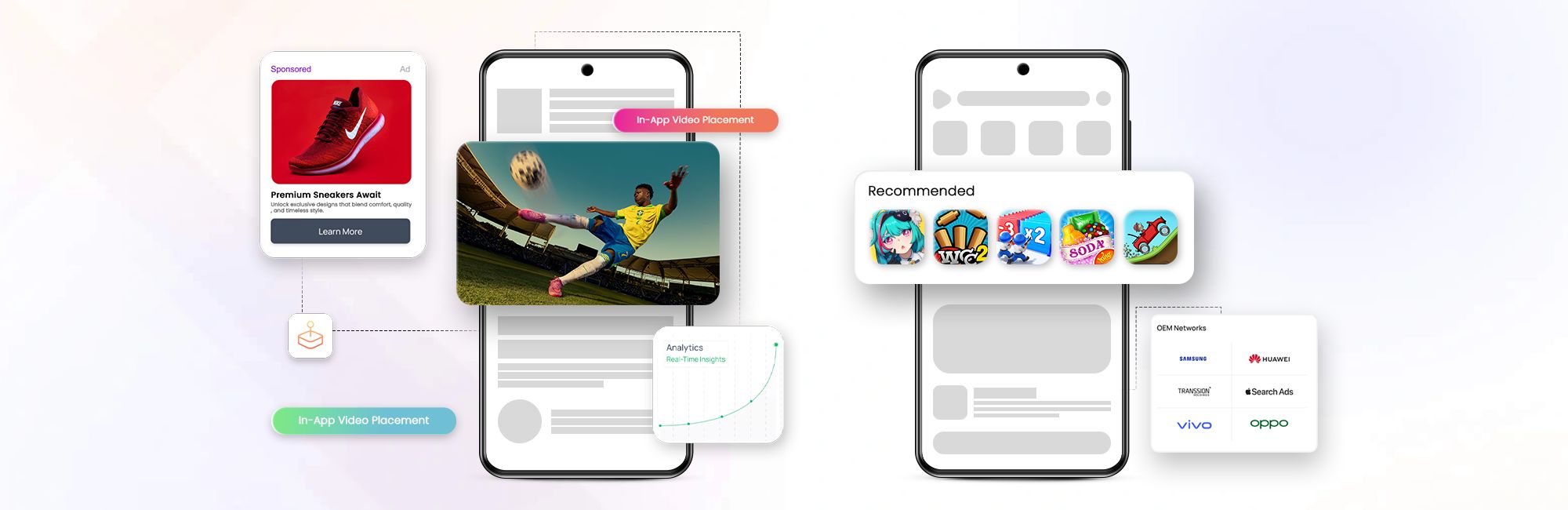
OEM advertising and in-app advertising serve different roles in a modern mobile acquisition strategy. OEM advertising reaches users through manufacturer-owned device ecosystems and is generally stronger for Android-first user acquisition, lower fraud exposure, and reaching users during device setup. In-app advertising reaches users inside mobile applications and performs better for retargeting, post-install engagement, and lower-funnel conversions.
Rather than choosing one over the other, most advertisers combine both: OEM builds new user volume and in-app campaigns improve retention, monetization, and long-term return on ad spend. The right budget split depends on campaign goals, operating system mix, target market, and attribution capabilities.
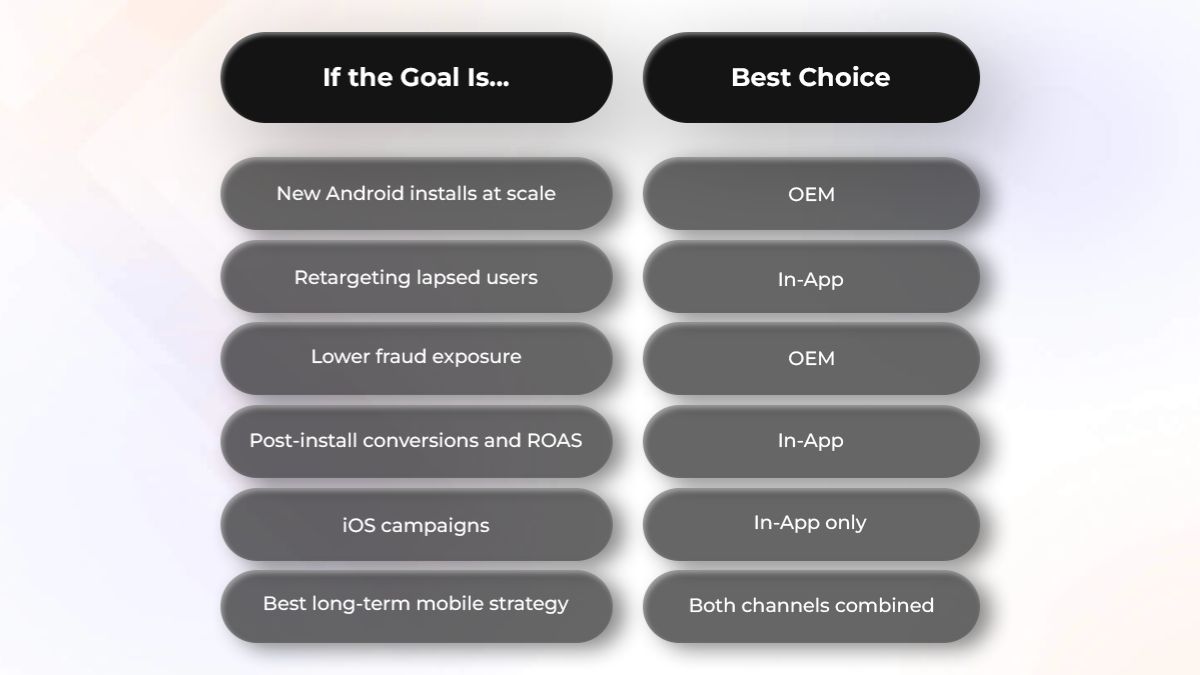
Mobile advertising is becoming harder to scale through a single acquisition channel. Rising auction competition, privacy-driven attribution loss, and growing fraud pressure are forcing advertisers to rethink how budgets get distributed across the funnel.
OEM advertising and in-app advertising have emerged as two of the most important mobile channels in that shift. While both channels support mobile user acquisition, OEM advertising reaches users through manufacturer-owned device ecosystems, whereas in-app advertising reaches users inside mobile applications. Both operate through completely different delivery structures, targeting systems, and performance strengths.
This guide explains how advertisers measure OEM and in-app performance in 2026, how budget allocation changes by vertical and market, where attribution limitations still exist, and how both channels are evolving through 2030 as privacy frameworks and mobile AI systems continue reshaping user acquisition.
What Is the In-App Fraud Environment and How Does It Affect Campaign Results?
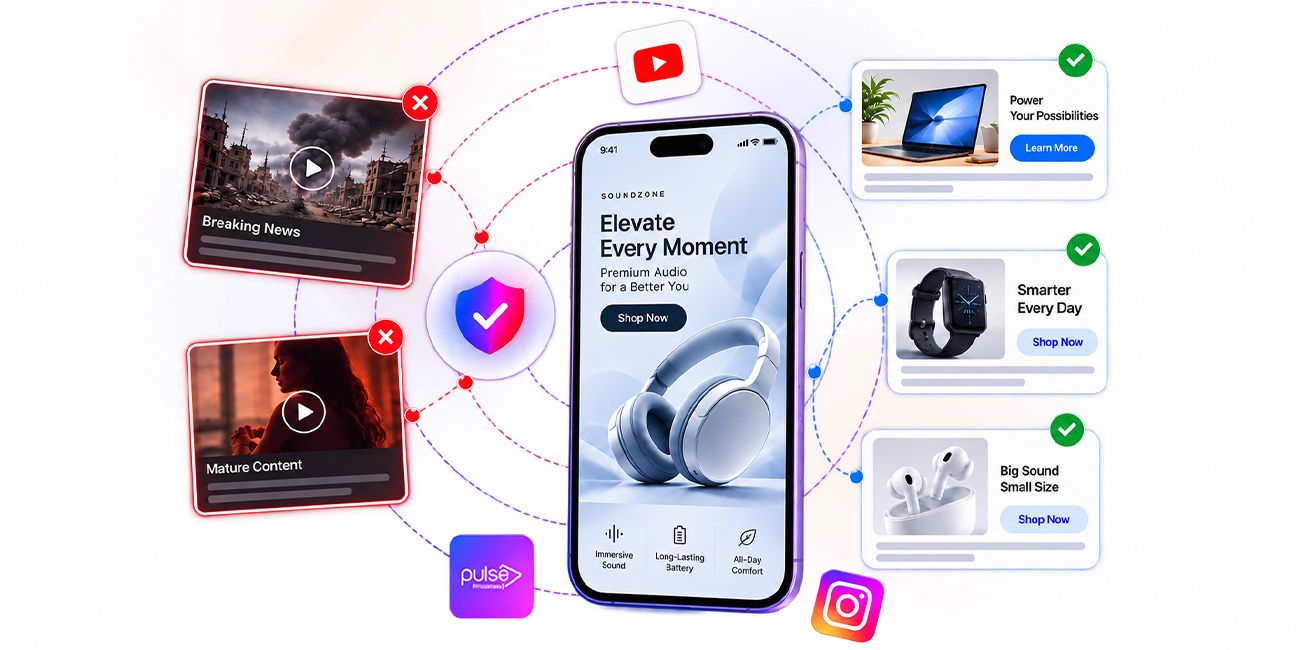
In-app advertising fraud takes several documented forms. SDK spoofing involves malicious apps mimicking legitimate publisher SDKs to report fake impressions and installs. Click flooding generates high volumes of fraudulent clicks immediately before organic installs occur, allowing fraudulent sources to claim attribution credit. Install farms use real devices operated by humans or automation to generate paid installs that never convert into real users.
These patterns concentrate in open programmatic supply chains. More intermediaries between the advertiser and the actual publisher means more opportunities for fraudulent traffic to enter the delivery path.
Why Do OEM Placements Carry Lower Fraud Exposure?
OEM advertising removes most of the intermediary layers where fraud is typically injected. A direct manufacturer partnership means the delivery path goes from the manufacturer’s platform to the device without passing through an anonymous open exchange.
Although OEM generally reduces fraud exposure through direct manufacturer relationships, advertisers should still verify supply quality and measurement practices before launching campaigns. The quality of OEM traffic depends on the directness of the supply relationship. Buying claimed OEM inventory through an unverified aggregator loses the structural advantage that direct OEM supply provides.
Through Pixalate’s MFA classification, Xapads filters low-quality supply before a bid is placed across in-app inventory. With the support of HUMAN’s post-bid integration, Xapads has maintained competitive IVT levels across its mobile supply network.
What Should Advertisers Verify Before Buying Either Channel?
For in-app campaigns: verify that every supply partner connects to a recognized fraud verification service. Confirm the MMP receives clean attribution data and that post-install event rates match expected benchmarks. High install volume with low post-install activity is a fraud signal.
For OEM campaigns: verify the platform has a direct manufacturer relationship rather than purchasing OEM inventory through an SSP that may blend it with open programmatic sources.

How Does Attribution Work Differently for In-App and OEM Campaigns?
How Does In-App Attribution Work and Where Does It Break Down?
In-app attribution depends on mobile measurement platforms (MMPs). When a user clicks an in-app ad and installs the advertiser’s app, the MMP matches the install back to the correct source using device identifiers, probabilistic modeling, or both.
On Android with GAID available, attribution works reliably. On iOS post-ATT, it becomes probabilistic for most users. Campaigns optimizing on cost per in-app event now manage a meaningful data gap on iOS that did not exist before the ATT framework was introduced.
How Does OEM Attribution Use Pre-Install Tracking?
OEM attribution operates at the manufacturer interface layer, which generally produces a cleaner install-level signal than identifier-based tracking for the install event specifically.
Major MMPs support OEM pre-install tracking. Advertisers can measure how many users opened the app following an OEM placement, compare performance across multiple OEM supply partners, and identify which partners bring the highest-value users by post-install behavior.
Incremental measurement is also available. By running holdout tests at the region or device cohort level, advertisers can isolate the true lift from OEM placements versus installs that would have happened organically regardless.
How Should Advertisers Match Measurement to Channel Strengths?
Both channels carry measurement limitations in 2026. In-app campaigns have richer post-install event data but weaker identity resolution on iOS. OEM campaigns have cleaner install-level attribution but fewer tools for deep funnel event tracking inside the installed app.
Many advanced mobile advertisers combine both: OEM covers the acquisition layer where install-level incrementality is the key metric, and in-app covers the engagement layer where post-install event data drives optimization.
Where Does Each Channel Fit in the Mobile Marketing Funnel?
How Does OEM Serve Upper and Mid-Funnel User Acquisition?
OEM advertising fits best at the top and middle of the funnel. It finds users who have not yet decided which apps to install. The device setup stage creates an unusually receptive moment because the user is actively choosing what to put on a new device.
OEM is particularly well-suited for new app launches, expansion into high-Android-share markets, and scaling user acquisition without adding to the same auction competition the rest of the campaign already faces.
How Does In-App Advertising Serve Mid and Lower Funnel Performance?
In-app advertising works across a wider range of funnel positions. Retargeting campaigns within in-app environments bring back users who installed but did not convert. Rewarded video and playable formats drive lower-funnel actions like subscriptions and in-app purchases.
In-app advertising is more versatile in the lower funnel but more sensitive to targeting quality. Clean audience segmentation and well-matched creative separate a cost-efficient in-app campaign from a wasteful one.
What Does a Combined OEM and In-App Strategy Look Like?
A fintech advertiser expanding into India might use OEM placements across the Xiaomi device ecosystem to build initial install volume at lower CPIs, then activate in-app retargeting to re-engage users who installed but did not complete account verification. Each channel does what it does best. The combined plan outperforms either channel running independently.
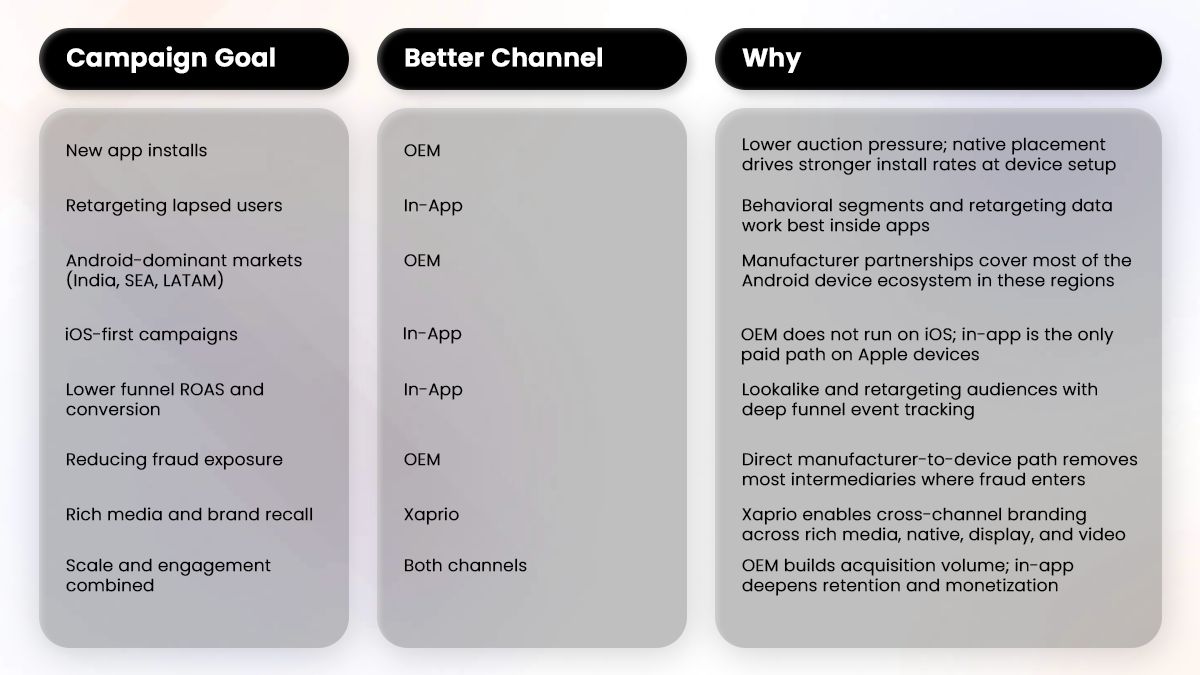
OEM vs In-App: Which Channel Fits Which Campaign Goal?
The table below maps common campaign goals to the channel that serves each goal best.
How Should Advertisers Allocate Budget Between OEM and In-App?
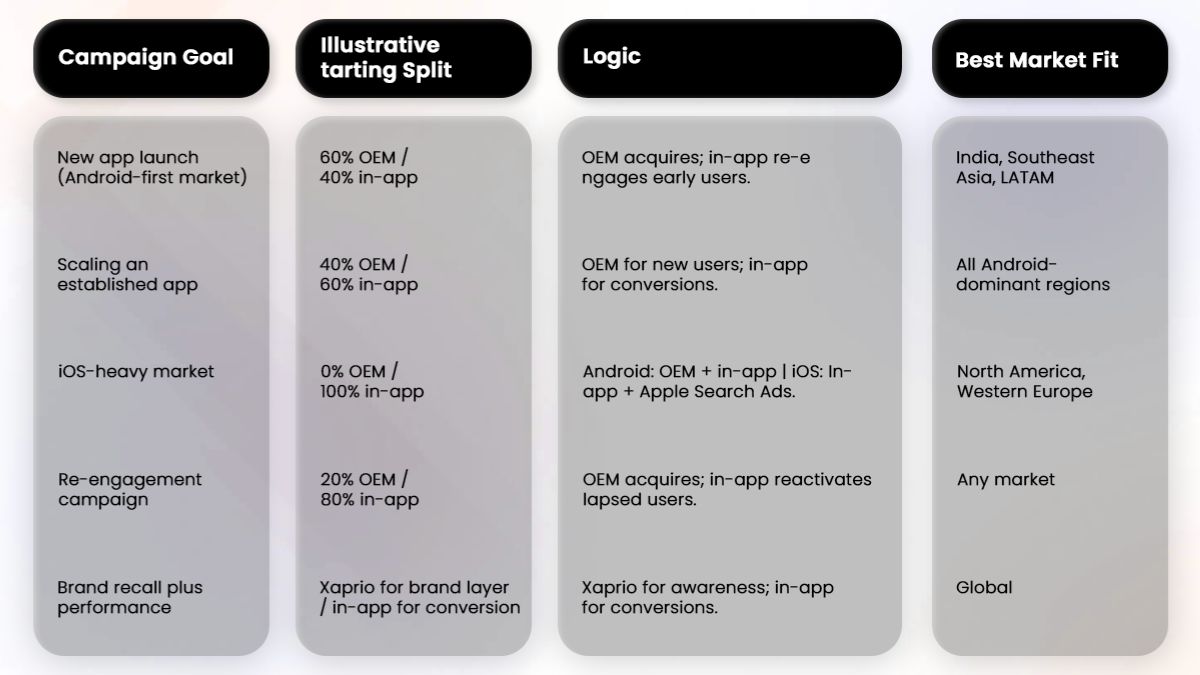
Channel selection and budget split are different decisions. Most campaigns benefit from running both OEM and in-app together. The question is how to weight them based on campaign objective, market, and funnel stage.
The table below provides a starting framework for budget allocation across common campaign scenarios. Actual splits shift based on performance data, vertical economics, and available OEM inventory in the target market.
How Should Advertisers Adjust the Split Over Time?
Campaigns should start with a higher OEM weighting in Android-dominant markets to build the initial install base at lower CPIs. As the installed user base grows, in-app retargeting budget increases to capture the re-engagement opportunity that OEM alone cannot serve.
In markets where Android share is below 50%, OEM contribution to the mix naturally decreases. In North America and Western Europe, where iOS share is high, the in-app channel carries a larger share of the acquisition budget.
OEM is particularly effective for solving acquisition challenges in Android-dominant markets. In-app advertising addresses retention and monetization. Budget allocation should reflect which problem the campaign is currently trying to solve.
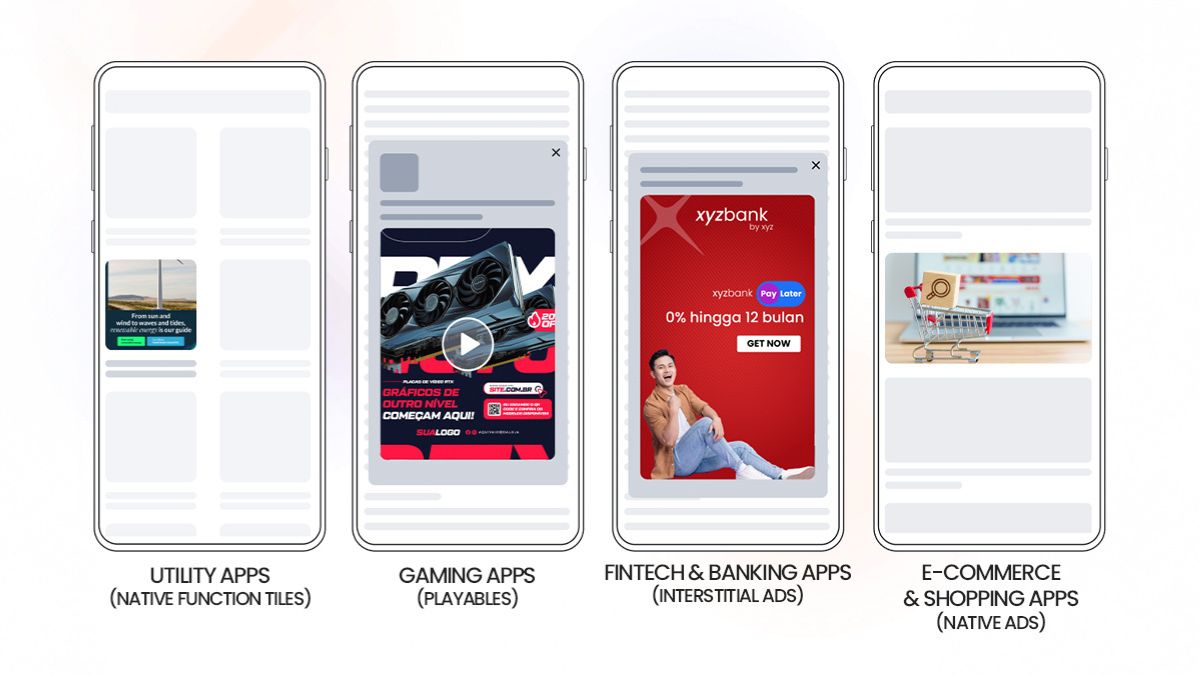
Which verticals perform best on OEM vs In-App?
How Do Gaming Apps Perform on Each Channel?
Gaming is both the largest in-app advertising category by revenue share and one of the strongest OEM verticals. The device setup stage is a natural moment to recommend games because users building a new phone are open to entertainment choices. OEM placements in manufacturer app stores consistently produce strong install rates for mid-core and casual gaming titles. Within other gaming apps, rewarded video and playable formats also perform well for cross-promotion.
How Should Fintech and Banking Apps Approach Channel Selection?
Fintech apps need high-intent users who complete multi-step onboarding flows. In-app contextual advertising inside financial content apps, investment platforms, and business news apps delivers users already in a financial consideration mindset. OEM advertising adds scale in Android-first markets where financial app adoption is growing fast. The combination of in-app contextual targeting for user quality and OEM volume for acquisition scale is the most efficient structure for fintech user acquisition in markets like India and Southeast Asia.
What Makes E-Commerce and Shopping Apps a Strong Case for Both Channels?
OEM placements drive first-time installs at the setup stage. Users who choose to install a shopping app during device setup often show stronger early engagement because the install was an active choice. In-app retargeting through shopping and social environments re-engages users who browsed but did not purchase. Dynamic product ads in in-app environments remain effective for lower-funnel re-engagement.
Why Do Utility Apps Perform Particularly Well on OEM?
Utility apps including VPN, file management, weather, security, and keyboard tools are natural fits for OEM advertising because they mirror the kinds of apps manufacturers recommend as part of the standard device experience. In-app advertising for utility apps can be expensive because competition is high across productivity categories. OEM advertising often delivers stronger ROI for utility categories, particularly in markets where those utilities have strong manufacturer-level relevance.
Where Are OEM and In-App Advertising Heading Through 2030?
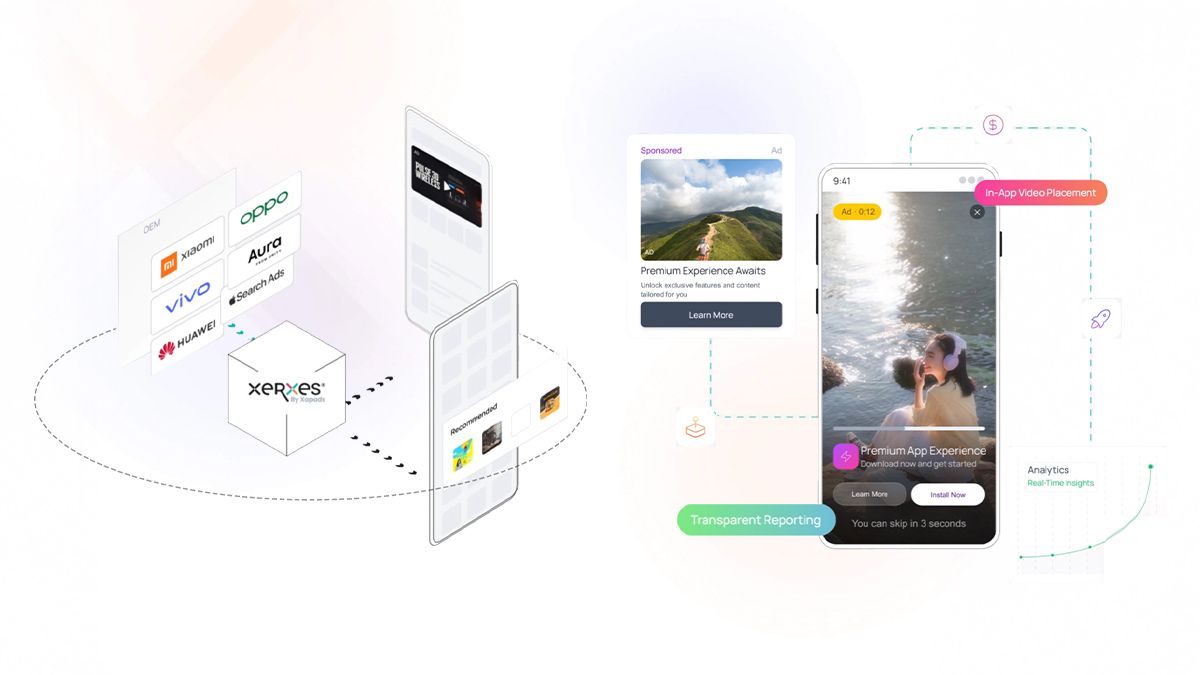
How Is On-Device AI Making OEM Targeting Smarter?
Major Android manufacturers are building AI assistants directly into their device software. These on-device AI systems can recommend content and ads using real-time signals processed on the device, reducing the need to send personal data to external servers. By 2030, 82.4% of total ad spending globally is expected to come from digital channels, making OEM advertising well positioned to benefit from this shift.
The way advertisers identify and measure users is also changing. As the industry moves away from traditional device identifiers, advertisers are relying more on first-party identity, contextual signals, and privacy-preserving measurement to reach relevant audiences. Following Google’s decision to retire the Privacy Sandbox initiative, the industry has continued shifting toward first-party data strategies and aggregated measurement approaches that reduce dependence on cross-app identifiers. In this environment, OEM advertising remains well positioned because it reaches users through the device ecosystem itself. Advertisers that establish OEM partnerships early are likely to be better prepared as privacy-first advertising continues to evolve over the coming years.
How Is In-App Advertising Moving Into Interactive and Richer Formats?
The in-app advertising market is forecast to reach USD 571.76 billion by 2030, growing at an 8.08% CAGR. Interactive ad formats, AI-powered creative optimisation, and richer video experiences are expected to drive much of this growth. Formats such as augmented reality experiences and shoppable video are making it easier for users to move from product discovery to purchase without leaving the app.
Measurement is evolving alongside creative innovation. On iOS, Apple is gradually moving from SKAdNetwork (SKAN) to AdAttributionKit (AAK), its newer privacy-focused attribution framework. AAK expands support for web-to-app journeys, alternative app marketplaces, and re-engagement measurement while continuing Apple’s privacy-first approach. As mobile measurement evolves, advertisers are increasingly combining these platform frameworks with aggregated reporting, first-party data, and incrementality testing to improve campaign optimisation across mobile apps.
What Does the Convergence of OEM and In-App Look Like After 2026?
From 2026 onward, successful mobile advertising strategies are expected to combine OEM and in-app advertising instead of treating them as separate channels. Campaign planning, budget allocation, creative delivery, and optimisation will increasingly be managed together using performance data from both environments.
As advertisers adopt more privacy-first measurement approaches, platforms that support planning, activation, and reporting across OEM and in-app campaigns are expected to become more important. Rather than relying on separate workflows for each channel, brands are increasingly looking for a unified view of campaign performance.
Data clean rooms are becoming an important part of this shift. They allow advertisers, publishers, and technology partners to analyse aggregated campaign data without exposing individual user information. Combined with unified reporting, first-party measurement strategies, and incrementality testing, clean rooms are expected to help advertisers compare OEM and in-app performance more accurately while supporting evolving privacy requirements and better long-term media planning.
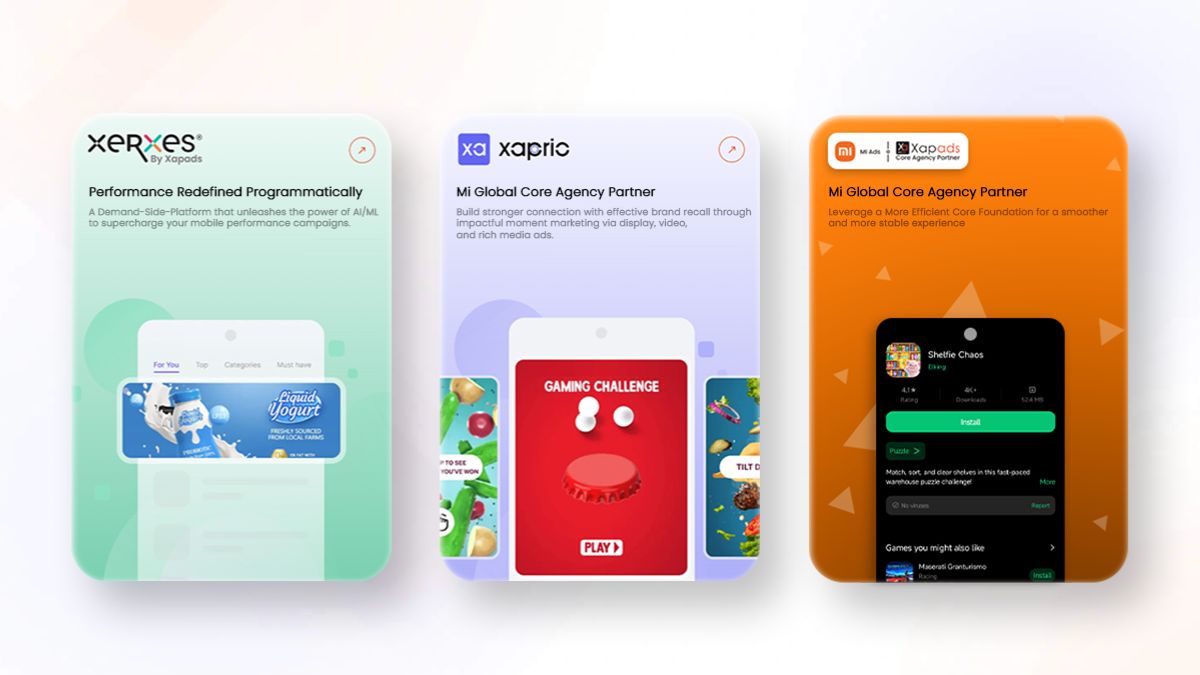
How Does the Xapads Ecosystem Support OEM and In-App Campaigns?
Xapads Media is a global advertising technology company reaching over 1.9 billion monthly audiences across 245 countries, with 10 offices worldwide and more than 100 awards. Each platform in the ecosystem supports a specific campaign objective.
Xerxes: Mobile Performance DSP for In-App Campaigns
Xerxes | Mobile Performance DSP
- 18,000+ websites and 25,000+ mobile apps across the supply network
- 50+ SSP integrations with single-hop, green supply path
- Buying models: CPM, CPC, CPI, CPA
- 100% ads.txt and app-ads.txt compliant
- Audience reach: India 472M+ MAU | Southeast Asia 212M+ | Americas 122M+ | Europe 105M+
Mi.xapads: Direct Access to Xiaomi OEM Inventory
Mi.xapads | Xiaomi OEM Ad Network (Exclusive Partner)
- 564M MIUI Monthly Active Users across 272 countries and regions
- 3.2B average daily impressions
- Regional reach: India 133M | Europe 104M | Southeast Asia 59M | LATAM 56M | Middle East 23M
- Mi TV: 60M+ monthly unique digital users across 106 countries
- Ad formats: lock screen, newsfeed, system apps, and OEM native placements
Provides direct access to Xiaomi’s advertising ecosystem with manufacturer-level placement quality and no open exchange intermediaries.
Xaprio: Cross-Channel Branding Across Both Channels
Xaprio | Branding DSP for Rich Media and Cross-Channel Campaigns
- 2x brand recall lift vs standard display campaigns
- 7.4 seconds average rich media engagement per session
- 50+ ad formats: interstitials, expandable banners, playable, interactive video
- Supply access across OEM, native, display, and video inventory
Xaprio enables cross-channel branding campaigns across rich media, display, native, OEM, and video. For advertisers layering brand activity across both OEM and in-app inventory, Xaprio handles the creative strategy and reach side of that work.
What Will Define the Strongest Mobile Advertisers Through 2030?
The mobile advertising landscape through 2030 will be shaped by three compounding forces: tightening privacy regulation, accelerating Android growth in emerging markets, and AI-driven targeting at the device layer. Each of these forces works in favor of OEM as a primary acquisition channel. On-device AI strengthens manufacturer-level targeting without depending on cross-app identifiers. Android growth expands the addressable OEM inventory base.
In-app advertising grows in sophistication at the same time, as interactive formats, clean room measurement, and retail media integration raise its ceiling for lower-funnel performance.
As programmatic advertising expands across CTV, mobile, OEM, and AI-driven buying, advertisers that understand how each layer of the mobile stack contributes to campaign performance will be better positioned to build scalable strategies through 2030. The strongest mobile advertisers will build infrastructure that lets both channels run together, with clean attribution, dynamic budget allocation, and channel-native optimization for each stage of the user journey.
Frequently Asked Questions
Can advertisers combine OEM and in-app campaigns?
Yes. Many mobile advertisers now combine both channels. OEM builds the initial user acquisition layer. In-app advertising handles retargeting, engagement, and conversion after install. Both channels serve different funnel stages and work better together than either does alone.
Which channel delivers lower acquisition costs?
OEM generally delivers lower CPIs in Android-dominant markets such as India, Southeast Asia, and LATAM because placements appear at the device setup stage with lower auction competition. In-app advertising CPIs vary significantly by vertical, audience quality, and creative format. For most performance campaigns in Android-first markets, OEM produces a lower cost per install on the acquisition side, while in-app delivers stronger cost efficiency on post-install conversions where behavioral data improves targeting precision.
What attribution tools work with OEM advertising?
Major mobile measurement platforms support OEM pre-install tracking. Advertisers can measure how many users opened the app following an OEM placement, compare performance across OEM supply partners, and run incremental holdout tests to isolate the true lift from OEM campaigns.
Which channel works better in emerging markets?
OEM performs strongly in India, Southeast Asia, LATAM, and the Middle East because Android market share exceeds 80% and manufacturer ecosystems from Xiaomi, OPPO, Vivo, and Transsion have deep penetration. In-app advertising complements OEM in those same markets for retargeting and lower-funnel performance.
How will privacy changes affect in-app advertising going forward?
ATT has limited IDFA availability for most iOS users globally. Android’s Privacy Sandbox, rolling out from 2026 onward, will similarly restrict GAID availability over time. These changes reduce in-app targeting precision. OEM advertising, which uses OS-level manufacturer data rather than cross-app identifiers, is structurally less affected by these restrictions.
Related Post