Quick Answer
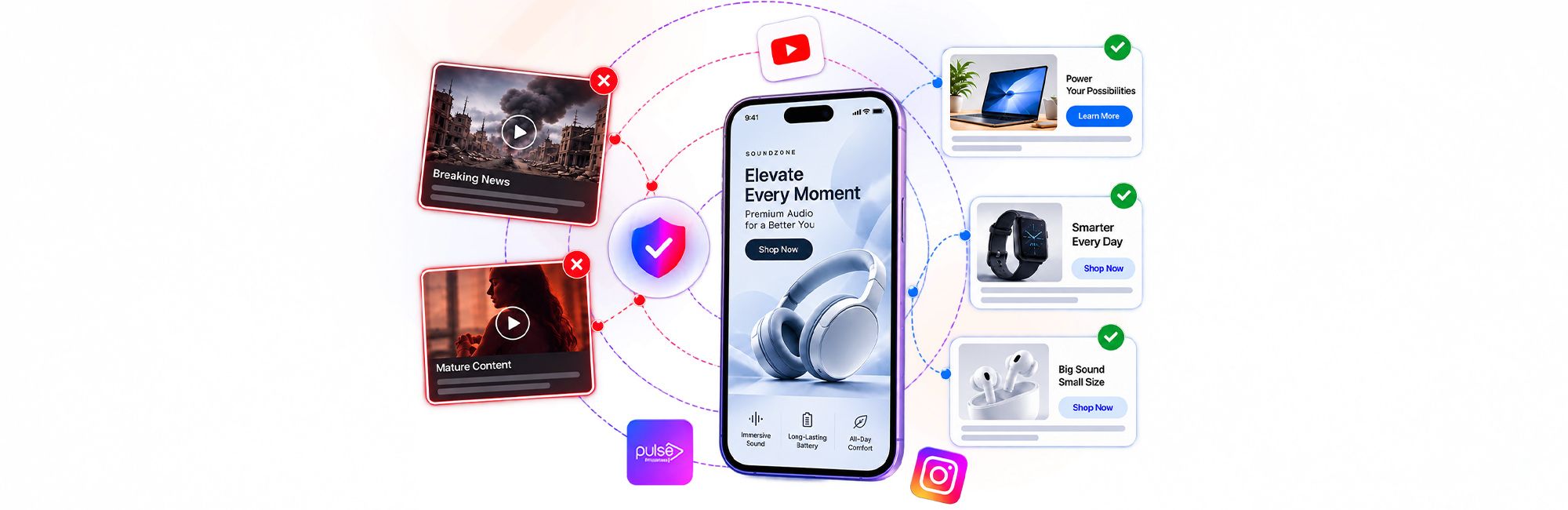
Brand safety in mobile advertising means keeping an ad away from any environment that could seriously damage the advertiser’s reputation, things like violent content, hate speech, or illegal activity. It’s a different, narrower idea than brand suitability, which is about whether a placement fits a specific brand’s values even if it isn’t actually harmful.
Mobile apps need their own version of this because app content doesn’t work like a webpage. Apps generally don’t offer the same page-level URL and readable text a website does, so the signal a platform has to work with often leans more heavily on bundle IDs, app store categories, and whatever context an SDK or mediation layer can pass along.
Introduction
A brand’s ad showing up next to something genuinely damaging isn’t a hypothetical. It’s happened publicly enough times, ads next to extremist content, ads funding channels nobody would want to be associated with, that most advertisers now treat brand safety as a real line item rather than an afterthought.
Mobile makes this harder to manage, not easier. An app generally doesn’t hand a platform the same page-level text and URL a website does. It hands over a bundle ID, a category, maybe a store URL, and whatever signals get passed through an SDK or mediation layer along the way. That’s a thinner, more structured starting point than a full page of readable content.
This article covers what brand safety actually means, how it’s genuinely different from brand suitability, why mobile apps need their own approach to it, and what actually gets checked before and after an ad runs.
For advertisers, this combination of rising viewership, low viewer cost, and improving ad technology has turned FAST channels into a real line item in the media plan. The rest of this article covers what FAST channels are, why they are growing, which platforms lead the category, and how advertisers should plan and measure campaigns running on them.

What Does Brand Safety Actually Mean in Mobile Advertising?
At its narrowest, brand safety is about keeping an ad out of an environment that could create real reputational risk, and in some cases legal risk as well. That covers a fairly specific list: violence, hate speech, illegal content, extremist material, sexually explicit content, and a handful of other categories most advertisers agree on regardless of industry. It isn’t a judgment call about whether a placement feels slightly off. It’s a floor, the environments no brand should be advertising in at all.

Brand Safety vs Brand Suitability
This is the distinction most explanations skip past, and it matters more than the basic definition does. Brand safety sets the floor, the placements that are unacceptable for essentially any advertiser. Brand suitability sits above that floor and asks a different question: does this specific placement actually fit this specific brand.
An insurance brand’s mascot ad appearing next to an article about a phobia connected to that same animal isn’t unsafe. Nobody’s reputation is at legal or moral risk. It’s just an awkward fit. A children’s brand advertising next to mature-rated game content isn’t necessarily unsafe either, depending on the content, but it’s very likely unsuitable for that brand specifically. A gambling brand and a financial services brand can have almost opposite suitability rules while sharing the exact same safety floor.
This is also why a single universal blocklist doesn’t really work. What one advertiser rules out entirely, a different advertiser in a different category might consider perfectly fine. The baseline safety floor is broadly shared across the industry. Suitability is not, and treating the two as the same thing tends to produce rules that are either too loose for a cautious brand or too restrictive for one that doesn’t need to be that careful.
Why Brand Safety Works Differently in Mobile Apps
A website hands a brand safety system something to actually read: a URL, page text, metadata, sometimes the surrounding article itself. An app works with a different kind of signal. What a platform typically has access to is the app’s bundle ID, its store URL, its app store category, and whatever contextual fields, like content genre or page category, the SDK or mediation layer built into that app happens to pass along with the bid request. Those fields exist in the technical spec most exchanges use, but they don’t carry the same depth of readable content a full webpage offers.
That’s a thinner signal than a full page of text in most cases, and it creates real limitations. Two apps in the same app store category can have wildly different content, one might be a calm puzzle game and another might carry occasional mature themes, and a category label alone won’t tell a platform which is which. This isn’t unique to any one channel either. In one US survey, 46 percent of marketers ranked paid social advertising as the format carrying the highest perceived brand safety risk, a reminder that risk perception already varies a lot by format, mobile apps are simply one more environment with their own particular signal limitations rather than a uniquely dangerous one. Supply-chain transparency becomes more important here too, since a longer, less transparent path between the advertiser and the app makes it harder to verify what’s actually being classified in the first place.
None of this makes mobile inherently riskier than the open web. It just means the classification has to work with less direct information, which is part of why layered signals, not a single check, end up doing most of the actual work.
What Advertisers Actually Check for Brand Safety
Brand safety isn’t one filter doing one job. It’s several different checks working together, and most of the value comes from having more than one of them active at once.
The starting point is usually broad: content metadata and app or channel classification, which just says this app or channel falls into this general category, nothing more precise than that. From there it gets more specific. Contextual signals dig into genre, rating, and theme instead of stopping at a category label, and blocklists or allowlists sit alongside that, providing explicit inclusion or exclusion rules for specific apps or publishers regardless of what the automated classification decides. Supply-source information matters too, since knowing who’s actually authorized to sell a piece of inventory, and how many steps the path to it involves, adds a transparency check the content classification alone can’t give.
Then there’s independent verification, which measures the placement using its own methodology rather than relying entirely on the delivering platform’s own reporting, with mobile-specific standards like the Open Measurement SDK increasingly built in to support that kind of independent measurement inside apps. Not every platform runs every one of these, and which combination makes sense depends on the campaign, the category, and how cautious a given advertiser actually needs to be.

Brand Safety vs Ad Fraud vs Invalid Traffic
These three get treated as one big “quality” problem a lot, and they’re genuinely not the same thing. Brand safety is about where an ad appears and what surrounds it. Ad fraud and invalid traffic are about whether the activity behind an impression is real at all, a bot clicking an ad has nothing to do with what content that ad ran next to. Viewability is a third, separate question: whether the ad actually had a chance to be seen, regardless of where it ran or who saw it. Advertisers themselves track these as distinct concerns rather than one bucket. Brand safety topped the list of trust issues that would make US advertisers downgrade or pause a partner, cited by 44 percent, with ad fraud and harmful content environments named separately by 40 and 39 percent.
A campaign can be running in a perfectly safe, brand-appropriate environment and still be losing budget to invalid traffic. It can also be technically fraud-free and still end up somewhere no advertiser would want to be. Treating brand safety technology as if it automatically covers fraud, or the other way around, is one of the more common gaps in how campaigns actually get set up.
What Frameworks Help Define Brand Safety and Suitability
For several years, the Global Alliance for Responsible Media, or GARM, was the closest thing the industry had to a shared reference point, a common set of content categories and suitability tiers that advertisers, platforms, and verification vendors could point to when they needed a shared vocabulary. GARM was discontinued in August 2024, and as of a 2026 joint statement between the World Federation of Advertisers and X, it will not be revived or replaced with something similar.
That doesn’t erase the underlying structure GARM built. The idea of content categories, a safety floor, and suitability tiers above that floor remains influential in how the industry talks about the problem, even though GARM’s specific framework isn’t the actively maintained standard anymore. What’s replaced it isn’t a single new framework. There’s no single body maintaining a shared taxonomy the way GARM once did, which means each platform, DSP, and verification provider runs its own version of that basic structure, with real differences in taxonomy, risk modeling, and methodology depending on which tools a given campaign is actually using. However, third-party ad-verification vendors (like IAS and DoubleVerify) and IAB Tech Lab still utilize it for contextual ad placements.
Pre-Bid and Post-Bid Protection
Filtering before the bid happens
Pre-bid controls evaluate an opportunity before an advertiser’s money is ever spent on it. Category filters, blocklists, app-level risk signals, and supply-source checks all typically run at this stage, deciding whether a given impression is even eligible to be bid on in the first place. It’s generally cheaper to skip a bad opportunity at this stage than to buy it and find out afterward.
Verifying after the ad has run
Post-bid verification checks what actually happened once the ad was delivered, confirming the placement matched what was expected and catching anything pre-bid filtering missed. Pre-bid and post-bid aren’t doing the same job twice. Pre-bid tries to prevent a bad placement before it happens. Post-bid catches what got through anyway, and depending on the platform and workflow, that finding can inform future exclusions, settings, or a closer investigation rather than feeding back automatically.

How this looks in practice
Xapads is a decent example of what this looks like when it’s built into the infrastructure rather than bolted on afterward. Its supply runs on a single-hop path, fully compliant with ads.txt and app-ads.txt, keeping the route between a campaign and its inventory short enough to actually audit instead of buried under several layers of resale. On top of that, suitability scoring runs on contextual and semantic analysis rather than keyword matching, structured around the same content-category approach GARM’s framework popularized, and viewability gets checked against MRC-accredited standards, with creative scanned through The Media Trust before anything goes live. Fraud and invalid traffic controls stay their own separate layer throughout, not folded into brand safety as if they solved the same problem.
For advertisers, this combination of rising viewership, low viewer cost, and improving ad technology has turned FAST channels into a real line item in the media plan. The rest of this article covers what FAST channels are, why they are growing, which platforms lead the category, and how advertisers should plan and measure campaigns running on them.
Do Brand Safety Controls Block Too Much Inventory?
There’s a real tradeoff here that generic brand safety content tends to skip. Stricter controls reduce exposure to risky environments, but they also shrink the pool of inventory a campaign can actually reach, and content classification isn’t perfect. A keyword-based filter can flag a completely safe app because of an unrelated word in its metadata, cutting off inventory that was never actually a problem.
There’s no universally correct setting here. A brand facing heavy regulatory exposure, or one with strict internal policies around reputational risk, has good reason to run tighter controls even at the cost of some reach. A brand with lower risk tolerance for that kind of exposure might accept a smaller inventory pool as a reasonable price for that protection. The point isn’t finding the single right level of restriction. It’s understanding that every setting is a tradeoff, and the right one depends on what a specific brand is actually protecting against.
Common Mistakes: Brand Safety
Setting the rules once and walking away is probably the most common one. App content, categories, and supply partners all shift over time, and a static rule set from six months ago won’t catch what’s changed since. Relying only on keyword matching causes a different kind of trouble, since keywords miss context entirely and can end up blocking perfectly safe content while letting genuinely risky content through in the same campaign. Some teams also quietly assume a fraud-detection tool is handling placement risk too, when it usually isn’t built for that at all, brand safety and fraud prevention just aren’t the same job. And skipping post-bid verification means nobody ever actually confirms the pre-bid filtering did what it was supposed to.
Building a workable approach usually comes down to a short sequence rather than a single setup step: define the actual safety floor first, layer in suitability rules specific to the brand, choose pre-bid controls that match the risk level, add verification where the category calls for it, and then revisit all of it periodically rather than treating it as done.
Mobile Brand Safety Comes Down to Layers, Not One Setting
Brand safety in mobile advertising isn’t a single toggle a platform flips on. It’s inventory selection, contextual signals, pre-bid filtering, post-bid verification, and a brand’s own suitability rules, all working together rather than any one of them doing the whole job. Mobile makes this harder because apps expose a different, more structured kind of signal than a webpage’s readable text, which is exactly why layered checks matter more here, not less.
Frequently Asked Questions
What is brand safety in mobile advertising?
It’s the practice of keeping an ad away from any environment, app, or content that could create real reputational or legal risk for the advertiser, distinct from the broader question of whether a placement simply fits a brand’s values.
Is brand safety the same as brand suitability?
No. Safety is a floor that applies to nearly every advertiser, ruling out genuinely harmful environments. Suitability is specific to each brand and covers placements that are a poor fit without being actually damaging.
Why is brand safety different for mobile apps compared to websites?
Apps expose a different kind of signal than a webpage does. Classification often relies more heavily on bundle IDs, app store categories, and SDK-passed metadata than on readable page content, which makes layered checks more important than they might be on the open web.
Does app-ads.txt make mobile advertising brand safe?
No. App-ads.txt helps confirm who is authorized to sell a given app’s inventory, which is a supply-chain transparency check. It doesn’t say anything about whether the content inside that app is actually safe or suitable, that’s a separate question handled by brand safety controls.
What’s the difference between pre-bid and post-bid brand safety?
Pre-bid filtering decides whether an opportunity is even eligible to be bid on, before any money is spent. Post-bid verification checks what actually happened after the ad ran and confirms whether the pre-bid filtering worked.
Does brand safety technology also prevent ad fraud?
Not automatically. Brand safety controls where an ad appears. Fraud and invalid traffic controls check whether the activity behind an impression is genuine. They’re related problems, but one set of tools rarely covers both well.
Can strict brand safety settings reduce how much inventory a campaign can reach?
Yes. Tighter controls cut exposure to risky environments but also shrink the available inventory pool, sometimes including safe inventory that got misclassified. The right setting depends on a brand’s specific risk tolerance, not a universal standard.
Further Reading
Advertisers who want to understand how brand safety and fraud controls fit into the wider picture of campaign performance can read why many programmatic campaigns underperform and what advertisers can do about it.
Related Post