
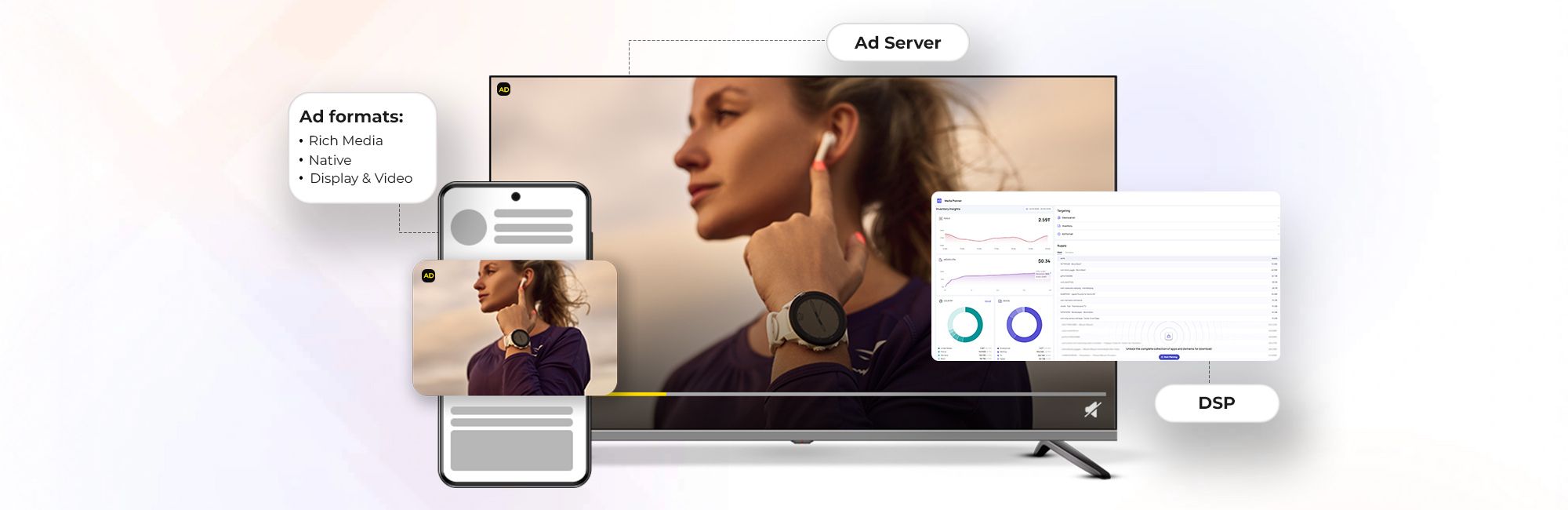
Every programmatic campaign relies on two technologies and many advertisers use the terms DSP and ad server interchangeably.Choosing the wrong one doesn’t just create technical issues—it affects reporting accuracy, campaign optimisation, and media efficiency. They solve completely different problems. A DSP buys ad impressions through automated real-time auctions. An ad server delivers and tracks those ads after the buying decision is already made. One is a buyer. The other is a delivery engine. Mixing them up creates campaign failures that show up in delivery logs, measurement gaps, and wasted budget.
Programmatic advertising now accounts for 90% of all global digital display ad spending. At this scale, infrastructure decisions compound. Getting the stack wrong directly impacts campaign delivery, audience reach, and reporting integrity.
An increasing share of automated media buying now occurs through Programmatic Guaranteed and Private Marketplace deals. US programmatic ad spend is projected to surpass $200 billion in 2026. Understanding which tool handles which job is the starting point for any programmatic stack decision.

What Is an Ad Server and How Does It Work?
An ad server is a technology platform that stores ad creatives, decides which creative serves to which placement, delivers that creative to the publisher or app, and records every impression, click, and interaction that follows. It does not discover new inventory. It does not bid in real-time auctions. Its job begins after the media-buying decision has already been made.
Types of Ad Servers
- Publisher-side ad servers (first-party) manage inventory, set priority rules across demand sources, and report delivery to advertisers. Google Ad Manager is the most widely used publisher-side ad server globally.
- Advertiser-side ad servers (third-party) sit on the agency or brand side. They centralize creative assets across publishers, manage trafficking, and produce independent measurement that does not rely on publisher-reported numbers. Google Campaign Manager 360 (CM360) is the standard for enterprise advertisers running multi-publisher campaigns.
What Are the Core Functions of an Ad Server?
Ad servers handle four jobs: storing creative assets by campaign and flight date; applying decisioning rules to match creatives to placements; delivering the winning creative in the correct format; and logging every impression, click, completion, and interaction into a delivery record that becomes the campaign audit trail. The logic is rules-based, not auction-based.
What Do Ad Servers Optimize For?
Ad servers optimize for delivery outcomes: hitting guaranteed impression commitments, enforcing priority rules, avoiding competitive conflicts, and producing auditable logs. In CTV and streaming environments, ad servers manage pod structure, competitive separation, and non-skippable delivery. These functions require deterministic logic that machine learning bid systems cannot replicate.
Pros and Cons of an Ad Server
Ad servers give advertisers centralized creative management, independent third-party measurement, precise delivery against guaranteed direct deals, and a clear audit trail for billing reconciliation.
The limitation is clear: an ad server does not discover new audiences, access open exchange inventory, or bid in real-time auctions. It is delivery infrastructure, not a media buyer.

What Is a DSP and How Does It Work?
A demand-side platform (DSP) is a technology platform that advertisers and agencies use to buy digital ad impressions across multiple publishers, exchanges, and supply-side platforms through automated auctions in real time. Every time a user loads a page or opens an app, the DSP evaluates that opportunity in milliseconds: is this audience worth bidding on, at what price, and does this impression meet brand safety requirements? It bids, wins or loses, and moves to the next opportunity before the page finishes loading.
Which DSPs Are in Active Use Today?
Enterprise advertisers and agencies choose DSPs based on campaign objectives, inventory access, targeting capabilities, and optimization requirements. While some DSPs specialize in mobile performance, others focus on cross-channel branding, retail media, or connected TV. The right platform depends on the type of inventory advertisers need to access and the outcomes they want to achieve.
For advertisers focused on mobile performance and user acquisition, Xerxes Media Xapads’ mobile performance DSP, provides access to more than 18,000 websites, 25,000 mobile apps, and 50+ SSP integrations. It supports CPM, CPC, CPI, and CPA buying models with machine learning optimization across mobile web and in-app inventory, making it well suited for app installs, user acquisition, and performance-driven campaigns.
Other widely used DSPs in the market include:
- The Trade Desk, which supports cross-channel programmatic buying across display, video, CTV, and audio, with strong identity and data capabilities.
- Google Display & Video 360 (DV360), which integrates closely with Google’s advertising ecosystem and is widely used by enterprise brands and agencies.
- Amazon DSP, which helps advertisers activate Amazon’s first-party shopping and audience signals for display and video campaigns.
Each DSP differs in inventory access, audience data, optimization capabilities, and measurement features. Rather than relying on a single platform for every objective, advertisers typically evaluate DSPs based on campaign goals, target audiences, available inventory, and performance requirements.


How Do DSPs Buy Inventory?
A DSP connects to SSPs and ad exchanges, receives bid requests, applies audience targeting logic, sets bids based on campaign objectives, and returns performance data to the advertiser. DSPs support CPM for brand awareness, CPC for traffic, CPI for app installs, and CPA for acquisition campaigns.
Pros and Cons of a DSP
DSPs give advertisers access to massive inventory across the open web without requiring direct publisher relationships, real-time optimization against performance goals, and cross-channel reach across display, video, mobile, and CTV.
The tradeoff: a DSP does not manage guaranteed direct deal delivery, does not produce independent delivery verification, and using DSP-reported data as the sole measurement source removes the impartiality that makes campaign reporting credible in billing audits.
What Is the Difference Between a DSP and an Ad Server?
The table below maps each platform against eight dimensions that matter to media planners and performance advertisers in 2026.

How Does Programmatic Ad Delivery Actually Work?
Understanding where each tool fits in the delivery chain removes most of the confusion. The sequence below shows how a single impression moves from advertiser intent to creative delivery:

Which Platform Differences Actually Impact Campaign Results?
Control vs Scale
Ad servers give advertisers deterministic delivery control: which creative runs on which placement, at what frequency, in what sequence. DSPs give advertisers buying scale: they bid across thousands of publishers simultaneously, reaching audience-matched impressions that no single direct deal could replicate. A direct deal managed through an ad server may cover a handful of named publishers. A DSP campaign reaches the same audience across thousands of publishers, apps, and CTV platforms simultaneously. Both serve different campaign needs. Neither substitutes for the other.
Guaranteed vs Auction-Based Buying
An ad server is the execution engine for guaranteed deals. When an advertiser commits to a fixed impression volume at a fixed rate with a named publisher, the ad server ensures that commitment is met. A DSP operates in auction environments where nothing is guaranteed. Every impression is contested by bid price, audience signal quality, and targeting match in the moment of the auction. Brands running upfront buys need an ad server. Brands running open exchange performance campaigns need a DSP.
Inventory Relationship
Ad servers manage inventory the advertiser already holds through a direct relationship: owned placements, sponsorships, or reserved guaranteed buys. DSPs access inventory the advertiser has no prior relationship with, discovering and bidding on impressions through SSPs and exchanges in real time. The distinction matters for measurement: ad server delivery is contractually defined; DSP delivery is probabilistic and subject to auction dynamics.
Targeting Logic
Ad servers apply pre-configured rules: serve creative A to segment B during time window C. DSPs apply machine learning to bid optimization. The system learns which impressions drive better outcomes, adjusts bids in real time, and improves performance over the campaign lifecycle. 90% of global digital display ad spending is now transacted programmatically, which reflects how deeply machine learning-driven bidding has displaced manual buying across the open web.
Reporting and Attribution
Ad server reports answer the delivery question: did the right ad appear in the right placement at the correct frequency? DSP reports answer the performance question: which impressions drove the outcomes the campaign was optimizing toward? Sophisticated advertisers run both reports together. The ad server confirms delivery integrity. The DSP explains performance results. One without the other leaves a gap that surfaces in billing disputes and measurement audits.
Do Advertisers Need Both a DSP and an Ad Server?
The right answer depends on campaign structure, buying model, and measurement requirements.
- An ad server is the right tool when running direct deals with guaranteed impression volumes, trafficking multi-publisher campaigns from a single dashboard, or operating in CTV environments where pod management requires deterministic delivery control.
- A DSP is the right tool when running programmatic campaigns at scale, buying across open exchanges or private marketplaces, or optimizing toward performance goals such as installs or acquisitions.
Both tools together are necessary for full-funnel campaigns where premium guaranteed buys and programmatic reach run in parallel. The ad server manages the direct deal layer. The DSP fills programmatic reach. The reconciled data from both platforms becomes the campaign source of truth, independent of any single platform’s self-reported numbers.
As advertisers diversify DSP usage across multiple channels, centralized ad server measurement becomes more important, not less, because it is the only layer that produces a consistent delivery log across all buying methods.
For a deeper look at how programmatic infrastructure decisions connect to campaign measurement, see Xapads’ guide to programmatic advertising infrastructure.
What Are the Most Common DSP and Ad Server Mistakes Advertisers Make?
Running Reporting Only from the DSP
Accepting DSP-reported delivery data as the sole campaign measurement source removes independent verification. An ad server running in parallel produces a delivery log the advertiser controls, one that does not depend on the DSP’s reporting accuracy. Without it, billing disputes between what the publisher charges and what the DSP shows become difficult to resolve.
Using a DSP as a Delivery Verification Tool
DSPs are not built to confirm that a specific creative appeared in a specific placement at a specific time. That is an ad server function. Advertisers who try to reconcile direct deal delivery using DSP logs end up with data that does not match publisher invoices.
Expecting an Ad Server to Optimize Bids
Ad servers do not bid. If campaign performance is underdelivering on CPA or CPI goals, the fix is in the DSP’s targeting logic and bid strategy, not in the ad server’s creative rotation settings. Confusing these functions delays the diagnosis of the actual performance problem.
Assuming One Tool Covers Both Functions
Even within integrated stacks where a single vendor offers both a DSP and an ad server, each tool handles a distinct job. Google’s stack includes DV360 (DSP) and CM360 (ad server). Running only the DSP and skipping the ad server layer means giving up independent delivery verification on every campaign, including guaranteed direct buys that carry contractual impression commitments.

How Does DSP Selection Affect Mobile Performance Campaign Results?
For advertisers running mobile performance campaigns, DSP selection determines which app inventory is accessible and how bid optimization responds to performance signals. Xerxes, the mobile performance DSP from Xapads, operates across 18,000+ websites and 25,000+ mobile apps through 50+ SSP integrations. Xerxes supports CPI and CPA buying models with machine learning optimization across in-app and mobile web placements. Supply path optimization runs through a single-hop, green supply path with full ads.txt and app-ads.txt compliance. For performance advertisers evaluating DSP options for mobile and in-app campaigns, supply breadth and SPO compliance are the two infrastructure factors that most directly affect delivery scale and measurement reliability.
For CTV-specific campaign infrastructure, see how Xapads approaches CTV delivery and ad pod management.
What Should Advertisers Prioritize When Building a Programmatic Stack in 2026?
The DSP vs ad server question is not a technical debate about software features. It is a media strategy decision about how campaigns buy, deliver, measure, and remain accountable. Ad servers give advertisers delivery accountability. DSPs give advertisers buying efficiency and audience reach at scale. Running only one means giving up either control or scale.
Advertisers and media teams that combine both tools, and that select the right DSP for the right inventory type rather than applying a single platform across all channels, run campaigns that are measurably more efficient and easier to audit. As guaranteed deal volume grows and measurement accountability demands increase, centralized delivery infrastructure becomes a strategic requirement, not just an operational choice.
Frequently Asked Questions
Is a DSP the same as an ad server?
No. A DSP buys ad impressions through real-time auctions across open exchanges and private marketplaces. An ad server delivers and tracks those ads after the buying decision is made. They serve different functions and work best when used together.
Do advertisers need both a DSP and an ad server?
Most full-funnel advertisers benefit from both. The DSP handles programmatic audience reach and performance optimization. The ad server handles delivery accountability and independent measurement. Campaigns mixing direct-bought inventory with programmatic buys require both tools to maintain reporting integrity.
What does an ad server do that a DSP cannot?
An ad server manages guaranteed delivery against direct deals, controls deterministic creative rotation, enforces competitive separation, and provides independent third-party delivery verification. In CTV environments specifically, ad servers handle pod management and non-skippable format enforcement in ways that auction-based bidding logic cannot replicate.
What does a DSP do that an ad server cannot?
A DSP discovers and buys audience-matched impressions through real-time bidding across open exchanges, private marketplaces, and programmatic guaranteed structures. It optimizes bids toward performance goals using machine learning. Ad servers do not access or bid on new inventory. They manage what has already been arranged.
How do DSPs and ad servers work together in a full-funnel campaign?
The DSP handles programmatic reach and performance buying. The ad server manages guaranteed direct deals, creative rotation, and delivery verification. Media teams reconcile data from both platforms to produce a campaign source of truth independent of any single platform’s self-reported numbers.
Which programmatic buying model is right for CTV campaigns?
CTV campaigns require both tools. A DSP handles audience targeting across CTV supply at scale. An ad server manages pod-level delivery rules, competitive separation, and non-skippable format enforcement. Running CTV campaigns without an ad server creates gaps in pod management and delivery verification.
Related Post