Quick Answer
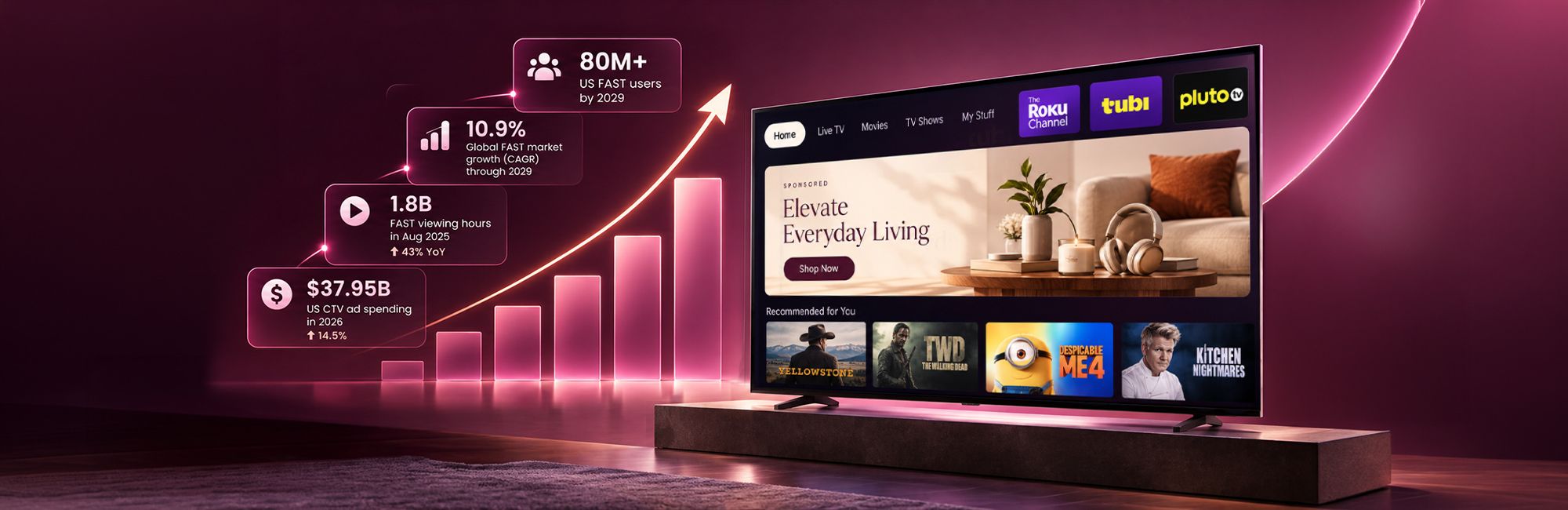
FAST channels are free, ad supported streaming services that deliver scheduled, linear style programming over the internet instead of cable. Advertisers are moving budget toward FAST because viewership keeps rising while connected TV inventory becomes easier to plan, buy, and measure. US FAST users are expected to pass 80 million by 2029, and the global FAST market is projected to grow 10.90 percent a year through 2029, reaching $16.14 billion. FAST viewing hours reached 1.8 billion in August 2025, up 43 percent year over year, with Roku Channel leading US viewership at 97.3 million viewers, ahead of Tubi and Pluto TV. US CTV ad spending is set to reach $37.95 billion in 2026, a 14.5 percent increase, showing how closely advertiser budgets are now tracking this audience shift.
Introduction
Cable subscriptions have been shrinking for more than a decade. Bills kept rising, contracts felt restrictive, and streaming promised freedom from cable, but as more services launched, households ended up paying for Netflix, Disney Plus, Max, and several others just to keep up with the shows they wanted.
That subscription fatigue created an opening. Viewers wanted the ease of turning on a channel without searching through endless menus, but did not want to pay for it. FAST channels filled that gap, bringing back a scheduled channel format people already understood while removing the subscription fee entirely. Smart TVs made this easier still, since manufacturers began building FAST apps directly into home screens, putting them within reach the moment a viewer turns on the TV.
Publishers saw the same shift from a different angle. Studios and content owners already held large libraries of older shows, movies, and sports replays sitting unused, and FAST channels gave that content a new way to earn revenue through ads, without asking viewers to pay. Many media groups are now extending this further into a global strategy, launching region specific channels built around local sports and international content libraries that widen the pool of inventory available to advertisers.
For advertisers, this combination of rising viewership, low viewer cost, and improving ad technology has turned FAST channels into a real line item in the media plan. The rest of this article covers what FAST channels are, why they are growing, which platforms lead the category, and how advertisers should plan and measure campaigns running on them.

What Is a FAST Channel and How Is It Different From AVOD or SVOD?
AVOD, or advertising supported video on demand, lets viewers pick individual titles from a library and watch them whenever they want, with ads inserted around the content. SVOD, or subscription video on demand, removes ads entirely in exchange for a monthly fee. FAST sits between these two models, sharing the free, ad supported economics of AVOD but delivering content on a fixed schedule instead of on demand. For an advertiser, the practical difference comes down to what is actually being purchased and how it is targeted, summarized below.

Both FAST and AVOD sit inside the broader CTV ad spending pool, which eMarketer expects to reach $37.95 billion in the United States in 2026, so the budget decision is often about which model fits the campaign goal, not whether CTV deserves a place in the plan at all.
Why Are FAST Channels Growing So Fast in 2026?
FAST growth is being pulled from two directions at once, viewers looking for a simpler and cheaper way to watch television, and publishers looking for a new way to monetize content libraries that would otherwise sit idle.
Viewer side drivers
Cost is the most obvious driver. FAST channels ask nothing from the viewer beyond watching a limited number of ads, which matters as households manage several paid subscriptions at the same time. Choice paralysis plays a role too. When a viewer opens a subscription app with thousands of titles, deciding what to watch can take longer than expected, and FAST channels remove that decision entirely by simply playing something. Smart TV adoption reinforces this pattern, since FAST apps are now preloaded onto most new television sets, putting them one click away from every viewer who turns on the TV.
Publisher side drivers
Media companies own decades of catalog content that rarely gets a second life once its original demand fades. FAST channels give that content a continuous audience again, often organized into themed channels built around a genre, a decade, or a single franchise. This turns an existing asset into an ongoing revenue stream through ad sales alone, without the cost of building a full subscription product around it. FAST viewing hours reflect this momentum directly, climbing to 1.8 billion hours in a single month in August 2025, a 43 percent jump from a year earlier.
Which Platforms Lead the FAST Market Right Now?

Several platforms have emerged as major players in the US FAST market, including Roku Channel, Tubi, and Pluto TV. Roku Channel leads with 97.3 million US viewers, helped by its position built into Roku hardware that many households already own. Tubi follows closely with roughly 92.5 million viewers, and Pluto TV, owned by Paramount, reaches around 68.6 million viewers. Beyond the leaderboard, what actually matters to an advertiser is whether a platform can deliver those viewers reliably. Strong platforms combine high ad fill rates, a clean electronic program guide, and playout automation that keeps streams running without gaps. Device support matters too, since a platform reaching smart TVs, streaming sticks, and mobile apps at once gives advertisers a wider and more consistent audience than one limited to a single device type.
Ad pod management is worth checking before committing budget. Some platforms stitch several ads together into a long, uninterrupted block, which raises the risk of a viewer changing the channel mid break. Spacing ads more evenly across the schedule reduces that risk and keeps more of each impression’s value intact. Direct supply paths generally reduce unnecessary intermediaries between buyers and publishers, leaving more of the media budget working toward actual reach.
Genre curation is becoming a bigger differentiator between platforms as well. Rather than offering one general entertainment channel, many leading platforms now run dozens of narrow, themed channels built around a single genre, decade, or franchise. This curation gives advertisers a more precise way to reach a specific audience mindset, since a viewer choosing a true crime channel or a classic sitcom channel has already signaled an interest that a broad entertainment feed cannot match.
How Should Advertisers Plan Media Buys Around FAST Channels?
Ad formats and buying models that apply
FAST inventory is commonly bought using cost per thousand impressions, or CPM, for straightforward reach campaigns. Some platforms also offer cost per completed view, or CPCV, where advertisers pay based on completed video views, although CPCV isn’t a standard option across every FAST platform. Advertisers can also access FAST inventory through private marketplace deals, known as PMPs, which can provide access to selected or curated inventory, or through programmatic guaranteed deals, which reserve a specified amount of inventory at agreed terms in advance.
Both approaches give more control over where ads run compared to buying in the open auction. Advertisers exploring how to set up these deal types in practice can find a step by step walkthrough in this programmatic advertising setup guide.
Measurement and brand safety considerations on CTV delivered FAST
Because FAST ads run through server side ad insertion, standard browser based tracking methods do not apply. Measurement instead relies on device-level and household-level signals, along with viewability standards set by the Media Rating Council, which require a set share of the ad to remain visible on screen for a minimum duration. Brand safety on FAST works through several layers rather than one. Platforms can use content metadata, channel classification, publisher controls, and blocklists or allowlists to help determine where ads can run. Contextual signals and suitability controls can add another layer of precision, while independent verification may provide additional checks for areas such as content suitability, fraud, or viewability. The specific controls available vary by platform, inventory source, and buying method. Many advertisers also rely on independent verification partners and supply quality controls to help evaluate inventory quality before and after campaigns run.
Where Unwire’s CTV infrastructure fits
Unwire, the dedicated CTV advertising platform from Xapads Media, supports the kind of buying FAST campaigns need, including PMP and programmatic guaranteed deals, contextual targeting by genre and content type, and real time reporting once a campaign goes live. Unwire delivers 100 percent viewability across premium channels and a 95 percent video completion rate, which matters directly for FAST placements where the ad cannot be skipped once it starts. OTT header bidding connects advertisers to FAST and broader CTV supply through a unified auction, reducing the work needed to reach multiple platforms separately.
What Risks Should Advertisers Watch For in the FAST Model?
Ad load and viewer alienation risk
FAST channels earn all of their revenue from advertising, which creates pressure to run more ad breaks and longer ad pods to maximize yield. Pushed too far, this reduces the viewing experience and can drive audiences toward a different channel or platform entirely. A viewer who feels every few minutes are interrupted by an ad break has an easy alternative available, since switching to another free channel takes only a second on most smart TV interfaces. Advertisers benefit when they choose platforms that balance ad load with viewer retention, rather than platforms chasing short term revenue at the cost of long term audience size. Reviewing how a platform spaces its ad breaks, and how long each pod runs, gives advertisers a practical way to compare inventory quality before committing budget.
Fragmentation across platforms and inventory quality variance
The FAST category includes dozens of platforms and nearly 1,870 individual channels operating globally, and quality varies significantly between them. A channel with strong playout automation and clean supply paths delivers a very different outcome than one with inconsistent streams and weak fill rates. This fragmentation also creates a frequency capping problem. A single household often has access to several FAST apps at once across a smart TV, a streaming stick, and a mobile device. Working with a platform that manages frequency at the household level helps reduce unnecessary repetition across devices where supported, though cross app frequency capping remains a difficult problem industry wide.
Frequently Asked Questions
Is FAST the same as free CTV advertising?
FAST is one format within the broader CTV advertising category. CTV includes any ad that appears on a connected TV device, while FAST specifically refers to scheduled, channel based streaming rather than on demand viewing.
How do advertisers buy FAST inventory?
Advertisers typically buy FAST inventory through CPM or CPCV pricing models, either in the open programmatic auction or through PMP and programmatic guaranteed deals that offer more control over placement.
What is the difference between FAST and AVOD for ad targeting?
FAST targeting is based on the channel and time slot a viewer selects, similar to a daypart buy, although some platforms also support audience and contextual targeting. AVOD targeting is based on the specific title a viewer chooses to watch on demand, along with audience and contextual signals.
Do FAST channels use third party cookies for targeting?
FAST environments generally do not rely on third-party browser cookies in the same way as web advertising. Targeting and measurement can instead use device, household, publisher, contextual and other available signals, depending on the platform and technology stack.
Is FAST advertising measurable the same way as digital display advertising?
FAST measurement uses CTV-specific approaches that can include impression logs, device and household signals, completion metrics, and third-party measurement solutions.
Further Reading
To understand how FAST fits into the wider connected TV landscape, see this comparison of CTV vs OTT advertising.
Related Post