
Quick Answer
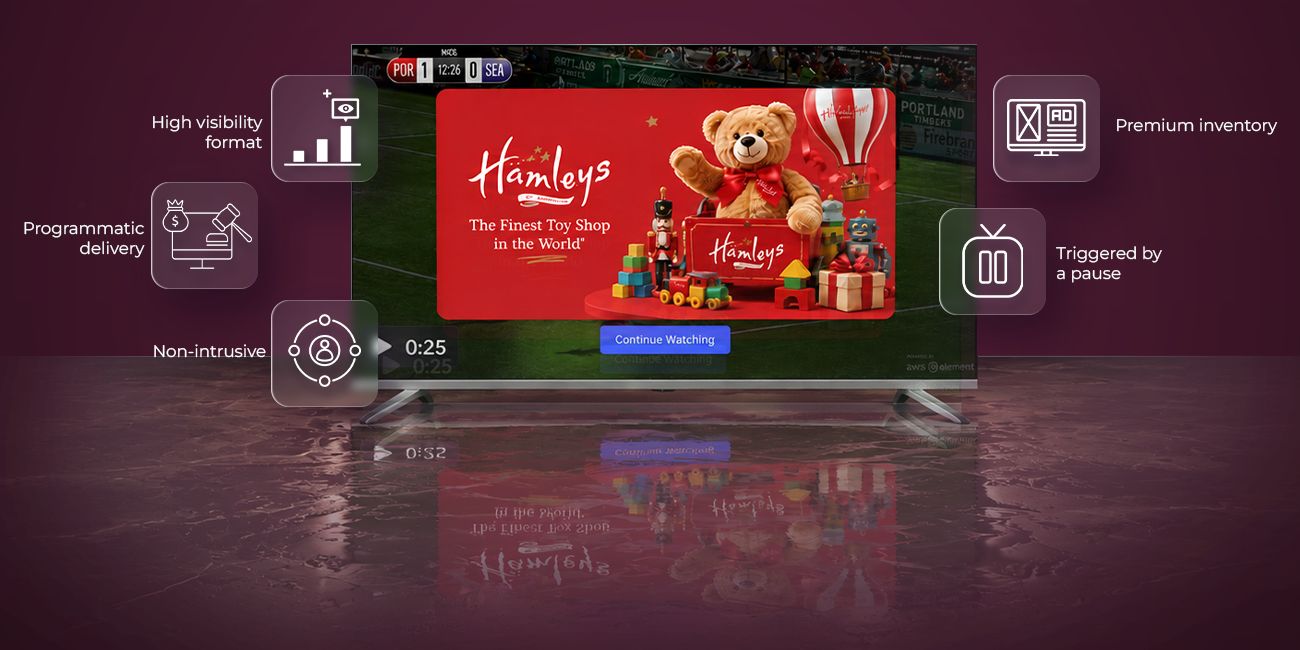
A CTV pause ad is a viewer-initiated advertisement that appears on screen when a viewer pauses streaming content, taking the form of a full-screen takeover or a partial-screen overlay depending on the implementation, and staying visible until playback resumes. Unlike pre-roll or mid-roll formats, a pause ad does not interrupt an active viewing session. It fills a moment the viewer has already chosen to step away from the screen, which is why the format has attracted advertiser interest as a viewer-initiated advertising moment rather than a scheduled interruption. Recent research has reported substantially higher attention levels for pause ads compared with standard CTV spots.
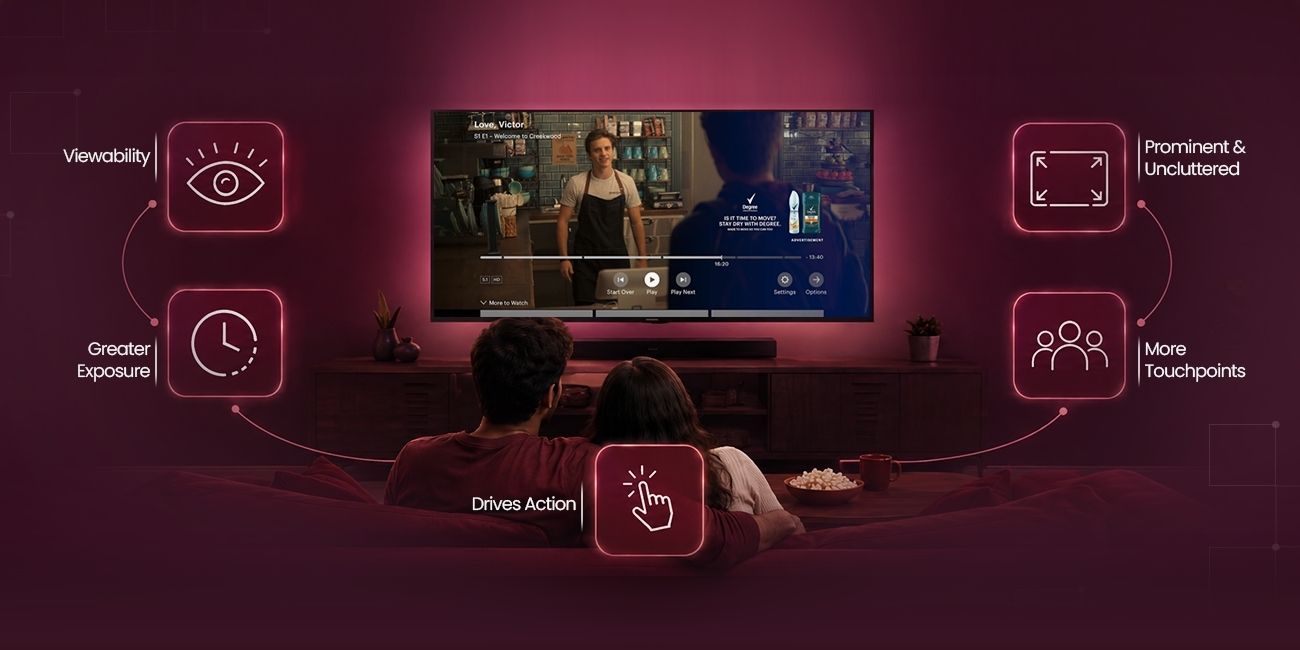
Pause ads are increasingly being integrated into programmatic CTV workflows, meaning demand-side platforms can target, deliver, and measure them alongside a household’s broader CTV campaign. The format works because it borrows attention that already exists rather than competing for attention mid-scene, with delivery triggered by viewer behavior rather than a fixed break in the content timeline.
Introduction
Streaming viewers pause content constantly, whether to answer the door, refill a drink, or check a phone notification. That pause used to be a dead moment for advertisers, a gap in the viewing session with no commercial value attached to it. Connected television changed that. Because CTV delivery runs through software rather than a fixed broadcast signal, the pause button itself can trigger an ad placement, turning a passive interruption into a controlled, brand-safe advertising moment.
This shift matters because attention on streaming platforms has become harder to hold. Viewers skip, multitask, and disengage from standard video breaks more than they did even two years ago. Formats that work with viewer behavior instead of against it are gaining ground for exactly that reason.
Pause ads are not a new idea. Streaming platforms experimented with the format as early as 2019, but adoption stayed limited because every platform built its own version, with different creative specs, different delivery logic, and no shared measurement standard. That fragmentation made pause ads difficult to buy programmatically at scale.
That is changing. Industry standards bodies have moved to formalize pause ads as a defined connected television ad type, and demand from advertisers has followed. The format is moving beyond isolated platform implementations as industry standards make pause ad inventory easier to define, signal, and transact programmatically.
This article explains what a CTV pause ad actually is, how the format works from a technical and buying standpoint, why advertisers are prioritizing it in 2026, and how it fits alongside other connected television placements.
What Is a CTV Pause Ad?
A pause ad is a viewer-initiated CTV ad experience that appears when a viewer pauses streaming content. Depending on the implementation, pause ads can take the form of a full-screen takeover or a partial-screen overlay, and the creative can remain visible until playback resumes. There is no countdown, no skip button, and no fixed duration, because the ad’s lifespan is tied entirely to viewer behavior rather than a preset timer.
Pause ads sit within a broader category of what the industry calls attention-based or moment-based formats. Rather than interrupting a scene the way a mid-roll spot does, a pause ad occupies a screen the viewer has already stepped away from. That distinction is the core of why the format performs the way it does. The viewer is not being asked to sit through anything, because there is no scheduled break to sit through. The ad is simply present in a moment that already exists.

How Do CTV Pause Ads Work Technically?
Pause ads are increasingly being integrated into programmatic CTV workflows rather than relying entirely on custom platform builds. When a viewer presses pause, the streaming environment can signal a pause ad opportunity back to the ad server, and the appropriate creative is selected and delivered according to the platform’s implementation and the programmatic standards it supports. A creative asset, typically a static image, a short looping animation, or an interactive overlay, is then rendered on top of the paused frame where the format allows it.
Because the format is event-triggered rather than scheduled, targeting can factor in what content was playing at the moment of the pause, giving advertisers genre-level or program-level context without needing personal identifiers. Depending on the platform and programmatic setup, pause ad inventory may be available through open auction, private marketplace deals, or guaranteed programmatic arrangements.
Measurement can use the household and cross-device frameworks already applied to other CTV formats, tracking delivery, viewability, and downstream engagement such as QR code scans or clickthroughs, with the available metrics depending on the platform and implementation.
Dwell time is the variable that separates pause ads from every timed video format. A viewer might resume playback after a few seconds or stay paused for several minutes, and the creative has to hold up regardless of how long it stays on screen. This is why most pause ad units are built as static or looping assets rather than full-motion video with a defined end point. A design that depends on a fixed runtime, the way a fifteen or thirty-second video spot does, breaks down the moment a viewer pauses for longer or shorter than expected. Effective pause ad creative is built to look intentional at any length, with a clear brand mark and a single, uncluttered message rather than a sequence of scenes that assumes a predictable viewing window.

Why Are Advertisers Adopting Pause Ads in 2026?
Three forces are driving pause ad adoption this year. The first is standardization. IAB Tech Lab’s CTV Ad Portfolio defines six core CTV ad formats, including Pause, and updates its programmatic CTV guidance with OpenRTB signaling support prioritized specifically for the Pause and Menu formats. That kind of standards body action tends to precede broader programmatic adoption, since buyers are more willing to commit budget to a format once creative specs and measurement definitions are consistent across streaming platforms.
The second is measured performance. Independent attention research has found that pause ads generate substantially higher viewer attention than standard sixty second CTV spots, a gap that shows up consistently across content categories rather than in a single vertical.
The third is the shift toward interactive, second screen viewing behavior. A majority of streaming viewers already watch television while engaging with a phone at the same time, which means a paused screen with a scannable element meets the viewer exactly where their attention already is. Pause ads sit at the intersection of all three trends: a standardized format, stronger attention data, and viewing habits that reward formats built for a second screen.
Where Do Pause Ads Fit Into the European CTV Landscape?
CTV is taking up a growing share of programmatic media planning worldwide, and the global connected TV market is projected to keep expanding through the rest of the decade, from just under 29 billion U.S. dollars in 2025 toward nearly 38 billion U.S. dollars by 2031. European advertisers are part of that growth curve. European CTV planning also has to account for privacy requirements such as GDPR, while advertisers are increasingly evaluating contextual signals, premium inventory, and less disruptive ad experiences alongside traditional audience targeting.
Pause ads fit naturally into that set of priorities. Where supported, Pause Ad campaigns can use contextual signals such as genre, program, device, or other available inventory signals, allowing advertisers to build relevant campaigns without relying exclusively on personal identifiers. As standardization work continues to reduce cross-platform friction, pause ads are becoming easier for European advertisers to evaluate alongside traditional pre-roll and mid-roll inventory in their CTV media plans.
With DMEXCO 2026 bringing together advertisers, publishers, agencies, and ad-tech companies in Germany, pause ads are a relevant part of the wider conversation around premium CTV inventory, programmatic buying, and emerging advertising formats.
What Formats Do CTV Pause Ads Support?
Pause ad creative has moved well beyond a static logo on a black background, and can generally be grouped into three common approaches.
Static and animated pause ads
The simplest form is a still image or a short looping animation branded to fill the paused frame. This format requires the least production effort and works well for straightforward brand awareness objectives.
QR-enabled pause ads
A scannable QR code sits on the paused screen, giving viewers a direct path from the television to a mobile landing page, product listing, or offer. Preference research shows QR-enabled pause ads perform especially well with younger viewers, with scannable codes ranking among the most preferred pause ad elements for Gen Z and millennial audiences. This format is the closest connection point between big-screen brand exposure and mobile-driven action.
Interactive and shoppable pause ads
Depending on the platform, these units can add interactive elements such as buttons, saved offers, or product information directly to the pause experience. These units require more creative development but extend the pause moment into a genuine consideration or conversion step rather than a pure awareness impression.
For advertisers planning pause ads as part of a broader CTV strategy, Unwire supports pause screen advertising alongside broader CTV inventory, allowing the format to be considered as part of a wider connected television strategy rather than as an isolated placement.
How Do Pause Ads Compare With Other CTV Ad Formats?
Pre-roll and mid-roll ads interrupt the content a viewer is actively watching, which is precisely what makes pause ads different. A pre-roll spot competes with a viewer’s intent to reach the content itself, and a mid-roll spot breaks a scene the viewer was already engaged in. A pause ad does neither. It appears only after the viewer has voluntarily stepped away, which removes the friction that standard in-stream formats carry by design.
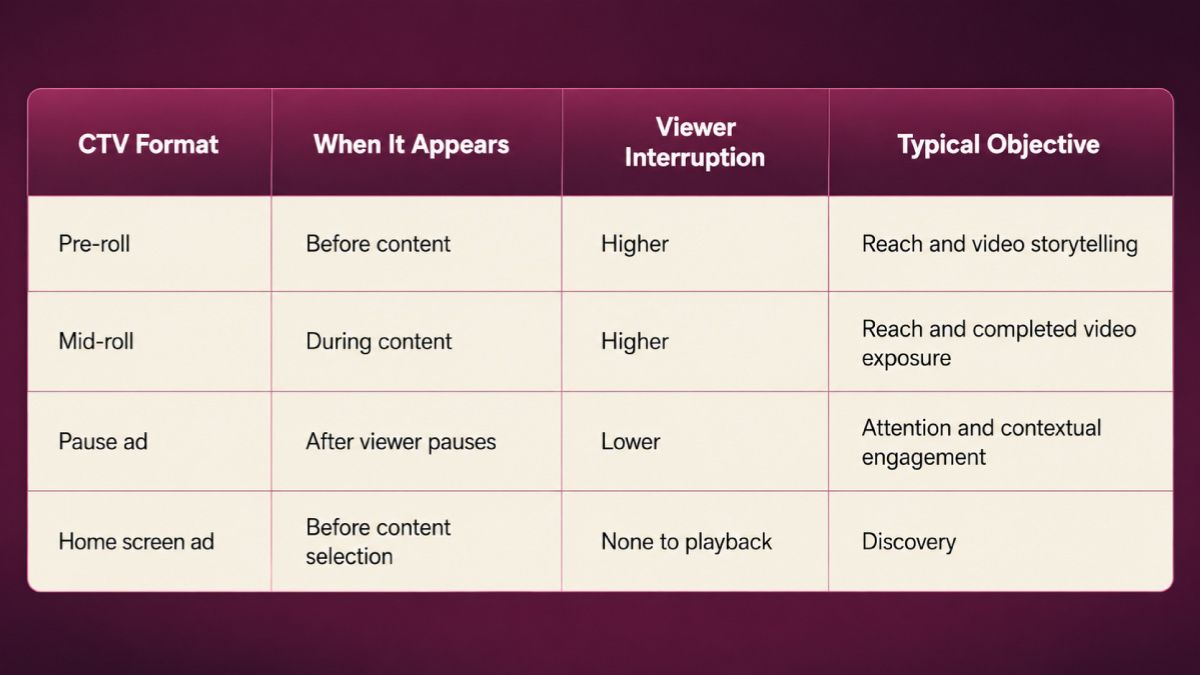
This does not make pause ads a replacement for in-stream video. The two formats serve different roles across a media plan, a distinction covered in more depth in how CTV and OTT formats compare for advertisers. In-stream spots build broad reach across a viewing session, while pause ads add a high-attention layer on top of that reach, reinforcing the message at a moment when the viewer is not being asked to sit through anything. Pause ads are one part of a broader portfolio of emerging CTV formats that also includes menu, screensaver, overlay, in-scene, and squeezeback placements, each suited to a different moment in the viewing session. Advertisers can use pause ads alongside in-stream formats when they want to combine scheduled reach with a viewer-initiated attention opportunity, rather than treating pause ads as a standalone tactic.
How Do Programmatic Pause Ads Work?
Buying pause ad inventory programmatically follows a sequence similar to other premium CTV placements, built around a small set of steps.
- Inventory signal: the streaming environment flags that a viewer has paused and a pause ad opportunity exists
- Bid opportunity: the signal is passed into the programmatic pipeline, where it can be evaluated through open auction or a pre-negotiated deal
- Targeting and context: genre, program, and device level signals inform which creative is eligible for that specific pause moment
- Deal type: advertisers can transact through open auction, private marketplace deals for curated inventory, or programmatic guaranteed commitments when volume certainty matters
- Creative delivery: the selected static, animated, or interactive asset is rendered on the paused frame
- Measurement: delivery, viewability, and any downstream engagement such as QR scans are tracked using standard CTV measurement frameworks
The value of programmatic pause advertising increases when advertisers can plan the format alongside premium CTV inventory rather than buying it as a standalone placement. A CTV platform such as Unwire can bring pause screen opportunities into a broader programmatic strategy, with contextual targeting, premium supply, and deal-based buying helping advertisers align pause ads with the rest of their CTV activity. For campaigns where inventory quality matters, private marketplace and programmatic guaranteed structures can also provide greater control over where and when these placements appear.
As with other programmatic CTV campaigns, advertisers should also evaluate inventory quality, invalid traffic controls, brand suitability, and measurement standards before scaling pause ad activity.
Benefits and Limitations of CTV Pause Ads
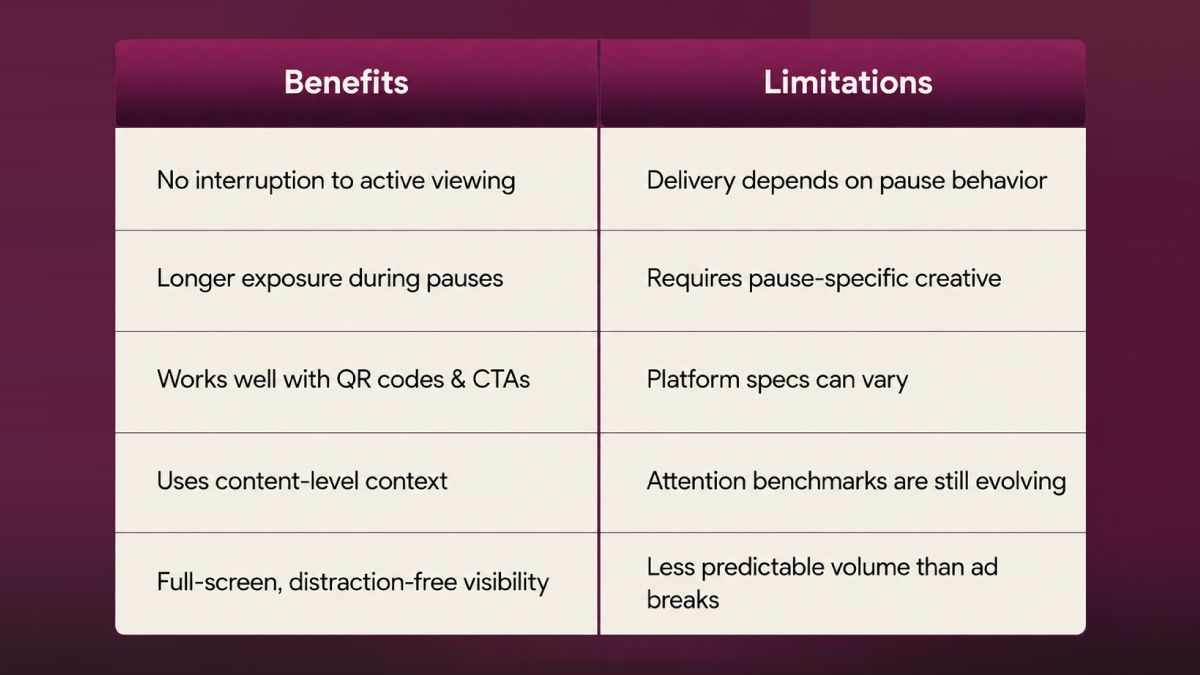
Benefits
- No additional interruption to active playback, because the format is triggered by the viewer’s own pause action rather than a scheduled break
- Potentially longer exposure than fixed duration video formats, since visibility can continue for as long as the content remains paused
- Strong compatibility with QR codes and interactive elements, meeting viewers at a moment when a phone is likely already in hand
- Genre and program level context available without relying on personal identifiers, which supports privacy conscious targeting approaches
- Full share of voice on screen, with no competing creative or surrounding content pulling attention away from the brand message
Limitations
- Pause frequency varies by content type and viewer habit, so delivery volume is less predictable than a scheduled ad break tied to a fixed content timeline
- Creative needs to function as a static or interactive unit built to hold up at any dwell length, which is a different production process than a timed video spot
- Historically fragmented specs across streaming platforms made buying more complex, though ongoing standardization work is closing that gap
- Attention data on the format is still newer than decades of linear and pre-roll benchmarks, so advertisers should treat early performance figures as directional rather than fixed
Conclusion
CTV pause ads turn an ordinary moment in viewing, the instant someone steps away from the screen, into a controlled, non-disruptive advertising opportunity. The format works because it aligns with how people actually watch streaming content rather than asking them to sit through a break they did not choose. As standardization removes the fragmentation that limited pause ads in earlier years, the format is moving from isolated platform experiments toward a defined, programmatically tradable placement within CTV planning, sitting alongside in-stream video as a distinct layer built for attention rather than interruption.
Frequently Asked Questions
What is a CTV pause ad?
A CTV pause ad is a viewer-initiated advertisement that appears when a viewer pauses streaming content on a connected television device, taking the form of a full-screen takeover or a partial-screen overlay and remaining visible until playback resumes.
How is a pause ad different from a pre-roll ad?
A pre-roll ad plays before content starts and interrupts the viewer’s path to what they came to watch. A pause ad only appears after the viewer has already chosen to step away, so it does not compete with viewing intent the way pre-roll does.
Can pause ads include QR codes or interactive elements?
Yes. Pause ad creative ranges from simple static images to QR-enabled units and fully interactive, shoppable formats with clickable buttons and product carousels.
How are CTV pause ads measured?
Pause ads can be measured using the household and cross-device frameworks applied to other CTV formats, tracking delivery, viewability, and any downstream engagement the creative supports, such as QR code scans, though the exact metrics available depend on the platform and implementation.
Can advertisers buy pause ads programmatically?
Yes, where supported by the publisher, streaming platform, and relevant programmatic infrastructure. IAB Tech Lab’s standards work specifically addresses how pause ads can be signaled and transacted through programmatic systems, though implementation still varies by platform.
Explore the Future of CTV Pause Ads
Want to discover new possibilities with CTV Pause Ads? Meet our team at DMEXCO, Cologne, Germany, on 23–24 September at Booth A30, Hall 6.1.
Let’s connect and discuss how Pause Ads can unlock more value for your ad strategy.
Related Post