Quick Answer
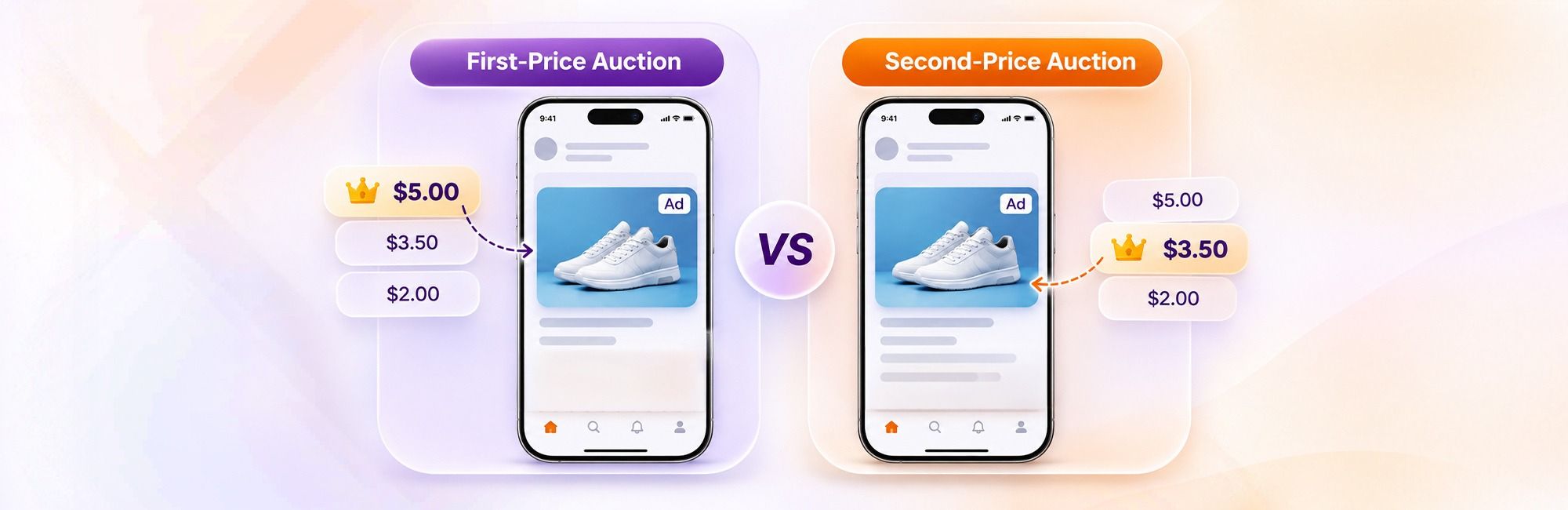
The main difference between first-price and second-price auctions is how the winning price is calculated, not who wins. In both, the highest eligible bid generally wins. In a first-price auction the winner generally pays its own bid, and in a second-price auction the winner generally pays a price based on the next-highest eligible bid, subject to floors, increments and the exchange’s rules.

Introduction
The same bid can lead to different prices, depending on the auction it enters. The pricing rule is one cause. Competing bids and price floors are others. Together they influence how much a campaign spends per thousand impressions, and how much a publisher earns from the same inventory.
The distinction became more important as programmatic auctions became more layered. A single impression may receive bids from several demand platforms through different exchanges, and in some setups it passes through more than one auction before an ad is chosen. When the pricing rule is unclear in one layer, a bidding strategy built for the old rule can stop working.
A lot of what gets repeated about the two models is also too neat. First-price auctions are said to always raise publisher revenue. Second-price auctions are said to make buyers bid their maximum willingness to pay. Both ideas come from tidy theory or from specific platforms, and neither holds across the whole market.
This article keeps one simple example running from start to finish, shows where floors and bid shading change the result, and explains how the picture looks inside mobile apps. Each section can be read on its own.
How Does a Programmatic Ad Auction Work?
When a person opens a web page or an app, the publisher’s supply-side technology makes the impression available to an exchange. The exchange sends a bid request to eligible bidders, usually demand-side platforms. The request describes the impression: where it appears, the format, the device and the auction rules. Bidders decide whether to bid and how much, and they return their bids within a time limit. The exchange applies its rules, picks a winner, and the ad is served. All of it takes a fraction of a second.
Two fields in the OpenRTB protocol matter here. The first is tmax, the maximum time in milliseconds the exchange allows for bids to arrive, including internet latency. The second is at, the auction type. In OpenRTB 2.x, a value of 1 means first price and 2 means second price plus, and the specification lists 2 as the default. Exchanges can define their own values for exchange-specific auction types.
The “plus” in second price plus refers to an increment above the next-highest bid or the floor. The field names the auction type but does not fix the size of that increment, so the exact payment depends on the exchange’s rules. The default of 2 is a protocol default, not a picture of which auction type the market uses today.
How Does a Second-Price Auction Work?
Take three bidders for one impression. Bidder A bids $5.00 CPM, Bidder B bids $3.50 and Bidder C bids $2.00. These numbers are illustrations, not market prices. Assume a low floor that does not affect the result, and an exchange that applies a $0.01 increment under second price plus.
Bidder A wins. The price is the second-highest bid plus the increment: $3.50 plus $0.01 makes $3.51 CPM. Bidder A was ready to pay $5.00 and pays $3.51. The one-cent increment is an assumption for this example, since exchanges set their own increments and floor treatment.
In the classic sealed-bid second-price model, the standard theoretical strategy is to bid one’s maximum willingness to pay, the most the impression is worth to the bidder, because the winning price is set by the next-highest bid and not by the winner’s own. That result holds only under specific assumptions. Real buying also involves budgets, deal terms, floors and optimization systems, so it is a starting point, not a description of how every advertiser behaves.
How Does a First-Price Auction Work?
Use the same three bids. Bidder A still wins, and now pays its own bid of $5.00 CPM. Bidders B and C do not win the impression.
With the other bids unchanged, a bid just above $3.50 would have been enough to win, but Bidder A could not know that when it bid. That uncertainty is central to first-price bidding. Bidding its full $5.00, its maximum willingness to pay, guarantees the win against these rivals but leaves no margin. Bidding lower saves money but risks losing an impression the advertiser values. The right bid depends on what the impression is worth to the campaign and on the buyer’s optimization approach.
Paying its own bid does not mean a first-price winner overpaid. Whether the bid was too high depends on what the impression was worth to that advertiser, and first-price auctions place more responsibility on buyers to set competitive bids.
Why Did Programmatic Advertising Shift Toward First-Price Auctions?
One factor was the complexity of multi-stage auctions. In older setups, an impression could pass through several auctions in sequence, which made it harder to see what price was needed to win.
First-price auctions were also gaining share among US SSPs before Google’s move. An analysis of 338 billion programmatic impressions across 39 US SSPs found 43.3% sold through first-price auctions in March 2018, up from 5.8% of the 171 billion impressions analyzed in December 2017. That is a historical snapshot from one analysis, not today’s market share, and the SSPs in it varied in size. Today the auction type still varies by exchange, deal type and inventory source, so it should be checked and not assumed.
Google’s own earlier Ad Manager setup shows the problem. A second-price auction among Authorized Buyers ran first, and the winning price then competed in a separate first-price auction. Google announced in March 2019 that it would move Ad Manager to a unified first-price auction. In May it released unified pricing rules and said price floor strategies built to influence where the second-price auction closed would no longer be relevant. In September it began the full rollout to all partners. Google also said its testing showed a neutral-to-positive effect on a publisher’s total revenue on average. That result comes from Google’s own tests and is not a benchmark for the wider market.
What Is Bid Shading and Why Do Advertisers Use It?
Every buyer has a maximum willingness to pay for an impression, the most it would pay given what the impression is worth to the campaign. In a first-price auction, bidding that full amount means paying it whenever the bid wins, even when a lower bid would also have won. Bid shading is the buyer-side technique of submitting a bid below the maximum willingness to pay while keeping a good chance of winning. The maximum stays the ceiling, and shading only moves the bid below it.
Buyers estimate the right level from past data: win and loss results, the spread of competing bids, and, where an exchange shares it, the minimum bid needed to win. Google, for example, said buyers bidding into Ad Manager through Authorized Buyers and Open Bidding would receive the minimum bid price to win after an auction closes. That is a feature of Google’s auction environment, and other exchanges may not share the same data. Models then predict a bid likely to clear without paying more than necessary.
Shading is a trade between price and volume. Shade too far, and the buyer loses impressions that were worth buying. Shade too little, and it pays more than needed. The effect on spend and on publisher revenue varies with competition, inventory and strategy, and there is no standard percentage saving.
In a classic second-price auction, buyers have less reason to shade, because the payment generally depends on a competing bid and the auction rules, and bidding up to the maximum willingness to pay is the usual starting point.
How Do Price Floors Affect the Winning Bid?
A price floor is the minimum price a seller accepts for an impression. A hard floor makes bids below the threshold ineligible. Soft or dynamic floors adjust the threshold through platform-specific rules.
Return to the example and raise the floor to $4.00 CPM. Bidders B and C, at $3.50 and $2.00, are now ineligible. Only Bidder A remains.
In a second-price auction, there is no eligible second bid. For this example, assume the exchange applies the floor as the price when no eligible second bid exists. Under that assumption, Bidder A pays $4.00 CPM. That is more than the $3.51 paid when the floor was low. In a first-price auction, Bidder A still pays its own $5.00 CPM, and a $3.90 bid from Bidder A would not have met the floor.
So floors matter in both models. In a first-price auction, a floor mainly decides which bids are eligible. In a second-price auction, it can also change the price paid.
Does a First-Price Auction Always Earn Publishers More?
No. The idea is tempting, because the winner pays its own bid, but publisher revenue depends on more than the pricing rule. Competition decides how many bidders push the price up, bid shading changes what winners actually submit, and floor settings, fill rate, demand mix and platform fees all play a part.
If buyers shade bids heavily, some of the gain from first-price auctions can disappear. If a publisher has strong demand, the pricing rule may matter less than the number of bidders. Google’s neutral-to-positive result comes from its own tests of Ad Manager publishers and should not be treated as a rule for every publisher.
A first-price auction makes the link between the winning bid and the auction payment direct, but it does not reveal every fee, intermediary margin or the publisher’s net proceeds. A transparent winning price and a transparent supply chain are two different things.

How Do First-Price Auctions Work in Mobile Apps?
Mobile apps often add another layer through mediation, where a platform manages demand from several ad sources. Three terms get mixed up here.
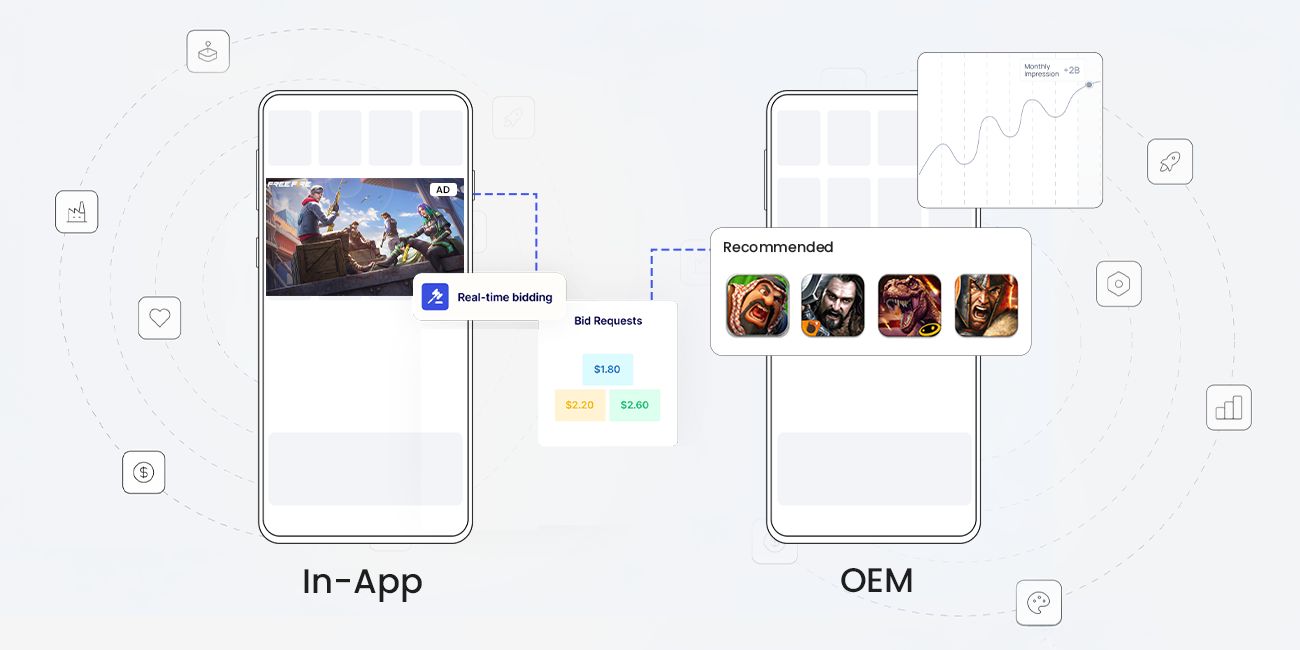
In-app bidding: participating demand sources submit bids for an impression in a real-time auction and respond within a time limit.
Mediation waterfall: the platform calls traditionally mediated demand sources in sequence, according to its configured rules.
Unified auction: a platform-specific setup that brings eligible demand into a shared decision process. How real-time bidders and waterfall demand are treated depends on the platform.
Because each mediation platform sets its own rules, the auction type and the mediation setup should be confirmed with each partner before bids are compared across platforms.
How Should Advertisers Adjust Their Bids?
Start from expected value. Set the maximum willingness to pay from the campaign’s objective, the expected value of the impression, and constraints such as a target cost per install or cost per action. For an install campaign, the likelihood and expected value of an install help inform it.
Read win rate, effective CPM and outcomes together. A higher win rate can come from paying more, and paying more does not help unless outcomes hold up. Win rate alone does not show whether a campaign is efficient.
Test against a baseline. Change one bid setting at a time and hold budget and targeting steady, so the cause of any change is clear.
Use bid shading where it is available, and watch what it costs. Shading lowers the bid below the maximum willingness to pay, so track lost impressions next to the savings, since it can trade volume for price.
Check the supply path. The same impression can reach a buyer through more than one path, and overlapping paths can waste spend and hide which route delivers value. Supply-path analysis can help find duplication, fees and differences in inventory quality, though the impact depends on the setup.
Auction price and campaign price also sit on different layers. Inside the auction, bids and clearing prices are quoted per thousand impressions. Around it, a campaign can be bought and measured on CPM, CPC, CPI or CPA. Xerxes, the mobile performance DSP from Xapads, supports all four buying models and connects to more than 25,000 mobile apps and 50 or more SSPs. For install campaigns, CPM is best read alongside cost per install and install quality, because a low auction CPM does not by itself mean valuable users at an efficient cost.
Two practices hold up as auction rules and supply paths change. Bid and outcome data should stay clean, since bid shading and optimization both depend on it. And supply-chain records should stay in place: ads.txt and app-ads.txt let publishers declare which sellers are authorized to sell their inventory, and sellers.json lets exchanges and other intermediaries disclose who sells through them, which helps buyers verify selling relationships and spot duplication.
Conclusion
First-price and second-price auctions differ mainly in how the winning price is set, not in who wins. Neither guarantees a better outcome, because results depend on floors, competition, bid shading, supply paths and how each exchange applies its rules.
FAQ
What is the difference between first-price and second-price auctions?
In a first-price auction, the winning bidder generally pays its own bid. In a second-price auction, the winner generally pays a price based on the next-highest eligible bid, subject to floors and the exchange’s rules. With comparable rules, the highest eligible bid generally wins in either model, so the payment rule is what differs.
Do advertisers pay more in first-price auctions?
Not necessarily. For the same submitted bid, a first-price winner pays that bid, while a second-price winner generally pays a price based on the next-highest eligible bid. Buyers can bid below their maximum willingness to pay through bid shading, so the actual cost depends on competition, floors and bidding strategy.
How does bid shading work?
Bid shading means submitting a bid below the buyer’s maximum willingness to pay, the most it would pay for the impression, while keeping a good chance of winning. Buyers use past win and loss data, the spread of competing bids and, where shared, the minimum bid needed to win to estimate the right level.
Does Google Ad Manager use first-price auctions?
Yes. Google announced the move to a unified first-price auction in Ad Manager in March 2019 and began the full rollout in September 2019. That applies to display and video inventory sold through Ad Manager, not to every Google advertising product.
Which auction type is better for publishers?
It depends. Publisher revenue is shaped by competition, bid levels, bid shading, floors, fill rate and demand mix. Google’s neutral-to-positive result is specific to Ad Manager, so comparing revenue, fill rate and other outcomes under the relevant setup is the better test for a given publisher.
Are first-price auctions used in mobile apps?
In some setups, yes. Mediation platforms can run in-app bidding, a waterfall or a unified mix, and each sets its own auction rules, so the auction type should be confirmed with each partner.
Related Post