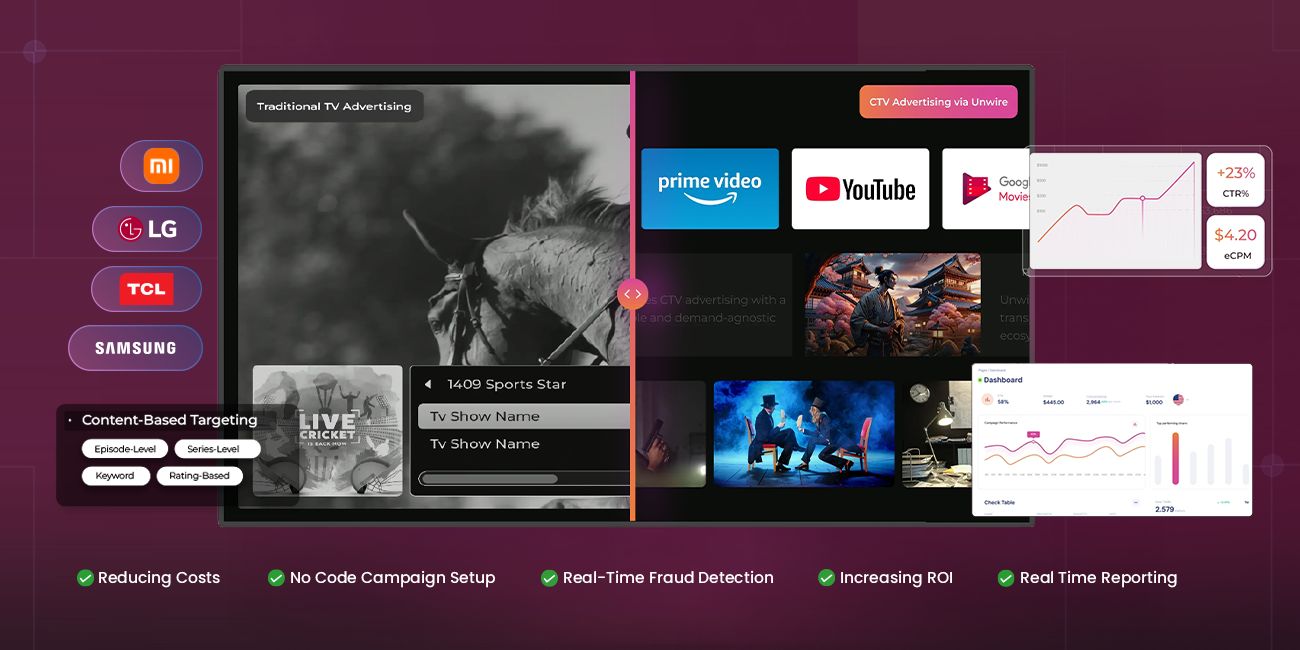

Connected TV advertising has moved beyond brand awareness campaigns. In 2026, performance marketers use CTV to drive measurable outcomes — from website visits to actual sales. The channel now combines the visual impact of television with the tracking precision of digital platforms.
CTV ad spending is projected to reach $38 billion in the United States in 2026, growing 14% year-over-year as streaming cements its lead over linear television. 70% of advertisers plan to increase CTV spending in 2026, with budgets climbing an average of 17%.
The shift is clear: streaming reached 47.5% of total US television viewing time, surpassing broadcast and cable combined and marking the highest share ever recorded.

Why Performance Marketers Are Moving to CTV
The Scale Is Real
119.8 million US households watch CTV in 2026, with 90% using at least one connected device every month. This is not a niche channel anymore.
Streaming now accounts for 47.5% of all US television time — more than broadcast and cable combined. Audiences spend over two hours per day in this lean-back, high-attention environment, far more focused than fragmented mobile or desktop viewing.
Programmatic Makes It Accessible
CTV accounts for 17.2% of total US programmatic digital display ad spending in 2026, with over 84% of all CTV inventory now transacted programmatically. Demand-side platforms give advertisers access across multiple streaming services with audience-level precision — no traditional TV relationships required.
This brings real-time bidding, automated optimization, and performance tracking that linear TV buying could never support. The same programmatic infrastructure handling billions in spend is now accessible to performance teams at any budget level.
Completion Rates Beat Everything Else
CTV ads deliver completion rates between 90-98%, with 15-second ads averaging 94.5% completion. These aren’t skippable pre-rolls. Viewers actually watch your entire message.
Performance marketers care about one thing: did the audience see your ad? CTV delivers this at scale. The format creates a focused viewing environment where ads get seen and remembered.
From Awareness to Action: The Performance Shift
Real Attribution Is Here
The game changed when CTV platforms started tracking cross-device conversions. When someone watches your CTV ad, visits your website on their phone, and makes a purchase, modern attribution models can connect those dots.
According to Innovid’s 2025 CTV Insights report, CTV accounted for just 38% of impressions but drove over 63% of attributable conversions across their data set. This shows efficiency that performance marketers understand.
CTV-exposed households convert 45% higher than others, proving the channel’s impact on purchase behavior. The attribution technology uses household graphs to link TV exposure with actions on other devices.
ROAS That Makes Sense
Numbers matter in performance marketing. CTV delivers an average return of nearly $6 for every dollar spent, almost three times higher than linear TV.
Real brands are seeing real results. Metro Vein Centers started with a cost per website visitor of $14.86 in their first CTV campaign, then reduced it by 85% through optimization and retargeting. Kane Footwear delivered 250% higher ROAS than their goal.
These aren’t awareness metrics. These are performance numbers that show up in your dashboard and affect your bottom line.
More Than Half Focus on Performance Goals
85% of advertisers say CTV drives full-funnel performance, with 97% agreeing that premium CTV inventory improves ROI. 65% of marketers now classify CTV as a performance channel, with the majority using it to drive web visits, app installs, and revenue — not just awareness.
This represents a fundamental change in how the channel gets used. CTV is not just for Super Bowl spots anymore.
Building Your CTV Performance Strategy
Start With Clear Goals
Define what success looks like before you launch. Are you driving website traffic? App downloads? Product purchases? Store visits? Each goal needs different creative approaches and measurement frameworks.
Track metrics that matter:
- Reach and frequency for awareness campaigns
- Conversion rate and CPA for direct response
- ROAS for revenue-focused campaigns
- Incremental lift to measure true impact
CTV offers closed-loop attribution that links specific outcomes to your ad spend. Use it.
Target Like a Performance Marketer
Programmatic CTV lets you use the same audience data from your mobile or display campaigns. Upload first-party CRM data, retarget website visitors, or build lookalike audiences based on your best customers.
Available targeting options include:
- Demographic targeting: Age, gender, income, education
- Geographic targeting: DMA, zip code, radius targeting
- Behavioral targeting: Purchase intent, lifestyle, interests
- Contextual targeting: Genre, content type, daypart
- Retargeting: Previous website visitors or customers
- ABM targeting: Firmographic and persona-level data for B2B
The precision rivals any digital channel while keeping the impact of the big screen.
Optimize Creative for Performance
Your CTV creative needs to work harder than a brand spot. Hook attention in the first three seconds. Put your brand and core benefit up front. Keep offers or QR codes visible for at least 20 seconds.
Make sound-off work with captions, but reward sound-on viewing with payoffs. Produce multiple variants around different angles: problem/solution, social proof, heavy offers. Test everything.
Every call-to-action must be mobile-optimized. “Scan to buy,” “Use code TV25,” “Start free trial”—these should land on fast, UTM-tracked, mobile-first pages.
Choose the Right Platform
Platforms like Unwire from Xapads Media bring programmatic CTV capabilities designed for performance marketers — 120M+ global household reach, 99%+ fraud-free delivery verified by Pixalate, and 85%+ view-through rate on non-blockable video ads. The platform supports OTT header bidding, PMP and PG deal types, and real-time cross-device attribution built for performance-focused campaigns.
Look for platforms that offer real-time bidding and optimization, cross-device attribution and tracking, transparent reporting on performance metrics, integration with existing marketing stacks, and household-level frequency management.

The Future: 2026 to 2030
Growth Will Continue
US CTV ad spending reached $38 billion in 2026 and is on track to hit $46.89 billion by 2028 — surpassing traditional TV advertising for the first time in history. By 2029, the US CTV market is forecast to reach $51 billion, making it the fastest-growing major advertising channel.
The math is simple: audiences are moving to streaming, and advertising dollars follow. By 2028, over 75% of US CTV users will access content via smart TV, making the viewing experience even more seamless.
Retail Media Meets CTV
Retail media CTV is one of the fastest-growing segments in digital advertising. Ad spend is set to grow from $4.99 billion in 2025 to $10.28 billion by 2028, with retail media projected to represent one-fifth of all US CTV ad dollars by 2028.
Amazon leads this convergence, connecting its retail data with Prime Video and Fire TV inventory. This links verified shopping behaviour directly to CTV ad exposure the closed-loop measurement performance marketers have needed on TV for years.
Interactive and Shoppable Ads
Television advertising is becoming two-way. QR codes in ads now see scan rates as high as 70% when linked to familiar retailers. Voice-activated spots let viewers request information instantly.
Shoppable TV takes this further. Viewers can buy products directly from their screens, with formats like Walmart’s shoppable ads generating 3x higher sales. Features include dynamic product overlays, AR previews, and one-click purchases.
By 2027, expect more interactive formats that blur the line between advertising and commerce. Performance marketers who test these formats early will have a significant advantage.


AI-Driven Optimization
AI is making CTV campaigns smarter in real time. Machine learning algorithms analyse millions of data points to optimise bid prices, creative selection, and audience targeting continuously.
Over 84% of CTV inventory now transacts programmatically, with AI powering most of these buying decisions. In 2026, agentic media buying is also emerging — AI agents negotiating directly with publishers to cut out unnecessary programmatic fees. Two-thirds of US ad buyers plan to increase focus on agentic ad buying this year.
Dynamic creative optimisation will become standard. The same base ad will automatically adjust messaging, offers, and calls-to-action based on audience, context, and conversion probability.
Privacy-First Measurement
Third-party cookies are now fully deprecated in Chrome. CTV was never dependent on them, making it structurally ahead of display and mobile for privacy-safe measurement. First-party data usage has increased 40-70% since cookie deprecation, and CTV platforms work with clean rooms and privacy-safe identity resolution to measure campaigns without compromising user privacy.
Identity solutions are now live and scaling. Disney’s BridgeID, NBCUniversal’s PAIR framework integration, and more are fully operational. These enable targeting and measurement while respecting user privacy — a structural advantage CTV holds over every cookie-dependent channel.
Getting Started With CTV Performance Marketing
Test With Purpose
Start small but start smart. Commit enough budget to reach at least 250,000-1,000,000 households over 4-6 weeks. This gives you statistical power in your measurement.
Run A/B tests on creative, offers, and targeting. Use incrementality testing to measure true lift. Compare performance across different streaming platforms and content genres.
Integrate With Your Funnel
CTV works best when integrated with your full marketing funnel. Use search, paid social, and branded keyword campaigns during and after CTV flights to capture multi-device demand.
Sync with retail media and e-commerce partners to retarget in-market audiences. Someone who saw your CTV ad becomes a warmer lead for your lower-funnel tactics.
Partner With Experts
The CTV landscape is complex. Multiple platforms, varied inventory sources, different measurement standards. A partner is needed who understands both the technology and the performance strategy.
Unwire from Xapads Media brings programmatic CTV infrastructure built for performance — 120M+ global reach, real-time bidding, cross-device attribution, and fraud-free delivery verified by Pixalate. The platform applies performance marketing principles directly to the streaming environment.
Conclusion
Connected TV has evolved from a brand awareness channel into a full-funnel performance marketing platform. The combination of massive reach, precise targeting, high completion rates, and measurable outcomes makes it essential for modern performance marketers.
The data proves it. CTV delivers 23% higher ROI than traditional TV, with 90-98% completion rates and attribution capabilities that connect TV exposure to actual business results. 97% of advertisers now agree that premium CTV inventory improves ROI, with 88% saying CTV strengthens cross-platform performance.
As the channel matures toward 2030, agentic media buying, shoppable formats, AI-driven creative optimisation, and retail media integration will compound CTV’s performance capabilities. Performance marketers who build CTV expertise in 2026 lead the next wave.
The shift from reach to ROAS is complete. CTV is not the future of performance marketing — it is the present.
Related Post