Introduction
Unlock the full potential of in-app advertising and redefine the way you drive growth. With competition intensifying and user acquisition costs rising, in-app advertising stands as a powerful solution to achieve measurable results. By reaching users directly in their favorite apps, you can deploy data-driven strategies that maximize ROAS, optimize ad spend, and deliver scalable campaigns. This guide is designed to equip you with actionable insights, proven frameworks, and cutting-edge tools to master in-app advertising and stay ahead in an evolving digital landscape.
The global in-app advertising market will hit a staggering $390.04 billion in 2025, according to Statista.
By 2030, analysts project that number will climb to $569.95 billion.
Why the massive surge? It’s simple. We live on our phones. In 2024, the average user spent nearly 5 hours per day on mobile apps. That is where the attention is, and naturally, that is where the ad spend must go.
If you are a media buyer looking to maximize ROAS (Return on Ad Spend) or a publisher trying to monetize a new gaming app, understanding this landscape is no longer optional. It is the core of modern digital strategy.
In this comprehensive guide, we will break down exactly how in-app advertising works in 2026. We will look beyond the basic definitions and explore the AI-driven technologies, privacy-first strategies, and emerging formats that are defining the next decade of mobile growth.
What Is In-App Advertising?
In-app advertising is exactly what it sounds like: the practice of displaying advertisements within a mobile application rather than on a mobile website.
Think about when you play a mobile game and watch a short video to get an extra life. Or when you scroll through a news app and see a sponsored article seamlessly blended into your feed. That is in-app advertising.
The Core Difference
Many people confuse mobile web ads (viewed in a browser like Chrome or Safari) with in-app ads. Here is the distinction:
- Mobile Web Ads: Rely on cookies (which are disappearing) and operate in a browser environment.
- In-App Ads: Rely on Device IDs and SDKs (Software Development Kits) integrated directly into the app’s code. This allows for smoother performance, better targeting, and a much richer user experience.
The Evolution of In-App Advertising (2020-2026)
We have come a long way from the annoying, pixelated banners of 2015.
- 2020-2022: The industry focused on programmatic adoption and dealing with Apple’s privacy changes (ATT framework).
- 2023-2024: Video became king. Short-form video ads on platforms like TikTok set the standard for engagement.
- 2025-2026: AI took the wheel. Today, generative AI creates ad variations in real-time, and predictive algorithms determine the exact moment a user is most likely to convert.
The numbers back this up. In 2025, the average ad spending per mobile internet user reached $59.23 (Statista). For advertisers, this means high-value users are accessible. For publishers, it means a sustainable revenue stream without forcing users to pay for subscriptions.
How Does In-App Advertising Work in 2026?
To the user, it looks instant. You open an app, and an ad appears. But behind the scenes, a complex, high-speed auction happens in milliseconds.
Here is the step-by-step workflow of how an ad gets from a brand to your screen.
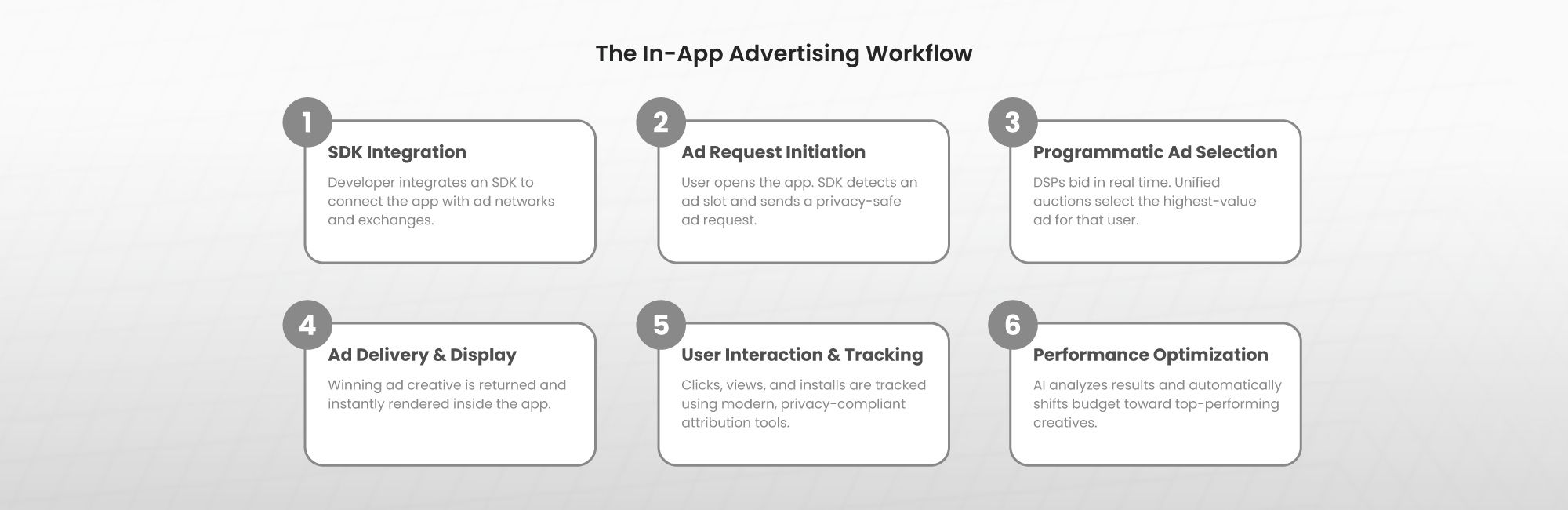
The In-App Advertising Workflow
Step 1: SDK Integration
It starts with the developer. An app publisher integrates a Software Development Kit (SDK) into their app. Think of the SDK as a bridge. It connects the app to an ad network or exchange, allowing them to “talk” to each other.
Step 2: Ad Request Initiation
A user opens the app. The SDK detects an opportunity to show an ad (like a banner slot at the bottom or a video break between game levels). It sends out an Ad Request. This request contains data about the available slot and the user (e.g., location, device type, demographics—all privacy-compliant, of course).
Step 3: Programmatic Ad Selection
This is where the magic happens. The request goes to an exchange or mediation platform. Advertisers (via their Demand-Side Platforms, or DSPs) receive this signal. Their algorithms analyze the user data instantly.
- “Is this user in our target audience?”
- “How likely are they to click?”
- “What is the right price to bid?”
In 2026, Unified Auctions and Header Bidding are standard. This means multiple advertisers bid simultaneously, ensuring the publisher gets the highest possible price and the advertiser gets the best possible inventory.
Step 4: Ad Delivery & Display
The highest bidder wins. The ad creative is sent back through the pipeline to the app. The SDK renders the ad on the user’s screen. This entire process takes less than 200 milliseconds—faster than a blink of an eye.
Step 5: User Interaction & Tracking
The user sees the ad. If they tap it, the SDK records the click. If they watch a video to the end, it records a “completed view.” In 2026, attribution tools track what happens after the click, determining if that user eventually bought a product or installed a new app.
Step 6: Performance Analysis & Optimization
Data flows back to the advertiser. AI algorithms analyze performance in real-time. If Creative A is performing better than Creative B, the system automatically shifts the budget to the winner.
Understanding the In-App Advertising Ecosystem
The ecosystem can feel crowded, but every player has a specific role.
Key Players in 2026
- Publishers (App Developers): The owners of the digital real estate. They want to monetize their traffic without annoying their users.
2. Advertisers (Brands): The buyers. They want to reach specific audiences to drive sales or installs.
3. Ad Networks: They aggregate inventory from many publishers and sell it to advertisers.
4. Ad Exchanges: Digital marketplaces where publishers and advertisers trade inventory programmatically (automatically).
5. Supply-Side Platforms (SSPs): Tools used by publishers to manage their inventory, optimize yield, and connect to multiple exchanges.
6. Demand-Side Platforms (DSPs): Tools used by advertisers to buy ad inventory across many platforms from a single interface.
7. Mediation Platforms: These are crucial for publishers. A mediation platform manages multiple ad networks to ensure the app always fills its ad slots with the highest-paying ads.
Self-serve platforms like Xerxes have simplified this ecosystem significantly. They allow publishers to connect directly with demand sources while maintaining transparency and control over their pricing, effectively democratizing access to premium advertisers.
Types of In-App Advertising Formats in 2026
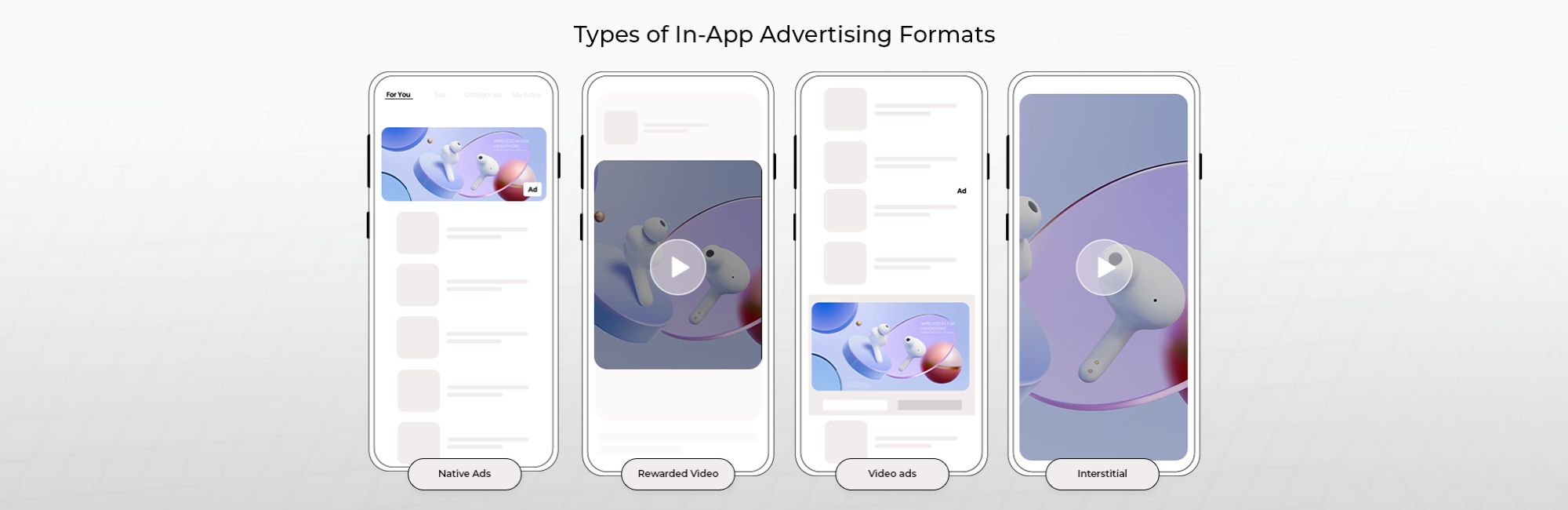
Choosing the right format is critical. A format that works for a news app might fail in a gaming app.
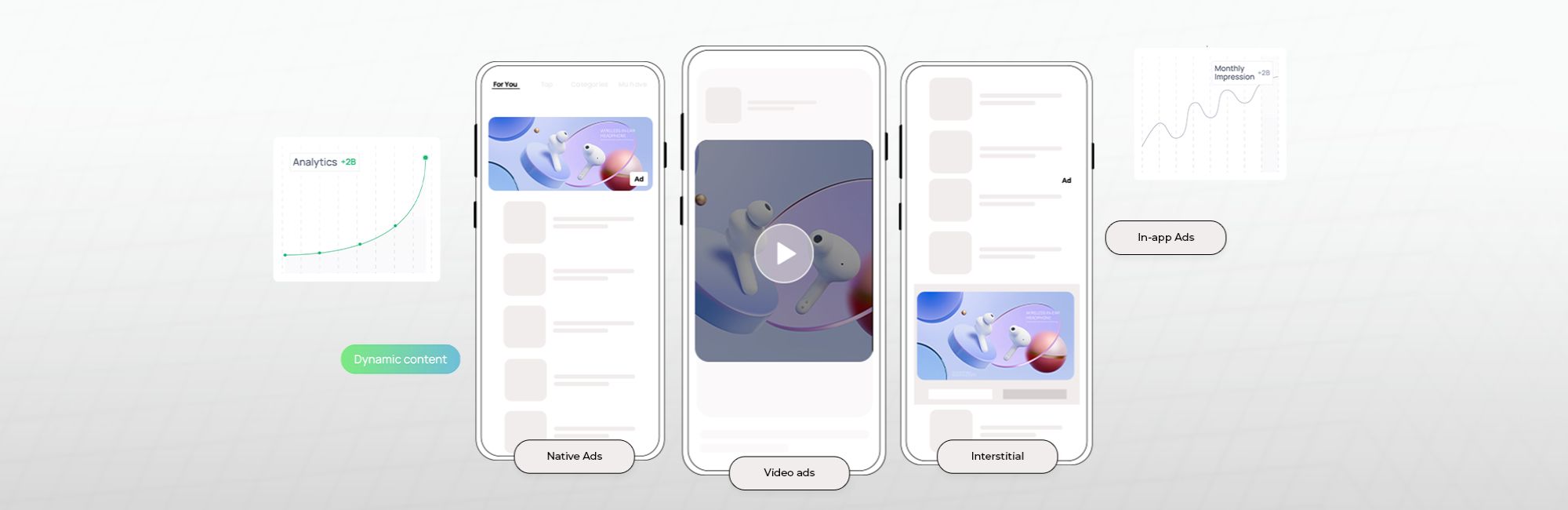
1. Banner Ads
The classic format. These are small rectangular image or text ads that sit at the top or bottom of the screen.
- Pros: Easy to implement, non-intrusive.
- Cons: Lower engagement rates compared to full-screen formats.
- 2026 Update: Adaptive banners now use AI to resize perfectly for every device, improving viewability.
2. Interstitial Ads
These are full-screen ads that appear at natural transition points (like between levels in a game).
- Pros: High visibility, high engagement (users can’t miss them).
- Cons: Can be disruptive if used too frequently.
3. Video Ads
Video is dominant. These can be pre-roll (before content), mid-roll, or post-roll.
- Stat: Video ads are projected to account for a massive share of display spending by 2028.
- Trend: Short-form, vertical video (6-15 seconds) is the standard for mobile.
4. Rewarded Video Ads
The user’s favorite format. Users choose to watch an ad in exchange for an in-app reward (like currency, lives, or premium content).
- Engagement: Extremely high completion rates because the user is incentivized.
- Economics: eCPM (effective cost per mille) rates for rewarded video remain strong, often ranging between $9.29 and $19.40 depending on the region.
5. Native Ads
These ads match the look and feel of the app environment. In a news feed, a native ad looks like another article.
- Pros: Least intrusive, combats “banner blindness.”
- Cons: Requires more customization to fit different app layouts.
6. Playable Ads
Interactive ads that let users play a mini-version of a game before downloading it.
- Conversion Quality: Users who download after playing are more likely to stick around because they already know they like the gameplay.
7. Audio Ads (New 2026 Focus)
With the rise of mobile gaming and streaming, programmatic audio is booming. These ads play in the background while users listen to music or play games, often without interrupting the visual experience.
In-App Advertising Pricing Models
How you pay (or get paid) depends on your goals.
CPM (Cost Per Mille)
- Definition: You pay for every 1,000 impressions (views).
- Best For: Brand awareness campaigns. You want eyeballs on your brand.
- Publisher View: Predictable revenue.
CPC (Cost Per Click)
- Definition: You pay only when someone clicks the ad.
- Best For: Driving traffic to a website or landing page.
- Risk: Publishers take the risk here; if no one clicks, they don’t get paid.
CPA (Cost Per Action)
- Definition: You pay only when a specific action happens (e.g., a purchase or a signup).
- Best For: Performance marketers focused strictly on ROI.
- Note: This is the most expensive model per unit but the safest for advertisers.
CPI (Cost Per Install)
- Definition: You pay for every app install generated.
- Best For: Mobile user acquisition (UA) campaigns.
- Stat: Mobile app revenue is projected to reach massive heights, driven largely by UA spend.
Why In-App Advertising Matters in 2026
For advertisers, the argument is all about performance.
1. Higher Engagement Rates
Mobile web browsing is fragmented. App usage is focused.
According to HubSpot, in-app click-through rates (CTR) historically outperform mobile web CTR significantly (0.54% vs 0.23% in earlier benchmarks). In 2026, with better creative tech, that gap has likely widened.
2. Superior Targeting Capabilities
Apps have access to first-party data that websites often don’t. Location data, device usage patterns, and in-app behavior create a rich profile (within privacy limits) that allows for hyper-relevant targeting.
3. Better Brand Safety
The app ecosystem is more curated. Unlike the open web, where an ad might appear next to questionable user-generated content, apps are easier to vet.
- Stat: Global ad fraud cost reached $88 billion in 2023 and is projected to grow to $172 billion by 2028 (Source: Statista). In-app environments, especially when using verified partners, offer better protection against bot traffic.
For Publishers: A Necessity
With 97% of apps on Google Play being free, advertising is the primary revenue engine. It allows developers to scale, fund updates, and build businesses without relying solely on in-app purchases (IAP).
Platforms like Xapads Media empower publishers to maximize these benefits. By providing advanced analytics and yield optimization tools, they help developers turn their user base into a sustainable business.
In-App Advertising vs Mobile Web Advertising: Key Differences
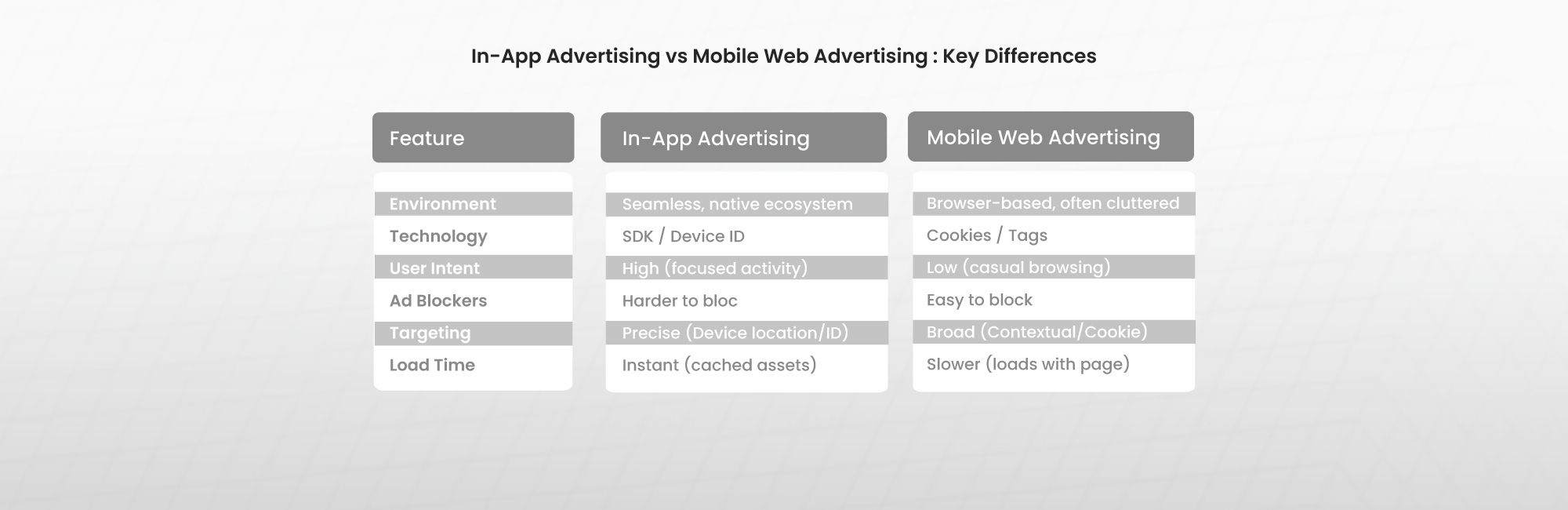
How AI Is Transforming In-App Advertising in 2026
Artificial Intelligence isn’t just a buzzword; it’s the operating system of modern advertising.
AI-Powered Ad Optimization
DSPs now use AI to bid more intelligently. Instead of a human setting a manual bid limit, an AI analyzes millions of signals in real-time to bid the exact amount needed to win the impression—not a cent more.
Contextual Intelligence with LLMs
Large Language Models (LLMs) now analyze the content of an app in real-time. If a user is reading an article about marathon training, the AI understands the semantic context and can serve an ad for running shoes instantly, without needing invasive user tracking.
Creative Generation
Generative AI allows for Dynamic Creative Optimization (DCO). An advertiser uploads one asset, and the AI generates 50 variations—changing the headline, the background color, or the call-to-action button—to see which one performs best for that specific user.
Fraud Detection
AI is the frontline defense against fraud. It detects anomalies like a sudden spike in clicks from a single IP address and blocks them before they drain the budget.
Navigating Privacy and Data in 2026
The “Cookieapocalypse” is old news. In 2026, we live in a privacy-first world.
The Post-Cookie Reality
Google’s Privacy Sandbox and Apple’s ATT have shifted the industry away from individual tracking toward aggregated data. Advertisers can no longer track “John Smith.” Instead, they track “Cohorts, groups of users with similar interests”.
Privacy-Preserving AI
New technologies like Federated Learning allow AI models to learn from user data directly on the user’s device. The data never leaves the phone; only the “learnings” are sent back to the server. This keeps user data private while still allowing for smart targeting.
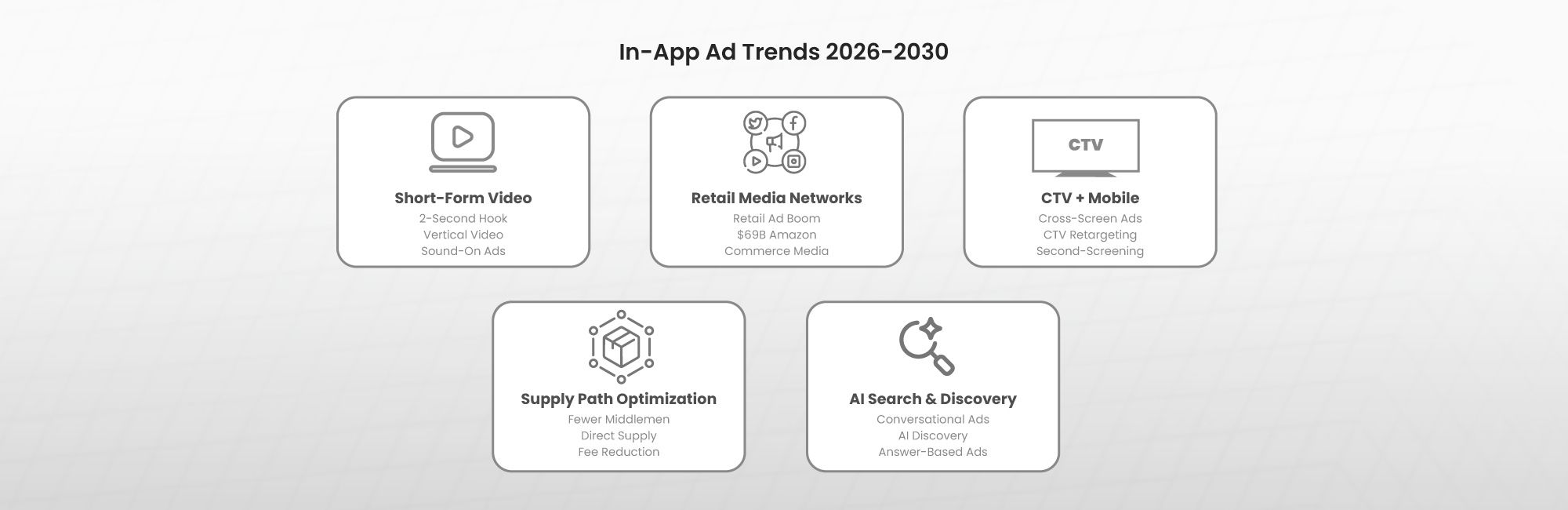
In-App Advertising Trends Shaping 2026-2030
1. Short-Form Video Dominance
Gen Z and Alpha have short attention spans. Ads must capture attention in the first 2 seconds. Vertical, sound-on, fast-paced video creatives are the primary driver of engagement.
2. Retail Media Network Explosion
Retailers are becoming ad networks. Apps like Amazon, Walmart, and Uber are massive advertising platforms.
- Stat: Amazon’s ad revenue alone is massive, projected at $69.3 billion in 2025.
3. Connected TV (CTV) and Mobile Convergence
Users watch TV with their phones in hand. Campaigns in 2026 are cross-screen. You might see an ad on your Smart TV and then get retargeted with a clickable offer on your mobile app 5 minutes later.
4. Supply Path Optimization (SPO)
Advertisers are cutting out the middlemen. They want the most direct path to the publisher to reduce fees and improve transparency.
5. AI Search & Discovery
With AI search engines changing how people find information, in-app ads are adapting to be more conversational and answer-based, appearing inside AI-powered discovery apps.
Best Practices for In-App Advertising Success
For Advertisers
- Optimize Creative for Mobile: Don’t repurpose TV commercials. Build for vertical screens. Use large text. Ensure the message is clear even with the sound off.
2. Test Everything: Use A/B testing frameworks. Test your headlines, your visuals, and your end cards (the final screen of the ad).
3. Balance Frequency: Don’t bombard the same user. Use frequency capping to ensure you aren’t annoying your potential customers.
For Publishers
- Prioritize User Experience: Never let an ad break the app flow. If an ad causes the app to crash or lag, users will uninstall it.
2. Diversify Demand: Don’t rely on one ad network. Use mediation to tap into multiple sources. Solutions like MI by Xapads help publishers orchestrate dozens of demand sources through a single integration, ensuring competition for every slot.
3. Implement Smart Mediation: Use hybrid bidding (Header Bidding + Waterfall) to ensure you get the best price for every impression.
Common In-App Advertising Challenges and How to Solve Them
Challenge 1: Ad Fraud
Solution: Work with verified partners who use tools like invalid traffic (IVT) detection. Demand transparency in reporting.
Challenge 2: Ad Fatigue
Solution: Refresh your creatives regularly. If a user sees the same banner 50 times, they stop seeing it entirely (banner blindness).
Challenge 3: Attribution Complexity
Solution: Use reliable Mobile Measurement Partners (MMPs). In the iOS ecosystem, master SKAdNetwork to track performance without compromising privacy.
In-App Advertising Success Stories from 2025-2026
Case Study: Gaming App Hybrid Monetization
A mid-core strategy game was struggling to convert free players to payers. They introduced Rewarded Video Ads that gave players free gold.
- Result: Revenue increased by 40%.
- Bonus: Retention actually improved because players could play longer sessions without hitting a paywall.
Case Study: E-Commerce User Acquisition
A fashion retailer moved the budget from mobile web display to In-App Video. They used dynamic creatives that showed users products based on their recent browsing history.
- Result: Cost Per Acquisition (CPA) dropped by 25% due to higher engagement rates in the app environment.
Essential Tools for In-App Advertising
For Advertisers
- Attribution: Adjust, AppsFlyer, Kochava.
- Creative: Tools like PulseVid.ai leverage AI to optimize video creatives specifically for advertising performance.
- DSP: The Trade Desk, DV360, Xapads.
For Publishers
- Mediation: AdMob, AppLovin MAX, IronSource.
- End-to-End Solutions: Platforms like Xaprio offer comprehensive monetization solutions that handle everything from format selection to demand management.
How to Get Started with In-App Advertising
For Advertisers: Your First Campaign
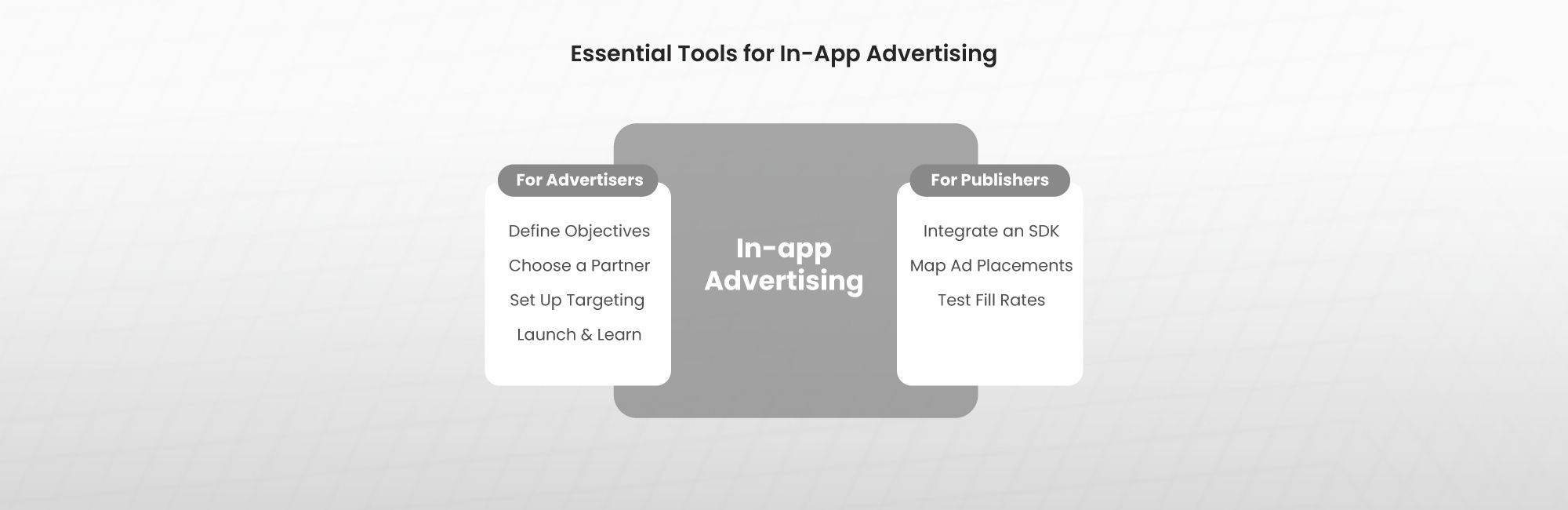
- Define Objectives: Are you looking for brand awareness (CPM) or installs (CPI)?
- Choose a Partner: Select a DSP or ad network that specializes in your vertical.
- Set Up Targeting: Define your audience based on location, interests, and device.
- Launch & Learn: Start with a small budget. Let the algorithm learn for 1-2 weeks before making major changes.
For Publishers: Monetization Setup
- Integrate an SDK: Choose a mediation partner.
- Map Ad Placements: Decide where ads fit naturally in your app.
- Test Fill Rates: Monitor how many of your ad requests are actually being filled with ads. If fill rates are low, you need more demand sources.
The Future of In-App Advertising
The trajectory is clear. As discussed in the beginning the market is heading toward $569.95 billion by 2030.
The future belongs to those who embrace AI, respect user privacy, and prioritize the user experience. The days of disruptive, irrelevant ads are fading. The era of personalized, helpful, and seamless in-app experiences is here.
Whether you are an advertiser looking to reach engaged mobile audiences or a publisher seeking to monetize your app, the tools exist today to make it happen. Platforms like Xerxes and the Xapads Media ecosystem provide the infrastructure and expertise to succeed in this dynamic landscape.
The opportunities are vast. The technology is ready. The only question is: Is your strategy ready for 2026?
Related Post