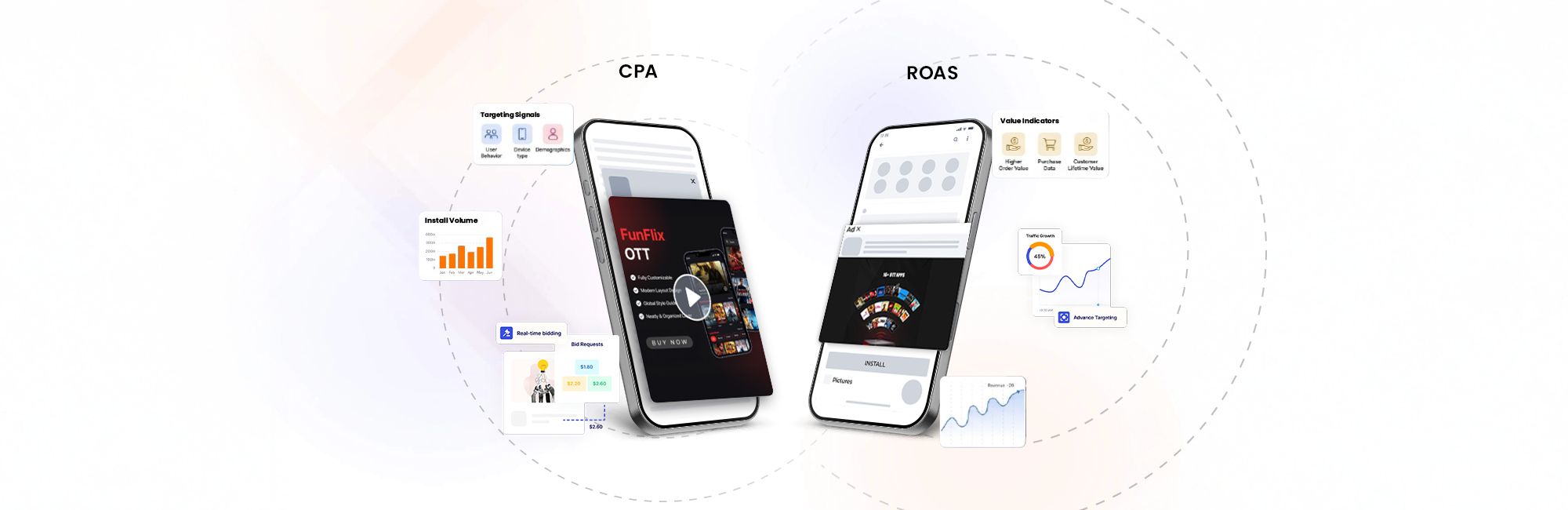
Global digital advertising spending reaches $835.82 billion in 2026, and total global ad spend surpasses the $1 trillion mark for the first time, according to eMarketer. In this environment, spending more does not automatically mean earning more. CPA and ROAS are two key metrics influencing campaign efficiency, and getting them right shapes whether a campaign scales profitably or bleeds budget without return.
This article explains key layers of CPA and ROAS targeting, from basic definitions to advanced channel-specific best practices, so advertisers and media planners build campaigns that deliver measurable results across mobile, CTV, YouTube, and omnichannel environments.
What is Cost Per Acquisition (CPA)?: How Advertisers Define and Use It
Cost Per Acquisition measures the total spend a campaign uses to produce one conversion. A conversion can be a purchase, a lead form submission, an app install, a subscription signup, or any action a brand defines as meaningful. The formula is straightforward: total campaign spend divided by the number of conversions equals the CPA.
CPA works best when all conversions carry roughly the same value. An app marketing campaign where every install delivers equal immediate value to the advertiser is a strong example. A lead generation campaign where every submitted form carries equal potential is another. When the conversion value is consistent, CPA gives advertisers clean cost control. The system focuses on volume, finding as many qualifying actions as possible without exceeding the stated cost ceiling.
In large-scale programmatic environments, CPA performance improves when campaigns run on clean supply and strong data signals. High-scale ecosystems with 2.4Bn+ reach and <0.80% fraud rate can lead to more stable optimization, often resulting in ~18% improvement in ROAS and 12–15% higher retention from better-quality conversions. These signals help the system identify which users are more likely to convert and continue engaging beyond the first action.
The limitation of CPA is that it ignores conversion value variation entirely. A campaign that acquires users at the same CPA may still deliver very different downstream value. When conversion values differ significantly, ROAS becomes the more appropriate optimization framework.
What is Return on Ad Spend (ROAS)?: What the Number Really Tells a Brand
Return on Ad Spend measures how much revenue a campaign generates for every dollar spent on advertising. If a campaign spends $10,000 and generates $40,000 in revenue, the ROAS is 4x or 400 percent. Unlike CPA, ROAS accounts for the value side of the equation, not just the cost side.
ROAS suits campaigns where conversion values differ significantly. An ecommerce advertiser running a product catalog ranging from $15 accessories to $1,500 electronics cannot treat every conversion equally. A $10 CPA on a $15 sale represents a loss. The same $10 CPA on a $1,500 sale is highly profitable. ROAS captures this distinction. The algorithm optimizes toward conversions that generate the highest revenue, not just the highest volume.
ROAS also works well for subscription businesses that track lifetime value and for performance campaigns where margins are understood and revenue data flows cleanly back into the buying platform in real time.
When to Pick CPA and When to Pick ROAS
The choice between CPA and ROAS shapes how the algorithm behaves, where it bids, and how it scales. Advertisers who pick the wrong metric for the campaign type end up working against the algorithm instead of with it.
CPA is the right choice when every conversion holds similar value, when the campaign objective is volume over revenue optimization, and when the advertiser operates in lead generation, app installs, or subscription models with fixed pricing. A SaaS platform with a single monthly tier of $99 benefits from CPA because every new subscriber carries equal immediate value.
ROAS is the right choice when conversion values vary, when the campaign runs across a product catalog with different price points, and when the advertiser has clean revenue data flowing back from purchases. Research from groas.ai analyzing over 2,800 accounts shows that Target ROAS campaigns generate 28 percent higher revenue per dollar spent compared to Target CPA campaigns, while Target CPA campaigns achieve 41 percent more total conversions on average. The practical implication is clear: use CPA when the goal is conversion volume and use ROAS when the goal is revenue efficiency.
The practical recommendation for new campaigns is to start with CPA to build conversion volume, then transition to ROAS once the campaign generates consistent revenue data and the algorithm has enough conversion history to optimize value. Transitioning too early to ROAS without sufficient conversion value history leads to delivery instability.
Why Targeting Setup Controls CPA and ROAS More Than Bidding Does
Most advertisers focus the majority of optimization time on bid adjustments. This is the wrong priority. Targeting setup determines whether the algorithm has access to enough relevant users to find conversions at the right cost. Bidding only adjusts how much the platform pays for the access that targeting provides. A well-structured targeting setup with a reasonable bid will consistently outperform a poorly structured targeting setup with a precisely calculated bid.
The Audience Breadth Rule Every Media Planner Must Know
Every CPA and ROAS optimization algorithm operates on probability. The algorithm scans available inventory and estimates the likelihood of each user converting before placing a bid. To do this accurately, it needs a wide enough pool to compare, contrast, and learn from. When targeting narrows the available pool below a critical threshold, the algorithm cannot find enough data patterns to make confident bid decisions.
The practical rule is this: the narrower the targeting, the higher the CPA will run, and the harder it becomes for the algorithm to hit a ROAS target. Advertisers who stack five or six audience filters simultaneously, layering demographic, behavioral, device, location, and interest restrictions all at once, reduce the scale the algorithm needs to work efficiently.
The correct approach is to begin with broader targeting and use performance data to identify which audience segments convert most efficiently. Then the advertiser tightens targeting around segments that prove profitable, not before that data exists.
How Over-Restricting Targeting Breaks the Algorithm Before It Starts
Algorithmic bidding systems need a minimum volume of conversions to optimize. According to Adalysis research, platforms typically require at least 15 to 30 conversions per month per campaign before a CPA or ROAS bid strategy functions reliably, and Google recommends 100 conversions in the prior 30 days for ROAS strategies to perform with stability.
When targeting restrictions reduce the audience pool so severely that the campaign cannot generate that minimum conversion volume, the algorithm essentially guesses. It does not have enough data to identify which users are likely to convert. Bids become unpredictable. CPA rises. ROAS falls. Advertisers often interpret this as a budget problem and increase spend, which compounds the issue rather than resolving it. The fix is structural, not financial.
Why Geography Restrictions Inflate CPA Without Warning
Geography targeting is one of the most overlooked CPA inflators in campaign management. Advertisers who restrict campaigns to highly specific geographic zones, such as city-level or zip code-level targeting in markets where the product has broad national demand, limit the algorithm’s bidding reach. Competition within small geographic zones tends to be intense, which drives CPMs and CPCs up, directly inflating CPA.
The practical approach is to test at a broader geographic level first, measure which regions produce the strongest conversion efficiency, and then gradually concentrate budget in those higher-performing regions. This preserves algorithmic learning while building toward geographic optimization through data rather than assumption.
How to Set a CPA or ROAS Target Before Launch
The most damaging targeting mistake advertisers make is setting an aspirational target rather than a data-backed one. Setting a CPA target 50 percent below historical performance, or a ROAS target twice as high as the campaign has ever achieved, does not motivate the algorithm to perform better. It prevents the algorithm from spending at all, because every available conversion appears too expensive to justify.
Calculating a Realistic CPA Floor From Margins and Data
A realistic CPA floor starts with business math, not aspiration. The advertiser takes the average order value or the customer lifetime value, applies the margin percentage, and calculates the maximum acquisition cost that still produces a profitable customer relationship. That number is the ceiling, not the starting target. The starting target should sit 10 to 15 percent above historical average CPA to give the algorithm room to operate and ramp, then move lower as performance stabilizes.
For example: a mobile app generates $30 in lifetime revenue per acquired user, and the business requires a 3 to 1 return on acquisition cost. The maximum profitable CPA is $10. Setting the campaign target at $8.50 gives the algorithm operating room while keeping the ceiling profitable. Setting it at $5 creates delivery paralysis because the algorithm cannot find enough qualifying conversions at that price within the available audience.
Setting a ROAS Target That Lets the Algorithm Spend
A ROAS target that is too aggressive shuts down campaign delivery. The algorithm evaluates each available impression and declines to bid when it cannot project sufficient conversion value to meet the target. According to Adalysis, if a campaign’s historical ROAS is 300 percent, setting the target at 500 percent can result in near-zero delivery volume. The target should start at or near historical performance and tighten incrementally as the algorithm stabilizes.
The Budget-to-Target Ratio That Most Campaigns Get Wrong
Budget and targets interact directly. An advertiser who sets a CPA target of $20 and provides a daily budget of $40 gives the algorithm room to acquire only two conversions per day at best. Two conversions per day is not enough data for the optimization algorithm to identify patterns and improve performance reliably. The general principle is that daily budget should support at least five to ten conversion events per day for stable CPA optimization.
Under-budgeted CPA campaigns generate erratic results. Days with zero conversions trigger overcorrections. The algorithm responds by bidding more aggressively the following day, which can produce a cluster of conversions at higher cost, inflating the average CPA across the measurement window. Increasing budget relative to target is often more effective than adjusting the target itself.
The Learning Phase: The Stage Most Advertisers Interrupt Too Early
Every CPA and ROAS bid strategy enters a learning phase when a campaign launches or a significant change is made. During this period, the algorithm processes the first conversion events, maps which signals correlate with conversion likelihood, and begins refining bid decisions accordingly. This phase is the most critical period of any performance campaign, and it is the stage advertisers interrupt most frequently.
What the Learning Phase Does and Why It Needs Room
During the learning phase, the algorithm runs exploratory bids across a wider range of users than it will target once learning completes. This exploration has a real cost. CPA runs higher and ROAS runs lower during the learning phase than they will after it completes. Advertisers who see elevated CPA during this period and immediately adjust targets, reduce budgets, or change audience targeting interrupt the learning cycle and force it to restart from zero.
The learning phase needs two things: sufficient conversion volume and time without significant structural changes. Sufficient conversion volume means the campaign needs to generate at least 30 to 50 conversion events before the algorithm builds reliable patterns. For campaigns with high-value, low-frequency conversions such as enterprise software trials or high-ticket purchases, this requires accepting a longer and more expensive learning window.
How Long It Takes and What Kills It Mid-Flight
For most campaigns, the learning phase runs one to two weeks under normal conversion volume. For campaigns with low daily budgets or restricted targeting that limits conversion opportunities, the learning phase can extend to three or four weeks or fail to complete at all if minimum conversion thresholds are never reached.
The actions that kill the learning phase mid-flight are the same actions advertisers reach for when performance looks unstable. Changing the CPA or ROAS target, adjusting the budget significantly, adding or removing large audience exclusions, and pausing then restarting the campaign all reset the learning counter. Every reset extends the period of elevated CPA and suppressed ROAS.
When to Step In and When to Hold Back
The practical rule is straightforward. Advertisers hold back during the learning phase unless the campaign is spending significantly above target or has exhausted the budget without generating a single conversion after several days. Minor CPA elevation, up to 30 percent above target during the first two weeks, is normal and does not require intervention. ROAS running 20 to 25 percent below target during the first ten days is normal and does not require a target adjustment.
Intervention is justified when CPA runs more than 50 percent above target for more than three consecutive days after the learning phase should have completed, or when delivery falls near zero because the target is too aggressive for the available audience pool. In that case, the structural issue is the target itself, not the creative or the audience.
CPA and ROAS Best Practices by Channel and Platform
No single CPA or ROAS approach works identically across every advertising channel. Mobile performance campaigns, CTV campaigns, YouTube campaigns, and omnichannel branding campaigns each carry different conversion mechanics, attribution windows, and optimization logic. Advertisers who apply mobile performance CPA rules to CTV campaigns, or YouTube ROAS logic to display campaigns, consistently misread results and make poor optimization decisions.
Mobile Performance Campaigns on Xerxes
Mobile performance campaigns require the most rigorous conversion tracking discipline of any channel. Xerxes, the AI and machine learning powered mobile performance DSP from Xapads, connects advertisers to 25,000 plus mobile applications, top OEMs and over 50 SSPs, covering audiences across India with 472 million plus MAU, South East Asia with 212 million plus, America with 122 million plus, and Europe with 105 million plus. The platform supports buying models across CPM, CPC, CPI, and CPA, giving media planners the flexibility to match bidding logic precisely to campaign objectives.
For mobile CPA campaigns on Xerxes, the core best practice is to ensure conversion events fire correctly through integrated mobile measurement partner tracking before the campaign launches. CPA optimization algorithms on mobile DSPs cannot learn without clean, real-time postback data. Every missed postback is a missed training signal. Campaigns with broken or delayed postbacks run far above CPA targets because the algorithm treats missed conversions as failures and bids conservatively to compensate.
Audience targeting on mobile performance campaigns should begin with OEM-level and app category-level targeting rather than hyper-specific segments. Performance signals such as in-app events, contextual patterns, and conversion behavior help algorithms identify high-probability audiences across inventory. Xerxes uses contextual, device, and performance signals across its 18,000 plus website and 25,000 plus mobile app inventory to improve conversion probability. Advertisers who start broad, measure which segments show the strongest install-to-conversion ratios, and then refine targeting around those segments consistently achieve lower CPA than advertisers who start with heavily restricted targeting from day one.
CTV Campaign Measurement on Unwire
CTV campaigns present a fundamentally different ROAS and CPA measurement challenge compared to mobile or web campaigns. CTV does not support click-based conversion tracking at the same level as mobile. Viewers watch an ad on a connected television and do not tap or click directly.
Conversion attribution on CTV requires view-through modeling, cross-device matching, and incrementality frameworks to measure genuine impact. Unwire, the dedicated CTV advertising platform from Xapads, gives advertisers access to 120 million plus global reach across full-screen environments supporting high viewability, with an 85 percent plus view-through rate via non-blockable video ads, and 99 percent plus fraud-free delivery verified through Pixalate.
According to a 2026 survey by Advertiser Perceptions and Premion, 89 percent of CTV advertisers agree that including CTV in an omnichannel campaign enhances performance and improves overall campaign ROAS. CTV drives search behavior, direct website visits, and brand recall that converts across other channels. Advertisers who measure CTV ROAS in isolation, looking only at direct click-through conversions from the CTV touchpoint, consistently undervalue the channel and reallocate budget away from one of the strongest full-funnel performance drivers available in 2026.
Unwire supports context-based targeting by content, programme, and genre, and offers OTT header bidding connecting leading video SSPs with direct demand. For CTV campaigns targeting ROAS outcomes, Unwire’s Smart Media Planner and real-time reporting allow advertisers to optimize against engagement signals and cross-device conversion data within a single platform. According to the Comscore 2026 State of Programmatic Report, CTV is expected to capture 26 percent of media budgets on average in 2026, with 45 percent of marketers actively moving budgets from linear TV to CTV. CTV is not a reach channel anymore. It is a measurable performance channel with full-funnel ROAS implications.
YouTube Contextual Targeting with Pulse
YouTube campaigns operate in a unique environment where the content surrounding the ad shapes how viewers receive and respond to it. An ad for a premium kitchen appliance appearing before a budget cooking tutorial reaches a misaligned audience. The identical ad appearing before a premium home chef recipe video reaches an aligned audience. Contextual alignment directly affects conversion rates and therefore ROAS. Pulse, the AI-powered contextual video targeting engine from Xapads, ensures YouTube ads appear in the right moments by analyzing content signals including keywords, themes, brand suitability, and sentiment. Pulse follows GARM industry safety standards to filter out inappropriate content categories and builds structured category inventories within YouTube’s ecosystem to give advertisers sharper targeting decisions.
For ROAS optimization on YouTube, the Pulse-enabled approach is to build placement targeting around contextually aligned content categories, exclude low-relevance content clusters that drain budget without driving conversion behavior, and use performance data from high-engagement placements to inform content category expansion. Pulse’s real-time AI optimization adapts campaign delivery using live performance signals, which compresses the time it takes to identify which contextual environments produce the best ROAS outcomes.
Omnichannel Branding Campaigns on Xaprio
Brand recall campaigns require a different performance framework than direct-response campaigns. ROAS on a branding campaign does not manifest immediately as purchase revenue. It manifests as reduced CPA on subsequent retargeting campaigns, higher conversion rates on lower-funnel touchpoints, and improved customer lifetime value because brand-aware users convert at higher rates and lower acquisition cost. Xaprio, the omnichannel branding DSP from Xapads, delivers campaigns across CTV, OEM, native, display, and video from a single platform, achieving a 2x brand recall lift, an average rich media engagement of 7.4 seconds per session, and 3.2 times the time spent per ad compared to static banners. These engagement depth metrics are the precursors to ROAS. Brands that drive 7.4 seconds of active engagement per ad exposure create stronger purchase intent than brands that deliver a static banner impression registering for under one second.
Advertisers running omnichannel branding campaigns through Xaprio should measure ROAS through brand lift studies, incrementality tests, and cross-channel conversion uplift analysis, not through direct last-click attribution alone. The contribution of brand investment to downstream CPA reduction is often larger than the direct ROAS figure suggests.
Prospecting CPA vs Retargeting CPA: Two Different Targets, Two Different Rules
Advertisers frequently make the mistake of applying a single CPA target to both prospecting and retargeting campaigns. This is a structural error. Prospecting campaigns reach users who have no prior relationship with the brand. Retargeting campaigns reach users who have already visited a product page, added to cart, or engaged with a previous ad. The conversion probability of these two groups is fundamentally different, and a single CPA target cannot serve both efficiently.
Why Prospecting CPA Typically Runs Higher and How Much Is Acceptable
Prospecting campaigns reach cold audiences. These users have no established purchase intent for the brand in question. The algorithm must find conversion-likely users within a large pool of cold traffic, which requires more impressions and more spend per conversion than retargeting. A prospecting CPA typically running 40 to 60 percent higher than the retargeting CPA is normal and expected. Advertisers who set prospecting CPA targets equal to retargeting CPA targets will consistently see prospecting campaigns fail to spend or fail to generate volume at scale.
The prospecting CPA ceiling should be calculated relative to the long-term value of a newly acquired user, not the immediate conversion value. A user acquired through prospecting at a CPA of $25 who generates $300 in lifetime revenue is a highly profitable acquisition even if the immediate ROAS appears thin by lower-funnel standards.
How Low Retargeting CPA Can Go Before It Signals a Problem
Retargeting campaigns work with warm audiences who already know the brand. These users convert at significantly higher rates, which drives CPA down. However, if retargeting CPA runs extremely low, it often signals that the retargeting pool is too small and dominated by users who were going to convert regardless of the ad. This is the incrementality problem. The campaign claims credit for conversions that would have happened organically without the ad, and the reported CPA looks excellent while the incremental impact is near zero.
A retargeting CPA that runs 70 to 80 percent below the prospecting CPA warrants incrementality testing to verify that the campaign generates genuine lift rather than simply claiming organic conversions already in motion.
How to Split Budget Between Both
A practical budget split for most performance campaigns allocates 60 to 70 percent toward prospecting and 30 to 40 percent toward retargeting. Prospecting feeds the retargeting pool. A retargeting campaign with no prospecting investment eventually exhausts its audience because no new users enter the upper funnel. Conversely, a campaign that over-allocates to retargeting captures high-intent users efficiently in the short term but fails to grow the audience base or scale total conversion volume over time.
Why ROAS Varies Based on Attribution Model
ROAS varies based on attribution model. Two advertisers running identical campaigns with identical actual business outcomes can report ROAS figures that differ by 200 percent or more simply because they use different attribution frameworks. Attribution model choice is a measurement decision that shapes every budget allocation decision that follows.
Last-Click vs Multi-Touch: What Each Model Shows and Hides
Last-click attribution assigns 100 percent of the conversion credit to the final touchpoint before the conversion occurs. A user who saw a CTV ad three days ago, clicked a search ad yesterday, and completed a purchase today gives all the credit to the search campaign under last-click. The CTV campaign shows zero ROAS contribution. The search campaign shows inflated ROAS.
This model systematically undervalues upper-funnel and mid-funnel channels including CTV, display, and YouTube, and overvalues lower-funnel channels including branded search and retargeting. Advertisers who make budget decisions based on last-click ROAS will over-invest in the final touchpoint and under-invest in the channels that create the demand those final touchpoints capture.
Multi-touch attribution distributes conversion credit across all touchpoints in the path. Linear multi-touch splits credit equally. Time-decay models weight credit toward the most recent touchpoints. Data-driven models use algorithmic analysis to assign credit based on which touchpoints had the highest statistical influence on conversion probability. Data-driven attribution produces the most accurate ROAS picture for omnichannel campaigns and should be the measurement default for any advertiser running across multiple channels simultaneously.
View-Through Attribution on CTV and What It Actually Measures
View-through attribution gives conversion credit to an ad impression that a user viewed but did not click. This model is essential for CTV, where click-through is not available as a standard interaction. View-through attribution recognizes that a CTV viewer who saw an ad and then converted via a direct website visit or a branded search query within a defined window was influenced by the CTV exposure.
The challenge is setting an appropriate view-through window. A 30-day view-through window assigns CTV credit to many conversions that had minimal causal connection to the ad. A one-day window misses the genuine influence of brand-building CTV impressions that take several days to generate downstream search and purchase behavior. A seven-day view-through window is a reasonable starting benchmark for most CTV campaigns, adjusted based on the product category’s typical purchase consideration cycle.
Incrementality Testing as the Real Truth Layer
Incrementality testing is the most reliable method for measuring true ROAS and true CPA impact. An incrementality test divides the target audience into an exposed group that receives the campaign and a holdout group that does not. The difference in conversion rate between the two groups represents the genuine lift the campaign creates, independent of organic conversion behavior. According to the Comscore 2026 State of Programmatic Report, 87 percent of media buyers say cross-channel performance metrics inside programmatic platforms are critical or valuable for decision-making. Incrementality testing is the highest-fidelity version of cross-channel performance insight, and more advertisers are building it into standard campaign measurement practice in 2026.
Five Targeting Mistakes That Destroy CPA and ROAS Results
The first mistake is launching a CPA or ROAS bid strategy before the campaign generates the minimum required conversion volume. Platforms require at least 30 conversions in the prior 30-day period for CPA strategies to function reliably and at least 100 conversions for ROAS strategies to perform with stability. Campaigns that activate automated bidding without this conversion history produce erratic results that get misread as audience or creative problems when the real issue is insufficient data.
The second mistake is changing targets, budgets, or audience settings during the learning phase. Every significant structural change resets the learning counter. Advertisers who make weekly adjustments during the first month of a campaign never allow the algorithm to complete its learning cycle, which means CPA and ROAS perpetually underperform against what the campaign could achieve with two to three weeks of structural stability.
The third mistake is using a macro conversion event for CPA optimization when that event happens too infrequently to generate adequate signal volume. Advertisers who optimize toward a final purchase event occurring only a few times per week give the algorithm insufficient frequency to learn. Using a higher-volume micro-conversion such as an add-to-cart or a checkout initiation as the optimization event generates the signal volume the algorithm needs, while staying directionally aligned with the ultimate purchase goal.
The fourth mistake is ignoring creative as a targeting variable. Ad creative shapes which users respond and which users scroll past. A static banner ad and an interactive rich media ad served to identical audiences generate different response rates from different subsets within that audience. The creative does not just communicate the message. It self-selects the audience that engages. Advertisers who lock targeting without testing creative variation miss a significant lever for CPA reduction and ROAS improvement.
The fifth mistake is measuring ROAS within too narrow an attribution window on upper-funnel channels. A CTV campaign measured on a one-day last-click ROAS window will almost always look unprofitable. The same campaign measured on a seven-day multi-touch basis, accounting for the search and direct conversion activity it generates downstream, will often show strong positive ROAS contribution. Measurement framework design is as important as campaign design, and mismatched measurement produces inaccurate understanding of what is actually working.
AI and Performance Signals: The CPA Reduction Engine from 2026 to 2030
According to the Comscore 2026 State of Programmatic Report, 82 percent of marketers now say AI-powered optimization is essential for campaign performance. The direction of CPA and ROAS optimization from 2026 to 2030 runs through AI capability, signal quality, and algorithmic maturity. Advertisers who build the right data infrastructure today create a compounding performance advantage that grows with every campaign cycle.
How Performance Signals Cut CPA Without Cutting Scale
Performance signal strategies reduce CPA not by narrowing the target pool, but by improving the algorithm’s ability to identify high-probability conversion opportunities within a large pool. When advertisers feed in-app event data, contextual patterns, and conversion behavior signals into the DSP, the algorithm builds audience models that find similar opportunities across broad inventory without requiring restrictive manual targeting filters.
Performance signals such as in-app events, contextual patterns, and conversion behavior help Xerxes algorithms identify high-probability audiences. Xerxes uses contextual, device, and performance signals across its 18,000 plus website and 25,000 plus mobile app inventory to improve conversion probability at every campaign stage. This approach maintains scale while improving precision, which is the exact combination that produces sustained CPA reduction without the delivery penalties that come from heavy audience restriction. Xapads reaches 1.9 billion plus audiences globally, giving advertisers the scale required for signal-driven CPA optimization at every funnel stage.
How AI Bidding Models Move Beyond Manual Targets
AI bidding in 2026 is no longer simply setting a CPA floor and letting the algorithm find conversions within it. Advanced AI bidding models now predict conversion probability at the individual impression level, weight bids against predicted conversion value rather than single-session conversion value, and adjust dynamically across daypart, device, geographic, and contextual signals within a single campaign. The Comscore 2026 State of Programmatic Report notes that 58 percent of media buyers expect programmatic investment to increase in 2026, with AI-powered bidding optimization cited as the primary driver of improved performance efficiency.
Advertisers who maintain manually set fixed CPA targets without leveraging dynamic AI optimization signals will fall behind campaigns that use predictive bidding models. The gap between manual target-based campaigns and AI-optimized campaigns widens with every quarter as the AI models accumulate more training data and refine their prediction accuracy.
What Advertisers Should Build and Prepare for by 2030
By 2030, static CPA and ROAS targets will largely give way to outcome-based bidding that defines value at the campaign level rather than the conversion event level. Campaigns will optimize toward predicted conversion value from the first impression, adjusting bids based on which opportunities are most likely to produce high-value outcomes, not just which users are likely to convert once.
Advertisers who build clean conversion signal infrastructure now, with accurate event tagging, mobile measurement partner integration, and cross-device identity resolution at the campaign level, create the data foundation that AI bidding models need to operate at peak capability between 2026 and 2030. The platforms that generate the cleanest, highest-volume conversion signal data will train the strongest optimization models, and those models will compound into increasingly efficient CPA and ROAS performance over time.
Advertisers often combine CTV awareness, contextual video, omnichannel branding, and mobile performance platforms in a full-funnel strategy to drive compounding returns across the entire conversion journey. In the Xapads ecosystem, this means CTV awareness built through Unwire, YouTube contextual engagement delivered through Pulse, brand consideration deepened through Xaprio’s rich media formats, and mobile performance conversions driven through Xerxes. Each platform feeds optimization signal into the next stage of the funnel, compounding performance quality at every step.
Common Questions Advertisers Ask About CPA and ROAS
When should CPA be used instead of ROAS? CPA works best when every conversion has similar value, such as app installs or lead generation. ROAS is better when conversion values vary, such as ecommerce or subscription models with different pricing tiers.
Why do CPA campaigns fail to scale? Most CPA campaigns fail because targeting is too narrow or conversion volume is too low. The system needs enough data to identify patterns. Without scale, optimization becomes unstable.
What is a realistic CPA or ROAS target to start with? Targets should be based on historical performance and business margins. Starting too aggressively restricts delivery. Most campaigns perform better when targets begin close to historical benchmarks and improve gradually.
Why does performance drop during the learning phase? During the learning phase, the system tests different audiences and placements. This often increases CPA or lowers ROAS temporarily. Making changes too early resets learning and delays performance improvement.
How should prospecting and retargeting be measured differently? Prospecting targets new users and usually has a higher CPA. Retargeting targets warm users and has a lower CPA. Both require separate budgets, targets, and evaluation frameworks.
Why does ROAS vary across attribution models? Different attribution models assign credit differently. Last-click favors lower-funnel channels, while multi-touch and incrementality models provide a more complete view of performance.
How does AI improve CPA and ROAS over time? AI uses conversion signals, user behavior, and contextual data to identify better opportunities. As more data is collected, the system improves targeting accuracy and bidding efficiency.
Fraud Awareness: We’re aware of individuals impersonating Xapads Media and offering fake review or job opportunities through Telegram/WhatsApp. Xapads does not ask candidates to deposit money or pay fees. Please verify recruitment communication via career@xapads.com and report suspicious messages to alert@xapads.com.