Quick Answer
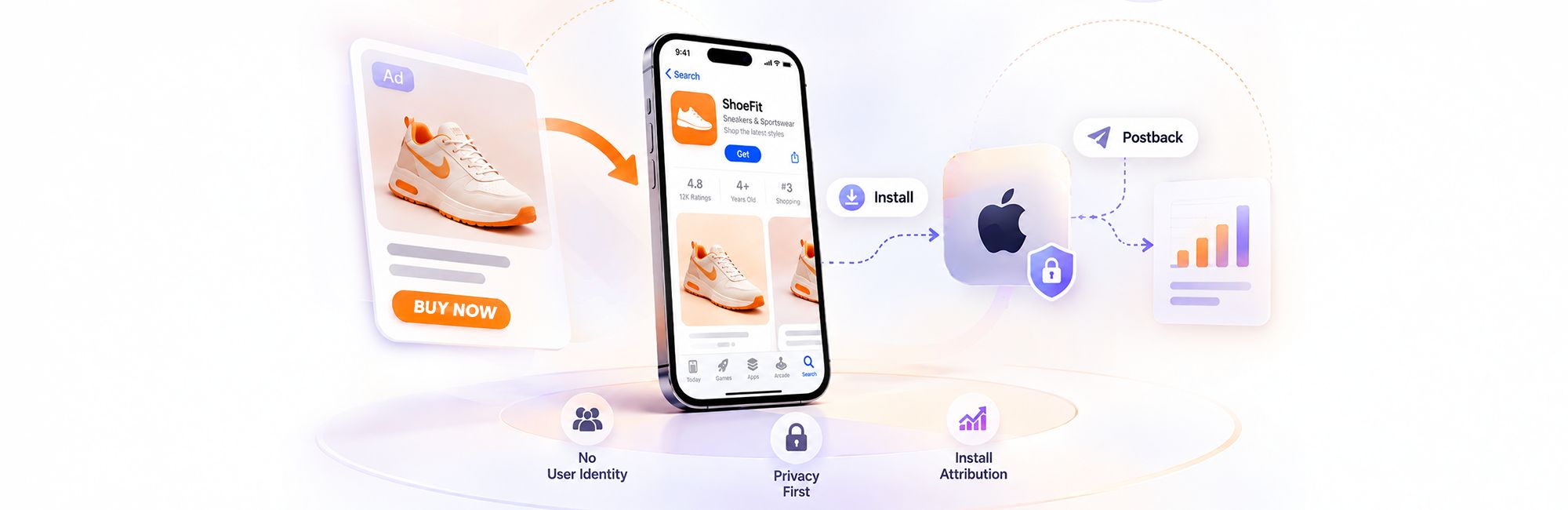
SKAdNetwork, or SKAN, is Apple’s privacy-preserving way to measure which ads led to app installs on iOS. When someone installs an advertised app after interacting with an ad, Apple sends the ad network a signed message called a postback. The postback can include a conversion value, a small code the app updates after installing, with a meaning the app and its ad network define. It never includes the person’s identity or device details. To protect privacy, Apple decides how much detail a postback carries based on how large a crowd the install blends into, and it sends postbacks after a delay, so the data often arrives late and can be thin or empty. SKAN works whether or not someone allows tracking through App Tracking Transparency. SKAN 4.0 is the latest numbered version, and Apple now points developers to AdAttributionKit for app ad campaigns, which works alongside SKAN. SKAN is an attribution framework, not an analytics tool. It tells an ad network that it earned an install, not who the person was.
Introduction
Anyone running an app install campaign wants a simple answer. Which ads brought in installs, and which of those people went on to do something valuable, like registering or placing an order? Budgets get moved on that answer.
On iOS, that answer used to lean on the IDFA, a device-level advertising identifier that tied an ad to an install on one specific phone. Since iOS 14.5 in 2021, apps have to ask permission through App Tracking Transparency (ATT) before tracking people across other companies’ apps and websites, and plenty of people decline. That matters because iOS held about 31 percent of worldwide mobile operating system market share in September 2026, a reminder of how large the iPhone audience is.
Apple’s answer is SKAdNetwork, usually shortened to SKAN. Introduced in 2018, it became far more important once ATT arrived. It lets advertisers learn which campaigns produced installs, and some later activity, without identifying anyone.
The trade-off is detail and speed. SKAN reports are aggregated, they arrive late, and parts are sometimes left out on purpose. Many advertisers see thin numbers on an early dashboard and assume something is broken. Often nothing is.
Apple has also introduced a newer framework, AdAttributionKit, which now sits alongside SKAN. This article covers how SKAN works, why its data looks the way it does, and where AdAttributionKit fits.
What is SKAdNetwork and why does it exist?
SKAdNetwork stands for StoreKit Ad Network. It is Apple’s system for attributing app installs to ads while keeping people anonymous. Apple confirms the install and tells the ad network that ran the ad, without saying who the person is or which device they used.
Apple built it because the older model gave outside companies a detailed view of what people did across apps. SKAN moves the matching job to Apple, and only a limited, aggregated result goes back out. It measures the install itself, plus a limited amount of activity after it, reported through a number called the conversion value.
SKAN is an attribution framework, not an analytics platform
SKAN does not give advertisers a dashboard. It produces postbacks, small signed messages that go to the ad network, with an optional copy for the developer. Ad platforms and mobile measurement partners (MMPs) turn those postbacks into the reports advertisers read. SKAN’s core job is narrow: it tells ad networks which ad impression earned an install, and it attaches limited campaign and post-install information to that result.
How does SKAdNetwork actually work?

Apple describes three actors. The ad network buys and serves the ad, and has to be registered with Apple. The publisher app, sometimes called the source app, is where the ad appears. The advertised app is the one being promoted, and the company behind it is the advertiser.
The ad network signs an ad impression, and the publisher app shows the ad. The person taps and installs from the App Store. When the app first opens, it registers the install by updating the conversion value, and it can keep updating that value as the person engages. When Apple’s timer runs out, Apple sends the postback to the ad network.
A simple SKAN install example
Take some invented names. Brightline Ads, an ad network registered with Apple, runs a campaign for Basket Bay, a grocery delivery app, and one place its ads appear is Puzzle Pond, a puzzle game. A person playing Puzzle Pond taps the ad, which Brightline has signed for Apple’s attribution process, and installs the app.
When the person first opens Basket Bay, the app tells Apple the install has happened. Soon after, the person signs up and places a first order, and Basket Bay updates the conversion value each time. The numbers mean nothing on their own, and Apple only carries them. Basket Bay and its ad network decided in advance that, say, 12 stands for “placed a first order.” That meaning is defined by the app and the ad network, not by Apple, and it isn’t contained in the postback.
Apple then assigns the app download a postback data tier, a privacy level that decides how much detail the postback can carry. After the conversion window closes and a random delay passes, it sends the postback to Brightline Ads, with a copy to Basket Bay’s developer if that is set up. Brightline sees an aggregated result: installs happened, and some share reached value 12. It sees no names and no devices.
What data does SKAN return, and what doesn’t it?
A SKAN postback is a small package of fields. It identifies the ad network and the advertised app, the SKAN version, and whether the install was a redownload. It carries a source identifier, a label the ad network sets for the campaign or another part of the buy. Where privacy thresholds allow, it also names the publisher app or website domain where the ad appeared, and it can carry a conversion value, fine or coarse. SKAN 4 adds the postback’s position in a sequence of up to three. Since SKAN 3, networks whose ads did not win attribution can also receive a postback marked as a non-winner. Apple decides how much of this detail is included through its postback data tiers, covered in the next section.
What SKAN doesn’t tell an advertiser
Postbacks carry no user or device identifier, so one postback can’t be matched to one person. A person’s journey, such as every ad they saw before installing, never reaches the advertiser, and results are not real time. SKAN also doesn’t offer the re-engagement attribution, for ads aimed at people who already have the app, that AdAttributionKit now supports.
Quality and fraud are separate questions. Apple signs each postback so a network can confirm it is genuine, but that protects the postback itself. It doesn’t show whether the traffic was real, the ad was viewable, or the placement suited the brand. Those need separate tools.
Why does SKAN data arrive late or look incomplete?
Two things cause most of the confusion, timing and privacy.
On timing, Apple doesn’t send a postback the moment something happens. The conversion window starts when the person first launches the app, and the app can update its conversion value until the window closes. In SKAN 4, the first window ends two days after first launch, and Apple then waits a random 24 to 48 hours, so the first postback lands three to four days after first launch, or sooner if the app locks the window early. For the second and third postbacks, the random wait is 24 to 144 hours.
On privacy, Apple assigns each app download a postback data tier from 0 to 3, based on the size of the crowd it blends into, which Apple calls crowd anonymity. Crowd size considers the app showing the ad, the advertised app, the country, and the source identifier. At Tier 0, the lowest, Apple sends only the first postback, and it carries no conversion value and only the two-digit part of the source identifier. Tier 1 adds a coarse conversion value. At Tiers 2 and 3, the first postback can return more digits of the source identifier, up to all four, and a fine conversion value, while the second and third postbacks carry only two digits and a coarse value. Tier 3 can also name the publisher app or website domain. Apple doesn’t publish the exact thresholds.
So a dashboard checked a day or two after launch can look thin. Installs are still waiting to be reported, and those that have arrived may carry limited detail. That is the system working as designed.
What does a null conversion value mean?
A null means the postback didn’t include a conversion value. That can happen because the postback’s data tier didn’t allow one, or because the advertised app never provided one, either by not updating the value or because a setup problem got in the way. It doesn’t mean the install didn’t happen. If nulls persist on a campaign with plenty of installs, check that the app is updating its conversion values.
What does SKAN mean for mobile performance campaigns?
A CPI campaign pays for installs. A CPA campaign pays for a chosen action after install, such as registering or buying. Either way, the buyer needs to trust the install and event data coming back, and on iOS a meaningful part of it now arrives as SKAN postbacks, with the delays and limits above. When a campaign is tuned on installs and in-app events, knowing how SKAN reports them is what makes the numbers readable.
Xerxes, the mobile performance DSP from Xapads, supports CPM, CPC, CPI, and CPA models and connects to more than 25,000 mobile apps and 50 or more SSPs.
What changed in SKAdNetwork 4.0?

SKAN 4.0 arrived in late 2022 to give advertisers more information, more often, without weakening the privacy protections.
Up to three postbacks across three windows
Earlier versions sent one postback per install. SKAN 4.0 can send up to three, each tied to a window that starts when the app is first launched: days 0 to 2, days 3 to 7, and days 8 to 35. Each is sent after its window closes and the random delay described above. “Up to three” is a ceiling. At Tier 0 only the first postback is sent, and only the winning network and the advertiser’s developer receive the later ones.
Fine and coarse conversion values
The conversion value now comes in two forms: a fine value from 0 to 63, as before, and a coarse value of low, medium, or high. Apple doesn’t assign a meaning to either form. The advertised app and the ad network define what each value stands for. The first postback can carry a fine value if the data tier is high enough. At lower tiers it carries a coarse value instead, and the second and third postbacks carry only coarse values. At the lowest tier there may be no conversion value at all.
Source identifiers
The old two-digit campaign ID, which allowed 100 values, became a four-digit source identifier that allows up to 10,000. Apple calls it hierarchical. Depending on the postback data tier, a postback returns two, three, or all four digits, and the shorter versions are the last digits, so 5739 comes back as 39 at the low end. The ad network decides what each part stands for, so the most important reporting signal, such as the campaign, should sit in the digits most likely to survive at lower data tiers.
LockWindow
SKAN 4.0 also lets an advertised app lock a conversion window early. When the app locks, Apple prepares that postback right away, ignores any further conversion value updates in the same window, and sends it after the usual random delay, so locking shortens the wait but doesn’t make delivery instant. It suits an event, such as a first purchase, that matters enough to report quickly.
Does SKAN require App Tracking Transparency?
No. SKAN works whether or not someone allows tracking. An app can call the SKAdNetwork APIs regardless of the choice the person made in the ATT prompt.
ATT is the permission prompt iOS shows before an app tracks someone across other companies’ apps and websites or reads their advertising identifier. SKAN attributes installs without needing that identifier, so a person can decline tracking and the install can still show up. What changes is access to device-level attribution through the IDFA, which requires ATT permission.
Is AdAttributionKit replacing SKAdNetwork?
Apple’s SKAdNetwork documentation now tells developers to use AdAttributionKit for app ad campaigns, but SKAN has not disappeared. It is still documented, and Apple’s release notes still list SKAN 4 as the latest version.
AdAttributionKit builds on SKAN’s foundations. It first shipped with iOS 17.4, and iOS 18 added re-engagement measurement for click-through ads, meaning ads that bring back people who already have the app. Apple has kept expanding it since. iOS 18.4 added overlapping re-engagement conversions and development postbacks created in iOS Settings for testing, and Apple has also added configurable attribution windows and cooldowns, plus a country code in postbacks that appears only when the crowd size allows it. For app installs, SKAdNetwork works with the App Store only, while AdAttributionKit also covers alternative app marketplaces. SKAN 4 can also attribute ads shown on web pages in Safari.
Can SKAN and AdAttributionKit work together?
Yes. Apple designed them to interoperate. An app can support both, and when it has ad impressions from both frameworks, the system sorts them and picks one winner, so the same install is not credited twice.
How should advertisers read SKAN data today?
Reading the data
Judge a campaign on early SKAN numbers with caution. Install counts show up first, richer detail arrives later, and some may never arrive. Before drawing a conclusion, check how complete the data is, how many postbacks carry a conversion value, and what happened to downstream events like purchases or retention.
Expect the numbers not to match, too. SKAN reports on Apple’s delayed schedule and data tiers, and credits one winning network per install. An ad platform or MMP can use its own attribution windows, reporting rules, and campaign-grouping logic. A gap between them isn’t automatically a sign that one is broken. Pick one source as the reference for each decision and watch the gap over time instead of forcing the totals to reconcile.
What to do next
Decide which in-app events reflect real value and map the conversion value to them, remembering that SKAN 4’s coarse values are blunt. Avoid cutting or scaling a campaign on the first few days of data, and check that ad partners support the Apple framework the campaign needs, whether SKAN, AdAttributionKit, or both.
Conclusion
SKAN remains an important privacy-preserving way to measure iOS app advertising, and it trades detail and speed for privacy, which is why its data arrives late and sometimes thin. Understanding iOS measurement in 2026 also means knowing where AdAttributionKit fits alongside it.
Frequently Asked Questions
Does SKAdNetwork require ATT consent?
No. An app can call the SKAdNetwork APIs whatever the person chose in the ATT prompt.
What is a SKAN conversion value?
It is a number the advertised app sets after install to reflect what the person did. It is a fine value from 0 to 63, or, in SKAN 4, sometimes a coarse value of low, medium, or high. The advertised app and the ad network define what each value means.
Why is a SKAN conversion value null?
Either the postback’s data tier didn’t allow a value, or the app never provided one. The install still happened.
How long does SKAN take to send a postback?
Not instantly. In SKAN 4, the first postback arrives three to four days after first launch: the first window ends after two days, and Apple adds a random 24 to 48 hours. Locking the window early can bring it sooner. The second and third postbacks follow their windows with a random 24 to 144 hours.
Why don’t SKAN and MMP install numbers match?
They follow different rules. SKAN reports on Apple’s delayed schedule and data tiers, while an MMP or ad platform uses its own windows and methods. A gap isn’t automatically a sign that either one is broken.
What is the difference between SKAdNetwork and AdAttributionKit?
AdAttributionKit builds on SKAN, adds re-engagement measurement and alternative marketplace support, and is the framework Apple now points developers to. The two interoperate.
Further Reading
Advertisers who want to see how an install connects to what happens afterward can read about how installs and retention fit together in programmatic app campaigns.
Related Post