Digital advertising in 2026 moves fast. Budgets are bigger, channels are wider, and the gap between high-performing campaigns and wasted spend is increasing. Two terms sit at the center of every modern media plan: programmatic advertising and native display advertising. Many marketing and planning teams debate one against the other. That debate misses the point.
Programmatic is about how ads are bought. Native is about what ads look like. These are two different dimensions of campaign strategy. The clearest way to think about it: programmatic is the engine, and native is the body. One drives the transaction. The other shapes the experience.
This guide breaks down both formats clearly. It compares them across every dimension that matters to campaign planning and gives advertising teams a practical decision framework. It is written for marketers, media planners, founders, and brand leaders who need to make smart budget decisions.
What Is Programmatic Advertising? The Engine Behind the Buy
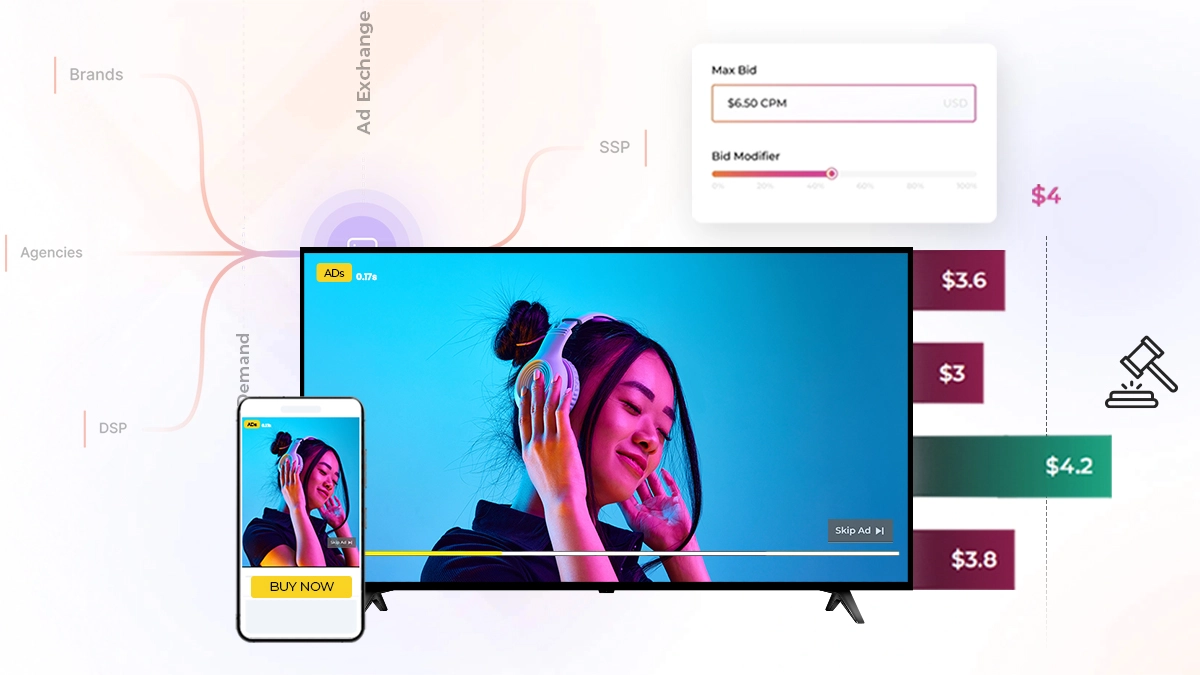
Programmatic advertising is the automated buying and selling of digital ad inventory through technology platforms. It replaces manual insertion orders with real-time algorithms that decide which ad runs, in which environment, for which audience, and at what price. All of that happens in under 100 milliseconds as a webpage loads.
The scale of this shift is significant. US programmatic ad spending has surpassed $200 billion in 2026, and globally, programmatic now accounts for over 90% of all digital display ad transactions. Programmatic is no longer a channel option. It is the operating system of modern media buying.
How Real-Time Bidding Works in 2026
When a user loads a webpage or opens a mobile app, the publisher’s supply-side platform (SSP) sends a bid request to an ad exchange. That request carries data about the impression: device type, location, app category, content environment, and available audience signals. Demand-side platforms (DSPs) read this data instantly and submit competing bids. The highest eligible bid wins the impression. The winning creative loads on screen before the page finishes rendering.
Header bidding, now standard across premium publishers, runs auctions across multiple demand sources simultaneously before the publisher’s ad server makes a final call. This process can improve fill rates and clearing prices for publishers while giving advertisers access to higher-quality inventory pools.
The Programmatic Stack: DSP, SSP, Ad Exchange, DMP
The programmatic ecosystem runs on four core layers. A demand-side platform (DSP) is where advertisers configure budgets, targeting parameters, and creatives. A supply-side platform (SSP) is where publishers list and manage available inventory for sale. The ad exchange sits between both and runs the real-time auction. A data management platform (DMP) stores and segments audience signals that inform bidding decisions on both the buy side and the sell side.
In 2026, private marketplaces (PMPs) have become the dominant transaction environment. More than 4 in 5 programmatic display ad dollars now flow through PMPs and programmatic direct rather than open exchanges. Advertisers choose PMPs because they provide brand-safe, premium inventory with cleaner measurement, verifiable seller identity, and fewer wasted intermediaries.
Buying Models: CPM, CPC, CPI, CPA
Programmatic supports multiple buying models that serve different campaign objectives. CPM, cost per thousand impressions, suits brand reach and awareness campaigns where visibility is the primary goal. CPC, cost per click, works for campaigns that drive traffic to landing pages or product listings. CPI, cost per install, is built specifically for app marketing campaigns where the objective is driving users to download and activate an application. CPA, cost per action, ties spend directly to a defined conversion outcome such as a purchase, sign-up, or form submission.
The ability to switch buying models inside a single DSP is one of programmatic’s defining advantages. Budget allocation can follow performance signals in real time rather than staying locked into a fixed deal structure.
For mobile-first performance campaigns, Xerxes is a dedicated mobile performance DSP that runs CPI and CPA campaigns across 18,000+ websites, 25,000+ mobile apps, and 50+ SSPs. It reaches 472M+ monthly active users in India, 212M+ in Southeast Asia, 122M+ in the Americas, and 105M+ in Europe — all through CPM, CPC, CPI, and CPA buying models from a single platform.
Where Programmatic Advertising Runs Today
Programmatic reaches audiences across mobile apps, web browsers, OEM device surfaces, and connected TV environments. Mobile commands the largest share. Mobile devices accounted for 62.2% of total programmatic advertising impressions in 2025, and that share continues to grow. The global programmatic display market reached USD 106.4 billion in 2026 and is forecast to reach USD 959.7 billion by 2036 at a 24.6% CAGR. CTV is the highest-growth channel, absorbing new programmatic budgets as linear TV audiences shift to streaming environments.
At scale, campaign performance depends not just on reach but on the quality of signals and supply. In high-scale programmatic environments with 2.4B+ reach and <0.80% fraud rates, advertisers can build more stable campaigns with cleaner data inputs. This often leads to improved outcomes over time, including ~18% uplift in ROAS, as systems learn which audiences and placements drive better results. These conditions allow campaigns to move beyond simple delivery and focus on consistent performance improvement across channels.
What Is Native Display Advertising? The Format That Fits In.
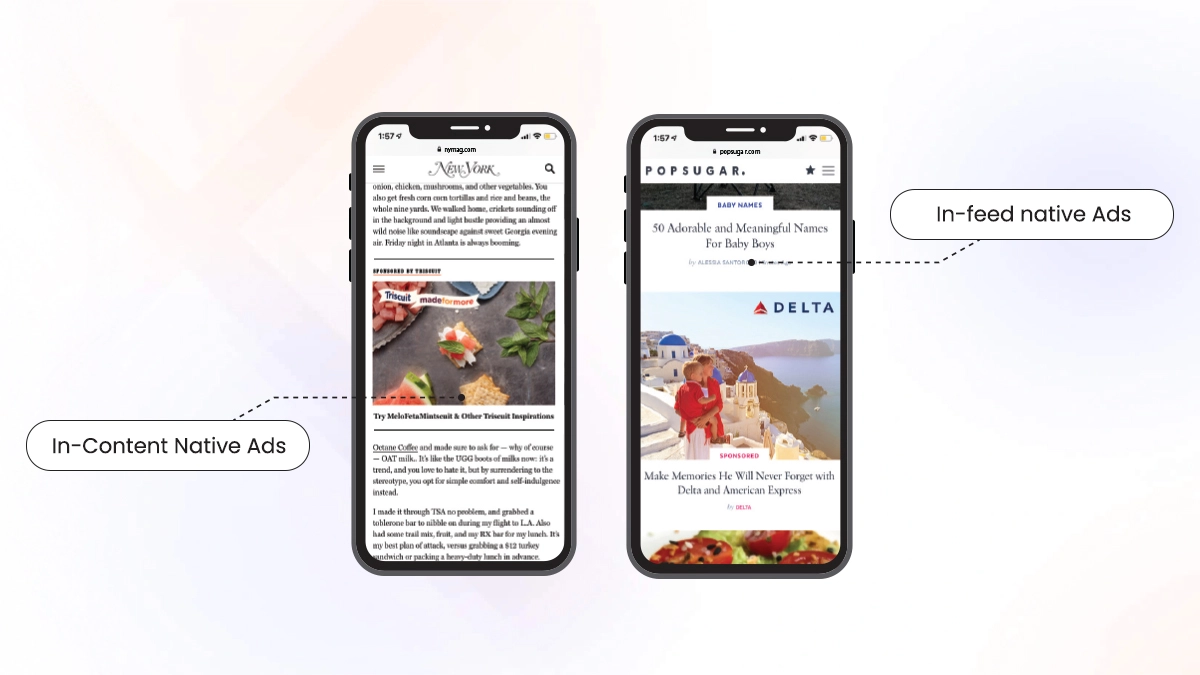
Native advertising is a creative format where the ad matches the look, feel, and function of the editorial environment it sits inside. On a news site, a native ad looks like an article. Inside a social feed, it looks like an organic post. Within a mobile app, especially across in-app environments where user attention is highest, it looks like part of the app interface. The ad does not interrupt the content experience. It lives inside it.
The global native advertising market reached USD 125.6 billion in 2026 and is tracking toward USD 892.2 billion by 2036 at a 21.7% CAGR. US native display ad spending alone is expected to reach $147.98 billion in 2026, a 13.1% year-over-year increase. Native formats continue to grow because they often deliver higher engagement compared to standard banner formats.
Why Native Ads Look Different From Standard Display
Standard banner ads occupy fixed-dimension slots that audiences have trained themselves to ignore. This behaviour is called banner blindness. Years of exposure to rectangular ad units sitting in the same corners and headers of every webpage have conditioned audiences to filter them out automatically.
Native ads sidestep this problem. They do not look like ads. They match the font choices, image styles, headline tone, and layout logic of the surrounding editorial content. A brand that places a native ad on a technology publication creates content that reads and looks like a technology article. The Sponsored label appears clearly and meets regulatory requirements, but the format earns attention because it fits inside the content flow rather than interrupting it.
Native Ad Formats in 2026
In-feed native ads appear inside content streams on news sites, social platforms, and app environments. They scroll with the page and match the visual rhythm of editorial content around them. Sponsored content consists of longer-form branded articles or videos hosted directly on publisher platforms. Content recommendation widgets appear at the bottom of articles and surface related sponsored stories to audiences who have already engaged with editorial content. In-app native ads blend into the interface of mobile applications, following the design conventions of each specific app environment.
Video native formats have gained strong momentum in 2026. Native video ads can achieve completion rates 9 times higher than standard pre-roll formats. Branded content articles generate up to 7 times the time-on-page compared to standard web articles. These are not marginal differences. They reflect a fundamentally different quality of user engagement.
Why Native Ads Generate Higher Engagement Than Banner Formats
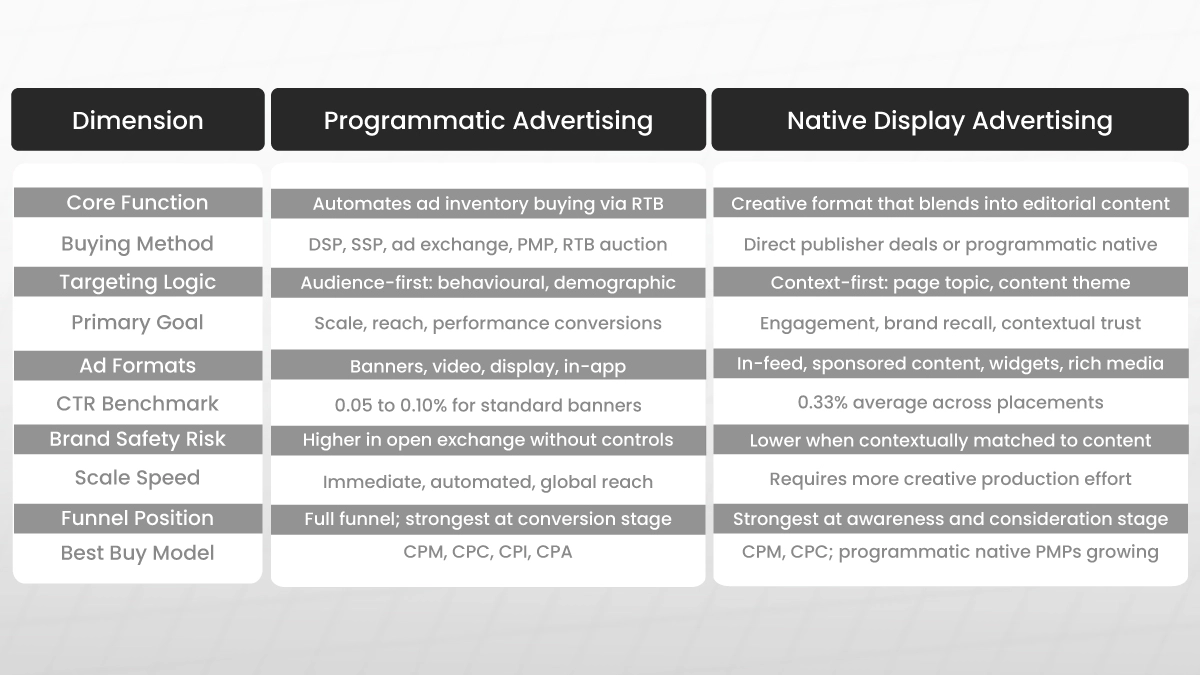
Native ads receive 53% more views than traditional display ads and generate a 0.33% average CTR compared to 0.05% for standard display banners. In-feed native ads on social platforms often reach a 1.2% average CTR versus 0.15% for banner formats. Exposure to native advertising can increase purchase intent by 18% and brand affinity by 9% compared to standard display.
The reason for these numbers is straightforward. Native ads appear inside content that audiences actively sought out and chose to read. The attention is already present. The ad benefits from that existing engagement rather than fighting against user resistance.
For brands running native and rich media campaigns at the consideration stage, Xaprio is an omnichannel branding DSP designed for exactly this purpose. It supports 50+ ad formats including in-feed native, rich media, display, video, OEM, and CTV. Campaigns running through Xaprio typically record 2x brand recall lift, 7.4 seconds of average rich media engagement per session, and 3.2x the time spent compared to static banners, with 100% transparent buying across 70+ global and OEM supply partners.
The Role of Labeling and Disclosure in Native Advertising
Every native ad carries a disclosure label. Regulatory requirements in most markets mandate clear and prominent labeling using terms like Sponsored, Promoted, or Advertisement. The label must appear before a user clicks through and must be visible without any action required.
Brands that follow these standards protect credibility and maintain audience trust while capturing native’s engagement advantage. Proper disclosure does not reduce performance. Native ads with clear Sponsored labels still consistently outperform banners because the format drives relevance, and relevance is what moves audiences.
Programmatic vs Native Display: The Core Differences Explained
The Buying Method vs the Creative Format
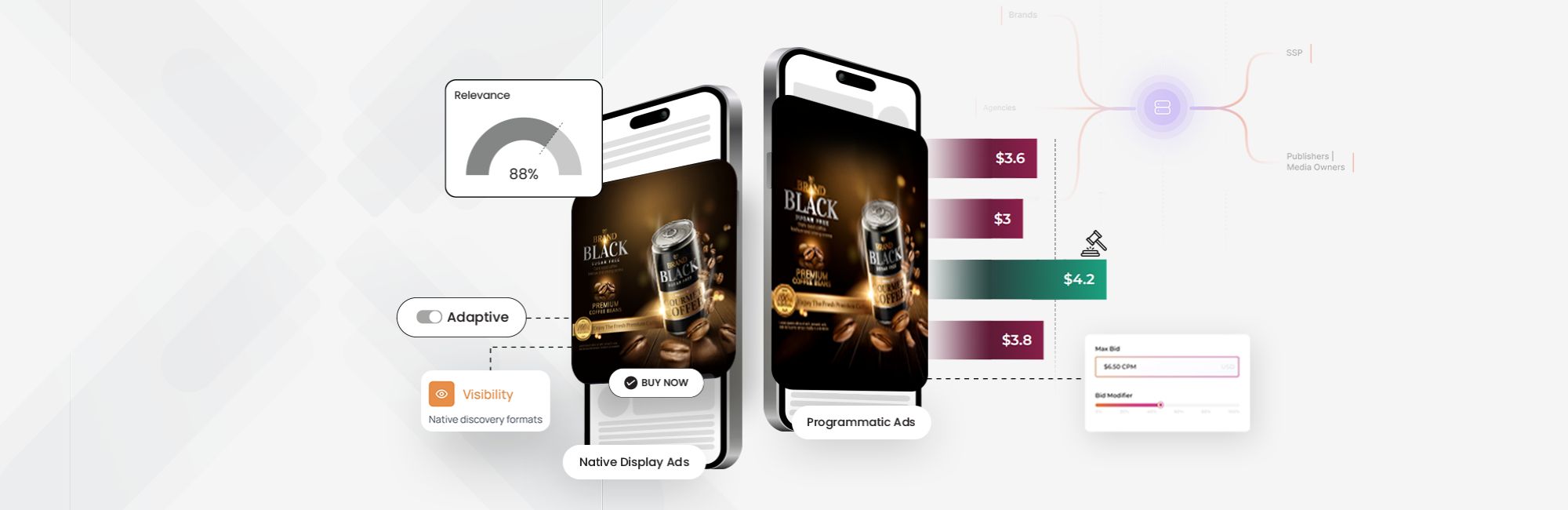
Programmatic describes how inventory is transacted. Native describes how the creative is formatted and presented. These two dimensions operate on entirely different layers of a media plan. An advertiser can run a native creative format through a programmatic buying process. That combination is called programmatic native, and it is one of the fastest-growing transaction types in digital advertising.
When brands treat programmatic and native as competing alternatives, they end up making flawed budget decisions. The right question is not programmatic versus native. It is: what buying method and what creative format serve this specific campaign objective?
Targeting Logic: Audience-First vs Context-First
Programmatic advertising targets audiences. A DSP uses behavioural signals, device data, demographic parameters, location information, and retargeting lists to find specific user profiles wherever they appear across the open internet. The content of the page those users are reading matters less than the fact that those users match the targeting criteria.
Native advertising targets context. The ad earns its placement because the editorial environment matches the brand’s content category. A financial services brand places a native ad inside a personal finance content stream. A fitness brand appears inside health and wellness editorial. The contextual signal determines placement. In a post-cookie environment where personal data signals are declining, this contextual-first approach is gaining real strategic value for advertisers who need reliable targeting that does not depend on third-party user tracking.
Scale and Speed: Where Programmatic Wins
Programmatic delivers large-scale reach that manual buying methods cannot match efficiently. A single DSP connects campaigns to thousands of websites, tens of thousands of mobile applications, and dozens of SSPs simultaneously. Campaigns go live within hours. Creative rotations deploy instantly. Bid adjustments happen in milliseconds as performance data flows back from each placement.
For advertisers running time-sensitive campaigns, retargeting sequences, or app install drives across multiple geographies at the same time, programmatic is the right channel. The automation removes operational friction from the buying process and replaces it with a system that continuously optimises itself as it runs.
Trust and Attention: Where Native Wins
Native advertising tends to command audience attention for longer than standard banner formats. Audiences spend 25% more time engaging with native ads than display ads. The format builds trust by delivering value inside the content stream rather than interrupting it.
For brands in competitive categories where trust signals carry weight, such as financial services, healthcare, and enterprise technology, native placement inside premium editorial environments can deliver measurable brand recall and purchase intent uplift that standard banner advertising often cannot achieve.
Brand Safety Considerations in Both Formats
Brand safety works differently across these two formats and understanding that difference matters for campaign planning.
In open exchange programmatic, ads can appear next to low-quality or brand-inappropriate content without strong controls in place. Made-for-advertising (MFA) sites inflate impression counts without generating genuine user engagement. An estimated $770 million in programmatic spend reached MFA publishers in Q2 2025 alone. This is why leading advertisers now route the majority of programmatic spend through private marketplaces and programmatic direct deals, where inventory is pre-vetted and publishers are accountable.
Native advertising carries lower brand safety risk by design. When ad placement is determined by contextual match to editorial content, the content category itself acts as a natural filter. A brand running native ads inside health and wellness editorial is unlikely to appear next to inappropriate material. The contextual qualification system filters unsafe environments before delivery happens.
Programmatic vs Native Advertising: 10-Dimension Comparison
Market Data: How Big Are These Two Channels in 2026?
Programmatic Advertising Market Size and Growth to 2030
US programmatic ad spending has crossed $200 billion in 2026. Globally, the programmatic display sector is valued at USD 106.4 billion in 2026 and is projected to reach USD 959.7 billion by 2036 at a 24.6% CAGR. The broader programmatic advertising market is expected to grow from USD 0.72 trillion in 2026 to USD 1.17 trillion by 2031 at a 10.34% CAGR.
Programmatic guaranteed and PMP transaction volumes are growing fastest within this overall market. Advertiser demand for measurable inventory quality, cleaner attribution, and verifiable brand safety is redirecting spend away from open exchanges toward curated, closed environments where both buyer and seller have clear accountability.
Native Advertising Market Size and CAGR Projections
The global native advertising market reached USD 125.6 billion in 2026 and is tracking toward USD 892.2 billion by 2036 at a 21.7% CAGR. Separate data places the native advertising sector at USD 146.97 billion in 2025, growing to USD 269.85 billion by 2030 at a 12.92% CAGR. Native ad spend reached $98 billion in 2026, representing 65% of all global digital display ad spending.
Why Standard Programmatic Display Is Decreasing in Appeal Over Native & Video
Standard non-video programmatic display is declining as a percentage of total digital ad spend. Absolute dollar volumes still grow, but the share is falling as budgets move toward native and video formats. US programmatic video ad spend surpassed non-video display for the first time in 2022, and the gap has widened every year since. In 2026, US programmatic non-video display is projected to reach $70.99 billion, but its share of total programmatic display spend continues to compress.
This shift carries a clear message for campaign planners: formats that earn user attention are outperforming formats that simply occupy ad slots. Native and video command genuine attention. Static banners in predictable placements increasingly do not.
Mobile Commands 62% of Programmatic Impressions
Mobile devices drove 62.2% of total programmatic advertising impressions in 2025. Mobile audiences are 4 times more likely to engage with native ads than desktop audiences, especially across in-app environments where user attention is highest. As media consumption continues to concentrate on smartphones and mobile app surfaces, both programmatic buying and native creative formats are converging around the mobile-first reality. Advertisers who plan campaigns around mobile screens as the primary surface align their strategy with where audiences actually spend their media time.
Pros and Cons of Programmatic Advertising
Pros
- Programmatic advertising can reach audiences at a scale no manual buying process approaches.
- A single coordinated campaign serves simultaneously across desktop browsers, mobile web, mobile apps, OEM device surfaces, and video environments.
- Real-time optimisation adjusts bids, audience targeting, and creative rotation based on live performance signals, meaning budgets can continuously flow toward what performs rather than staying locked in a plan built on historical assumptions.
- Advertisers adopting programmatic automation report approximately 45% improvement in campaign efficiency and around 38% reduction in manual buying workload. Those gains free media planning teams to focus on strategy and creative rather than spending time on operational execution.
- The multi-model buying structure is another core advantage. CPM, CPC, CPI, and CPA objectives can all be served from the same DSP interface, with budgets shifting automatically toward the model that delivers the defined outcome most efficiently.
Cons:
- Open exchange programmatic carries real and documented risk.
- Ad fraud remains a significant budget drain, with billions of dollars annually flowing to low-quality placements that generate fake impressions and clicks without delivering genuine user engagement.
- MFA sites exist specifically to exploit programmatic systems. Domain spoofing disguises low-quality inventory as premium publisher placements.
- Cookie signal deprecation is restructuring how audience data flows through programmatic systems. Chrome now gives users direct control over cookie settings, and other major browsers have already removed third-party cookies entirely. This shift forces advertising operations teams to invest in audience infrastructure and contextual signal capabilities to maintain targeting accuracy, per industry analysis.
Pros and Cons of Native Display Advertising
Pros
- Higher Engagement: Delivers stronger attention, dwell time, and interaction compared to standard display formats
- Contextual Alignment: Ads appear within content users actively choose, improving relevance and experience
- Brand Recall Lift: Can increase brand recall by ~9% compared to standard display formats
- High Video Completion Rates: Native video ads can achieve up to 9x higher completion rates than traditional pre-roll formats
- Ad-Blocker Resistance: Blends with editorial content, making it less likely to be blocked
- Privacy-Aligned Targeting: Works effectively with contextual signals instead of relying on third-party cookies
- Better User Experience: Feels less intrusive and integrates naturally into the content environment
Cons
- Higher Production Effort: Requires custom creatives (headlines, images, copy) tailored to each platform or publisher style
- Scaling Complexity: Difficult to scale efficiently without programmatic support for native formats
- Operational Overhead: Managing multiple publishers manually increases time and effort
- Creative Dependency: Performance depends heavily on content quality and relevance
- Disclosure Requirements: Must clearly label ads (e.g., “Sponsored,” “Advertisement”) across all placements
- Regulatory Variability: Compliance requirements differ across regions and continue to evolve
When Should a Brand Run Programmatic Advertising?
Performance Campaigns: App Installs, Conversions, Retargeting
Programmatic advertising is the right choice when campaign goals are performance-defined and outcome-measurable. App install campaigns running on CPI buying models need the geographic scale and millisecond-level optimisation that programmatic DSP infrastructure provides. Retargeting campaigns that re-engage past visitors across the open internet require audience data layers, cross-site tracking infrastructure, and automated bid management that programmatic delivers by design.
Conversion-focused campaigns in e-commerce, fintech, gaming, and travel verticals benefit from programmatic’s ability to match the right creative to the right user intent signal at the right moment. The automated system continuously learns which combinations of creative, audience, time, and context drive the highest conversion probability.
Audience-First Campaigns Requiring Geographic Scale
When a brand needs to reach a defined audience segment across multiple markets simultaneously, programmatic is the natural infrastructure. Geographic, demographic, device type, and behavioural targeting parameters can be combined, adjusted, and optimised in real time. A campaign reaching specific mobile user segments across India, Southeast Asia, and Latin America within a single media plan becomes operationally feasible through programmatic infrastructure at a scale that manual buying cannot achieve.
Campaigns Requiring Buying Model Flexibility
Programmatic’s multi-model buying structure is a strategic advantage when campaign objectives differ across markets or audience segments within the same campaign period. Brand awareness objectives in new markets run on CPM while performance retargeting in established markets runs on CPA, all managed from the same DSP interface without separate buying processes or disconnected reporting. That unified view reduces budget waste and improves total return on ad spend.
When Should a Brand Run Native Display Advertising?
Consideration-Stage Campaigns That Build Brand Recall
Native advertising performs strongest at the consideration stage of the marketing funnel. After initial awareness has been established, native formats carry audiences deeper into the brand story through formats that feel like content rather than advertising. Sponsored articles that educate, contextual in-feed placements that engage, and content recommendation units that surface relevant brand narratives all serve consideration-stage objectives that banner advertising cannot fulfil.
Brand recall lift, purchase intent increase, and time spent with content are the metrics that matter at this stage. Native advertising tends to deliver on all three, consistently outperforming standard display across each dimension in comparable testing environments.
Rich Media and Story-Led Campaigns for Premium Audiences
Premium audiences engaged with high-quality editorial content respond well to rich media native formats. Interactive native units that incorporate motion, sensor-based triggers, or embedded video within an editorial context can command attention for longer periods and register stronger brand association scores. For brands in premium-positioning categories such as luxury goods, automotive, enterprise technology, and financial services, native placement inside premium editorial environments often signals brand quality through association with the publishing context itself.
Omnichannel Campaigns Requiring Seamless Format Adaptation
Campaigns designed to reach audiences across CTV, OEM device surfaces, mobile apps, desktop browsers, and social feeds need creative formats that adapt to each environment without breaking the user experience. Native formats adapt by definition. A native campaign strategy executed through an omnichannel DSP lets brands maintain message consistency while the creative format adjusts to match each platform context automatically.
Can Programmatic and Native Work Together? The Full-Funnel Answer
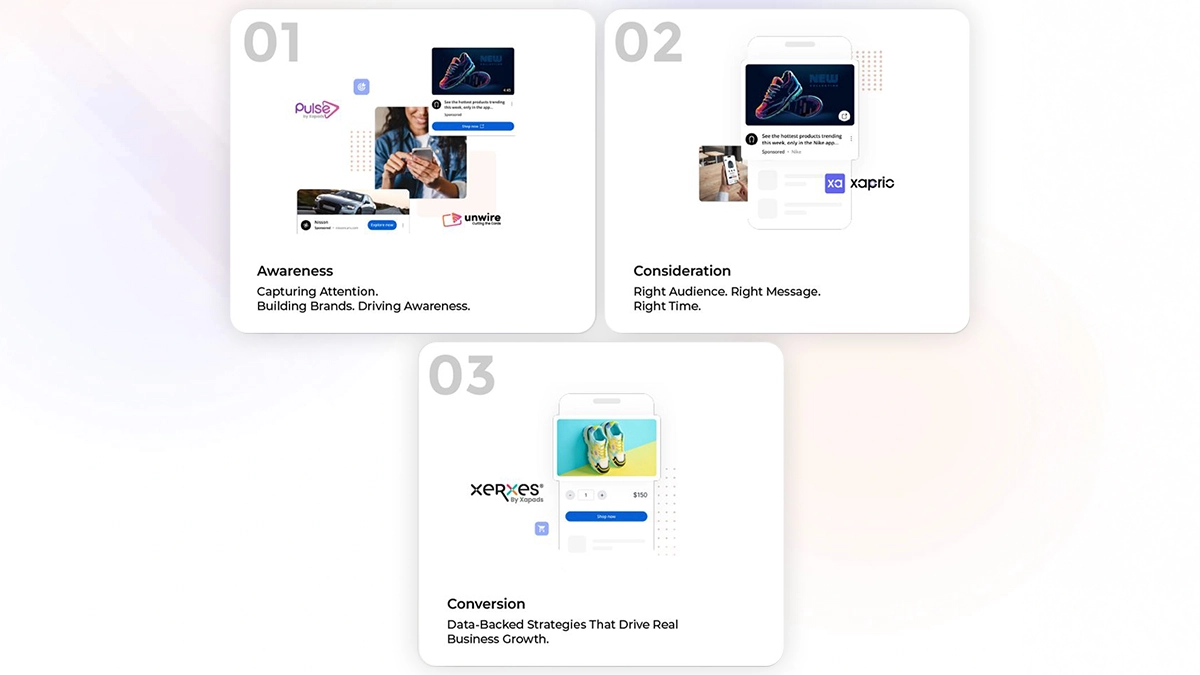
The Awareness to Conversion Funnel: How Both Formats Serve Different Stages
The most effective advertising strategies in 2026 do not choose between programmatic and native. They assign each format to the funnel stage where it performs best and run them in coordinated sequence as part of a single campaign architecture.
At the awareness stage, high-reach programmatic formats build initial brand recognition across large audience pools. At the consideration stage, native display formats carry audiences deeper into the brand narrative through contextually relevant content. At the conversion stage, performance-focused programmatic campaigns retarget engaged audiences and drive measurable outcomes through CPI and CPA buying models. Each stage feeds the next rather than operating in isolation.
The table below maps each stage to the right platform within the Xapads ecosystem:
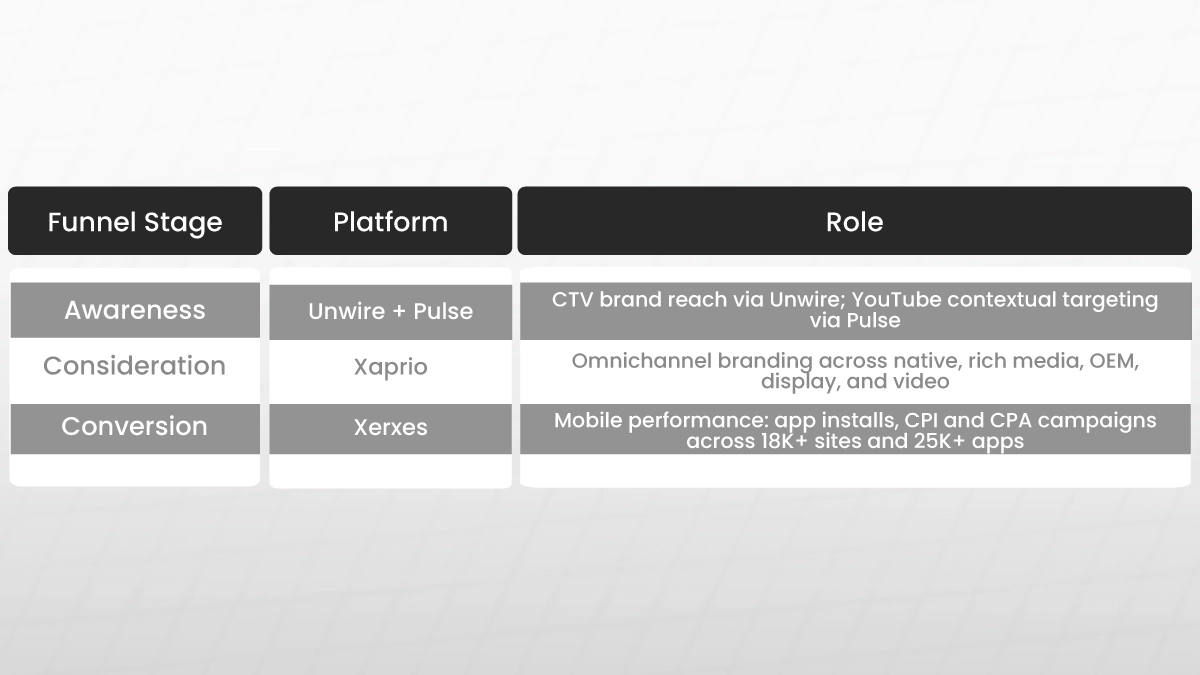
At the awareness stage, Unwire handles programmatic CTV advertising with 120M+ global reach, 100% viewability across premium channels, 85%+ view-through rate with non-blockable video ads, and 99%+ fraud-free delivery verified by Pixalate. For YouTube-specific awareness, Pulse is an AI-powered contextual targeting platform that ensures video ads appear on the right YouTube videos at the right moment, with full GARM brand safety compliance.
At the consideration stage, Xaprio runs omnichannel branding across native, rich media, OEM, display, and video from a single platform, with 2x brand recall lift and 7.4 seconds of average rich media engagement per session. At the conversion stage, Xerxes handles mobile performance campaigns across 18,000+ websites, 25,000+ mobile apps, and 50+ SSPs, reaching 472M+ monthly active users in India alone.
Programmatic Native: When Both Models Merge Inside a Single DSP
Programmatic native is the convergence of automated buying mechanics and native creative formats. A DSP purchases native ad inventory through real-time bidding, serving in-feed or contextually matched formats at scale without manual publisher negotiations for each placement. This eliminates the production friction and scaling limitations that historically made native difficult to run at volume.
Programmatic native retains the full engagement advantages of the native format while adding the targeting precision, real-time optimisation capability, and geographic reach of programmatic buying. In 2026, this combined approach has become the dominant transaction model within native advertising globally.
How Programmatic and Native Work Together Across the Funnel
Running programmatic and native in isolation often creates gaps in campaign performance. Programmatic campaigns focused only on performance can drive conversions, but they may not build strong brand recall over time. On the other hand, native campaigns can improve engagement and brand perception, but may struggle to deliver consistent conversions at scale.
The strongest results come from using both together within a clear funnel structure. Native formats help build awareness and consideration, while programmatic buying drives conversions and performance. When both are aligned across the funnel, campaigns can balance brand impact and measurable outcomes more effectively.
How AI Is Reshaping Programmatic and Native Advertising in 2026
AI-Powered Real-Time Bidding Optimisation
AI has changed what programmatic bidding can do. Modern DSPs use machine learning models that analyse campaign performance signals in real time and adjust bid values based on predicted conversion probability rather than historical averages. This moves programmatic from reactive adjustment to anticipatory optimisation that improves before problems become visible in campaign reports.
Agentic buying, where AI systems autonomously manage campaign decisions including audience selection, bid strategy, creative rotation, and budget pacing across the full campaign lifecycle, is the defining programmatic trend of 2026. Teams that have adopted agentic workflows report efficiency gains that manual buying cannot match at equivalent scale.
Contextual Intelligence: Moving Beyond Cookie-Based Targeting
With third-party cookie signals declining in reliability and availability, contextual intelligence has moved from a secondary targeting option to a primary strategy for many campaign planning teams. AI systems analyse the full content environment of a page including its topic, editorial tone, keyword signals, image content, and user intent indicators, and match ad placements to contexts that align with defined brand objectives.
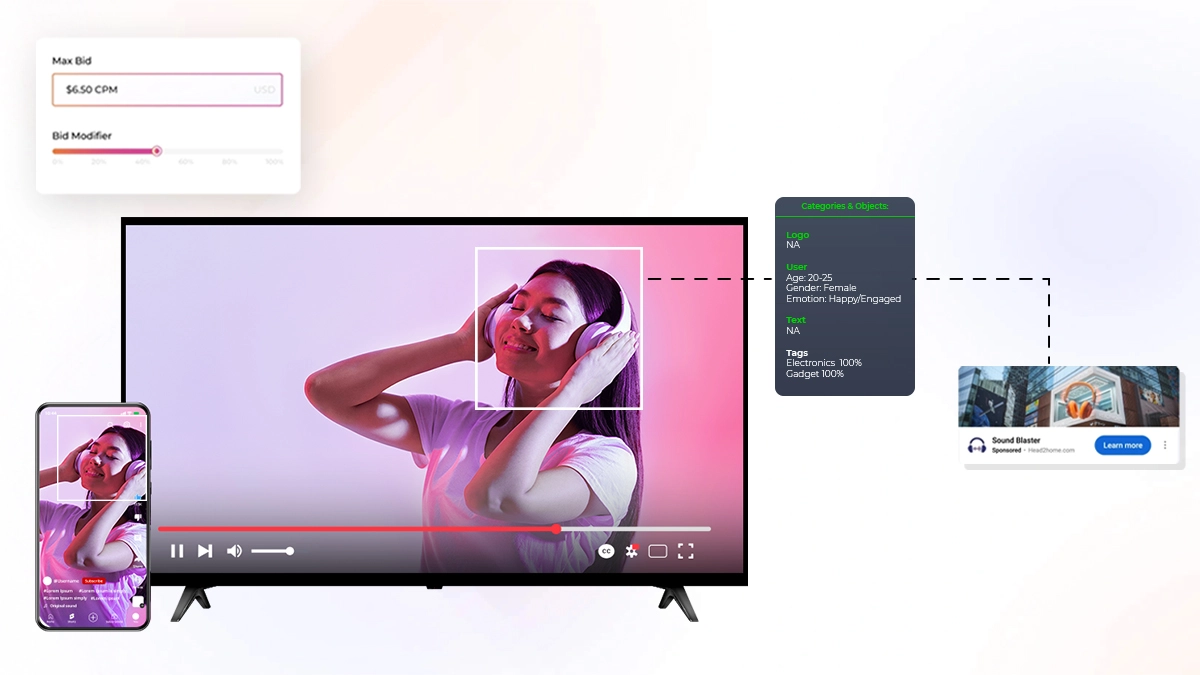
For YouTube-specific contextual targeting, Pulse uses AI to detect celebrities, brands, places, actions, on-screen text, audio, and sentiment within video content before serving ads. This ensures campaigns reach audiences inside contextually matched video environments with full GARM brand safety compliance, without relying on user-level tracking data.
Audience Data Infrastructure: The New Targeting Foundation
Cookie deprecation has accelerated investment in audience data infrastructure built on publisher relationships, clean room technology, and contextual signal systems. In 2025, 40% of US marketers relied on audience data collected through direct relationships as their primary targeting approach. Clean room technology allows advertisers and publishers to match audience segments without transferring individual-level records, enabling privacy-compliant targeting that works within tightening regulatory frameworks across both programmatic and native channels.
Brand Safety: A Critical Factor in Both Channels
The Problem of Ad Fraud in Open Exchange Programmatic
Open exchange programmatic carries real fraud exposure. Sophisticated bot networks generate fake impressions and fraudulent clicks at automated scale. Made-for-advertising sites produce content whose sole purpose is to monetise programmatic ad slots with minimal real user engagement. Domain spoofing disguises low-quality inventory as premium publisher placements to capture higher CPMs.
The industry’s response has been a consistent migration toward private marketplaces and programmatic guaranteed deal structures, where inventory is pre-vetted, seller identity is verified, and impression quality carries contractual accountability. Verification platforms provide fraud-free delivery assurances that open exchange environments cannot structurally offer.
How Contextual Targeting Reduces Unsafe Placements in Native
Native advertising benefits from a key brand safety advantage that programmatic open exchange lacks. When placement is determined by contextual content matching rather than audience ID targeting, the content category itself acts as a pre-delivery filter. A brand running native ads inside verified health and wellness editorial content is unlikely to appear next to inappropriate material because the placement qualification system is defined by what the content contains, not by who happens to be reading it.
Contextual targeting also reduces regulatory exposure in markets with strong data protection frameworks. When ad placement decisions do not depend on individual user tracking data, advertisers face lower compliance risk under GDPR, CCPA, and equivalent frameworks across Asia-Pacific markets.
What GARM Standards Mean for Campaign Delivery
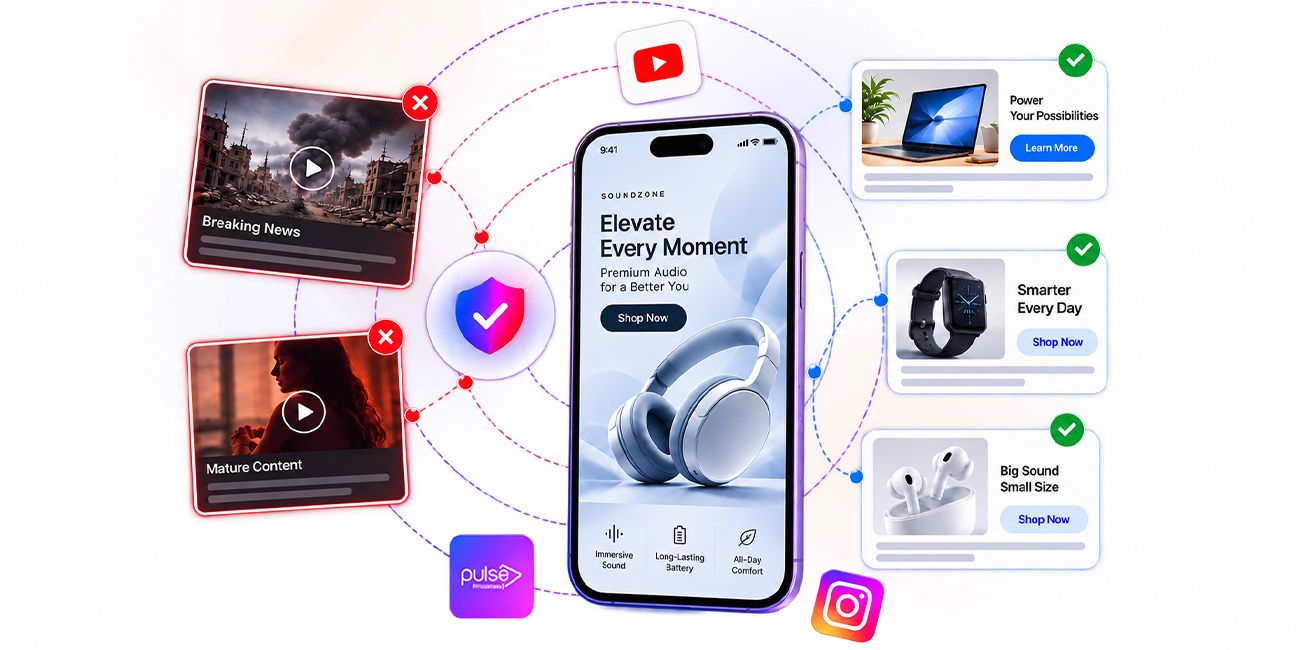
The Global Alliance for Responsible Media, or GARM, has established brand safety standards that define content categories advertisers should avoid across all digital channels. Those categories include violence, adult content, hate speech, misinformation, and other content environments that create reputational or legal risk for brands. Platforms and DSPs that certify GARM compliance give advertising teams structured, auditable protection against unsafe placements.
For YouTube video advertising, Pulse analyses video content signals before ad delivery to verify GARM-aligned placement, filtering out unsafe categories including violence, adult content, and hate speech. For CTV advertising, Unwire delivers 99%+ fraud-free inventory verified by Pixalate, with context-based targeting across premium channels at 100% viewability.
The View Ahead: Programmatic and Native Advertising from 2026 to 2030
Agentic AI Will Automate Campaign Decisions End to End
By 2028, agentic AI systems will likely manage the complete programmatic buying workflow autonomously: audience identification, bid strategy selection, creative rotation decisions, budget pacing, and real-time optimisation across every channel. Media planners will shift from executing campaigns operationally to defining strategic objectives and evaluating AI-generated recommendations. The operational execution layer of programmatic media buying will become largely automated for most campaign types.
Privacy Regulation Will Drive Contextual-First Native Strategies
Data privacy regulations are tightening globally. GDPR in Europe, CCPA in California, and emerging frameworks across Asia-Pacific markets continue to reduce the supply of personal data available for audience targeting at scale. This regulatory trajectory accelerates the shift toward contextual advertising strategies where placement decisions rely on content environment signals rather than individual user profiles. Native advertising is well-positioned for this environment because it already operates on contextual logic as its default targeting mechanism.
CTV Will Absorb a Larger Share of Programmatic Budget
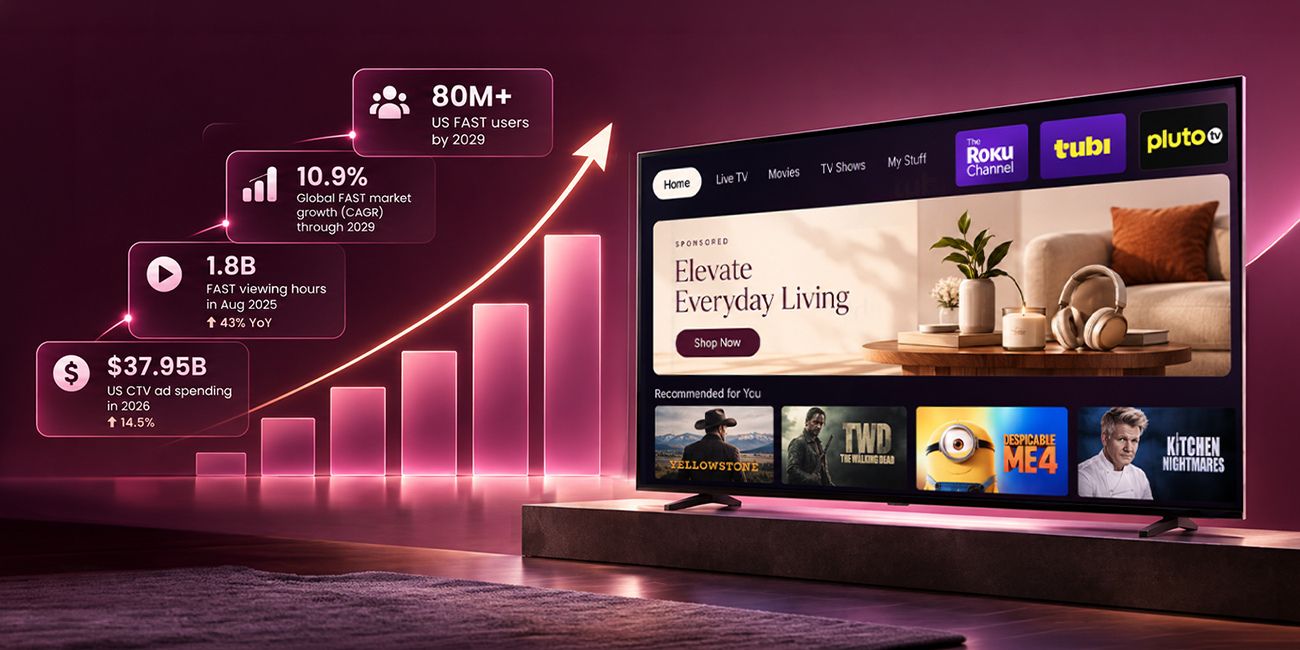
Connected TV is the highest-growth programmatic channel through 2030. As linear television audiences fragment across streaming services, smart TV platforms, and on-demand content environments, advertising budgets follow audience attention. CTV programmatic combines television-scale reach with the targeting precision and measurement accountability of digital. This channel is absorbing meaningful share from legacy display budgets as measurement capabilities improve and inventory quality rises.
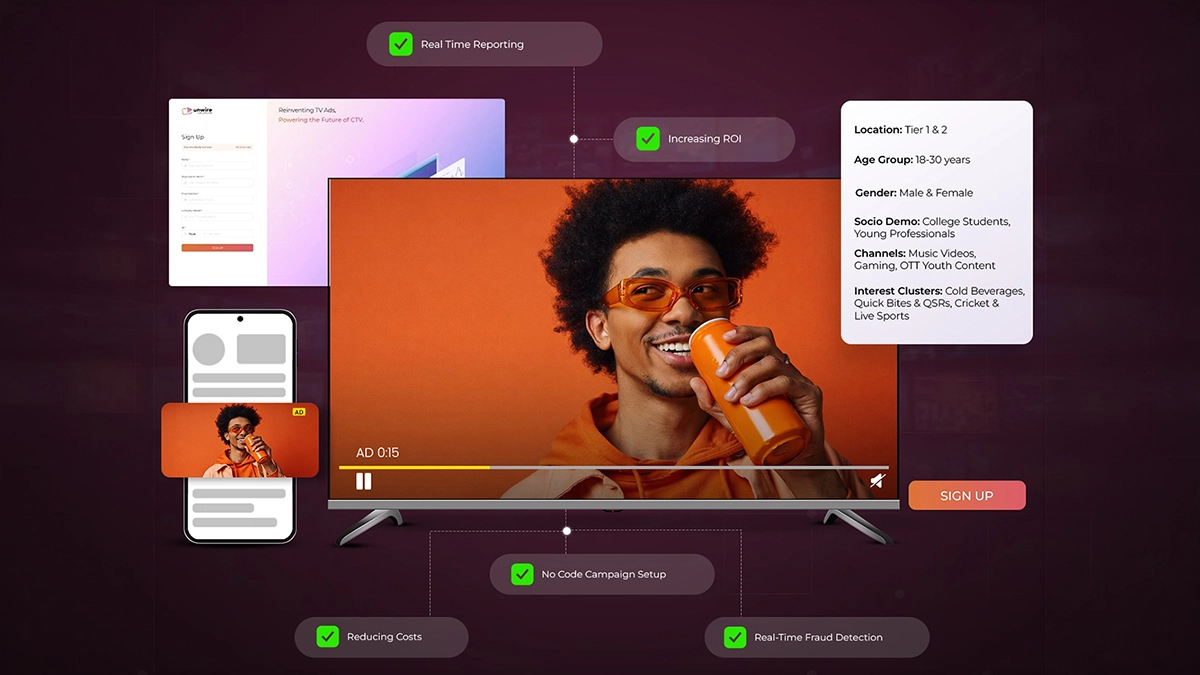
Advertisers looking to capture CTV inventory programmatically can explore Unwire, a dedicated CTV advertising platform that connects advertisers, broadcasters, and streaming services. Unwire features OTT header bidding, Smart Media Planner with AI-driven suggestions, PMP and programmatic guaranteed deal configuration, and real-time reporting. With approximately 10 ads per minute using contextual targeting and cross-device reach across CTV and mobile, it offers a transparent and flexible environment for CTV campaign execution.
Programmatic Native Will Become the Default Transaction Model by 2028
The convergence of programmatic buying mechanics and native creative formats is accelerating across every major market. By 2028, the majority of in-feed and content-matched ad placements will transact programmatically through DSP infrastructure rather than through manual publisher negotiations. The legacy model of negotiating native placements publication by publication will give way to DSP-powered automated buying that maintains contextual relevance and editorial alignment at full programmatic scale.
What Forward-Thinking Advertisers Are Doing Right Now
The most advanced advertising operations in 2026 are building connected funnel strategies that run awareness, consideration, and conversion as coordinated stages of a single campaign architecture. They are investing in audience data infrastructure built on publisher relationships and clean room technology to maintain targeting precision as third-party signals continue to decline. They are testing programmatic native at scale and using dynamic creative optimisation to personalise native creatives without proportional production cost increases. They are allocating growing portions of display budgets to CTV and mobile-first in-app environments where audience attention is highest. They demand supply chain transparency: verified publishers, fraud-free delivery certification, and measurable outcomes at every funnel stage.
Key Takeaways for Advertisers and Media Planners
Programmatic advertising is the buying infrastructure that powers over 90% of digital display transactions in 2026. Native advertising is the creative format that earns audience attention by integrating into editorial environments rather than interrupting them. These are not competing strategies. They operate on different layers and serve different strategic functions within a well-structured campaign plan.
Programmatic delivers scale, speed, and real-time optimisation across CPM, CPC, CPI, and CPA buying models. It is the right infrastructure for performance campaigns, retargeting sequences, and audience-first media buying across multiple geographies. Native delivers engagement, brand recall lift, and contextual relevance that standard banner formats cannot achieve. It is the right format for consideration-stage campaigns, premium audience environments, and brands that need to build genuine trust rather than simply occupy ad inventory.
The US programmatic market has crossed $200 billion in 2026. The global native advertising market is approaching $126 billion. Both are growing because both serve distinct and necessary functions in a complete advertising strategy. Running them together, coordinated through clear funnel logic, produces better outcomes than either channel achieves independently.
AI is transforming both channels at the same time: agentic buying in programmatic, dynamic creative optimisation in native, and contextual intelligence replacing cookie-based signals across both. Advertising teams that build connected programmatic and native capabilities now, and link them through clear funnel stage logic, are positioning for the changes accelerating between 2026 and 2030.
Frequently Asked Questions
What is the main difference between programmatic and native display advertising?
Programmatic is how ads are bought using automated systems. Native is how ads look, designed to match the content around them. One is the buying method, the other is the format.
Is native advertising bought programmatically?
Yes. Most native ads today are bought through programmatic platforms, allowing advertisers to scale campaigns across multiple publishers without manual work.
Which gives better ROI: programmatic or native?
It depends on the goal. Programmatic works better for conversions, while native performs better for engagement and brand recall. The best results come from using both together.
What buying models work best for programmatic campaigns?
Common models include CPM for reach, CPC for traffic, CPI for app installs, and CPA for conversions. The choice depends on the campaign objective.
How does AI improve ad performance?
AI helps by adjusting bids, testing creatives, and finding better placements based on data. This improves performance over time without manual effort.
What is banner blindness, and how does native advertising fix it?
Banner blindness is when users ignore standard ads. Native ads solve this by blending into content, making them more relevant and easier to notice.
Related Post