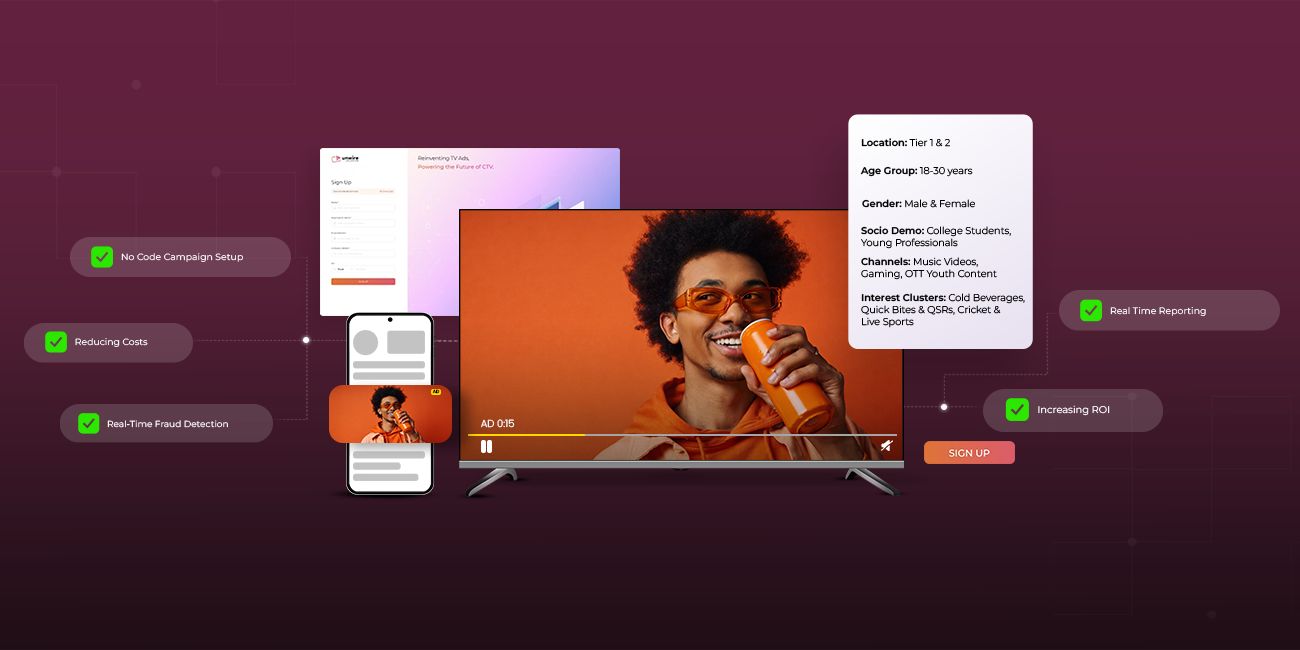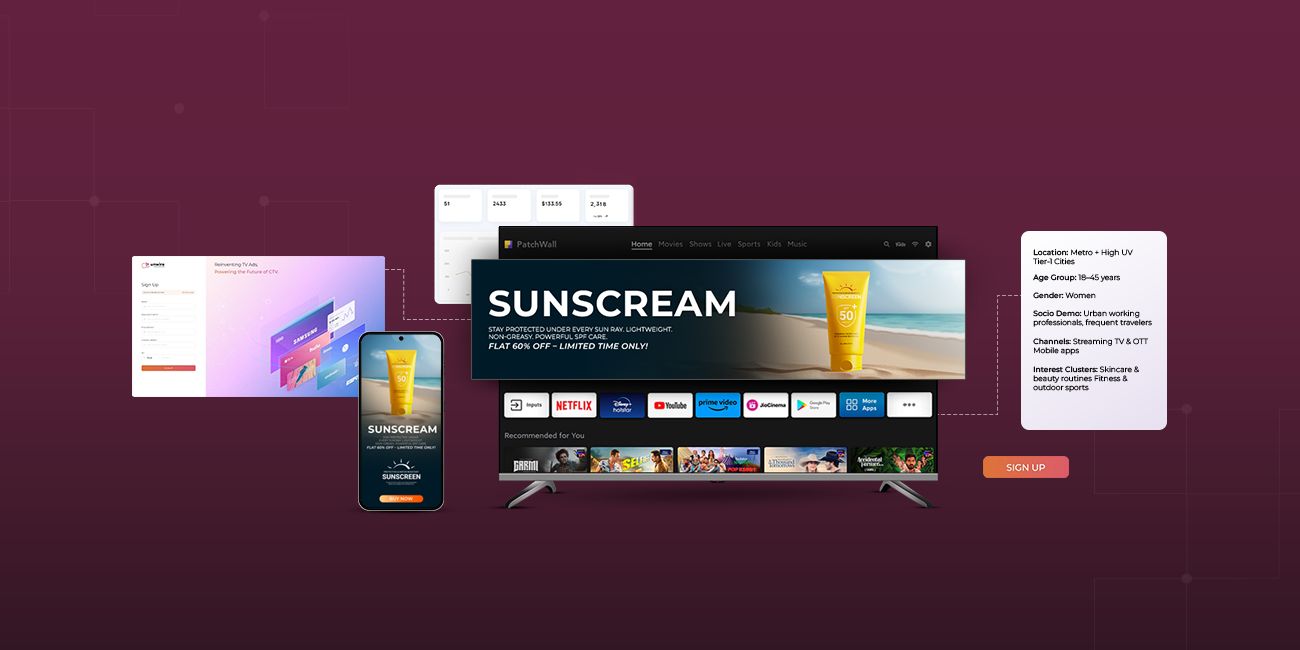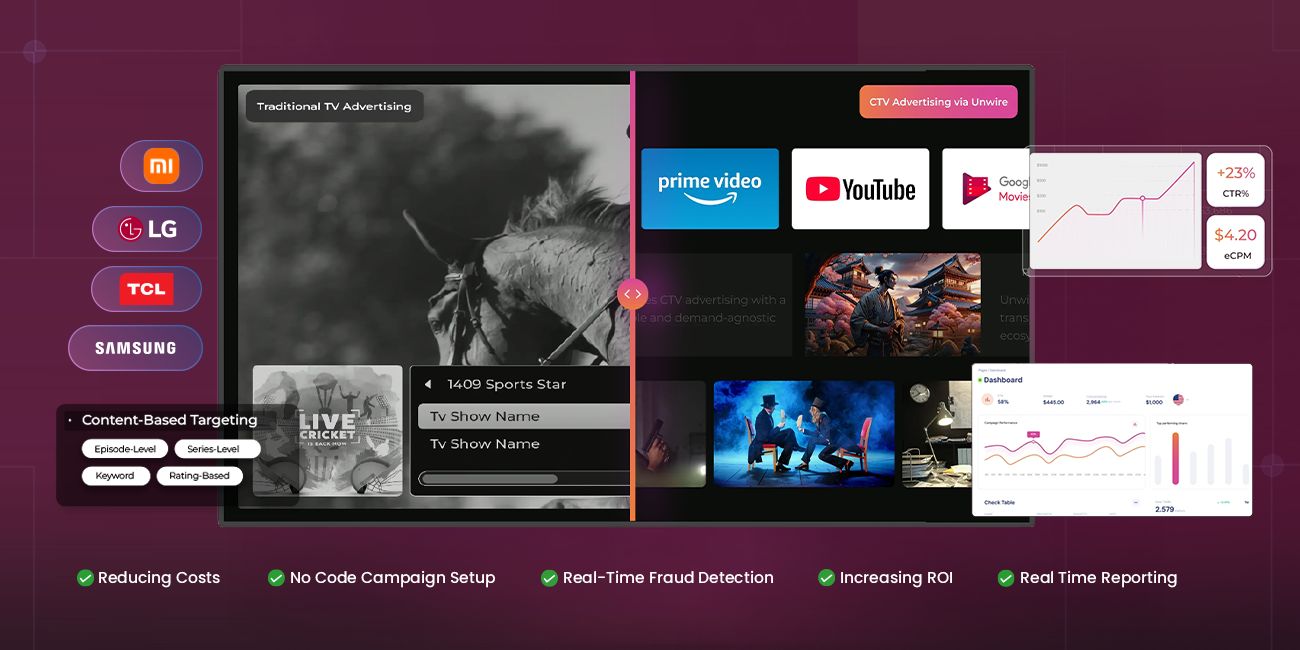
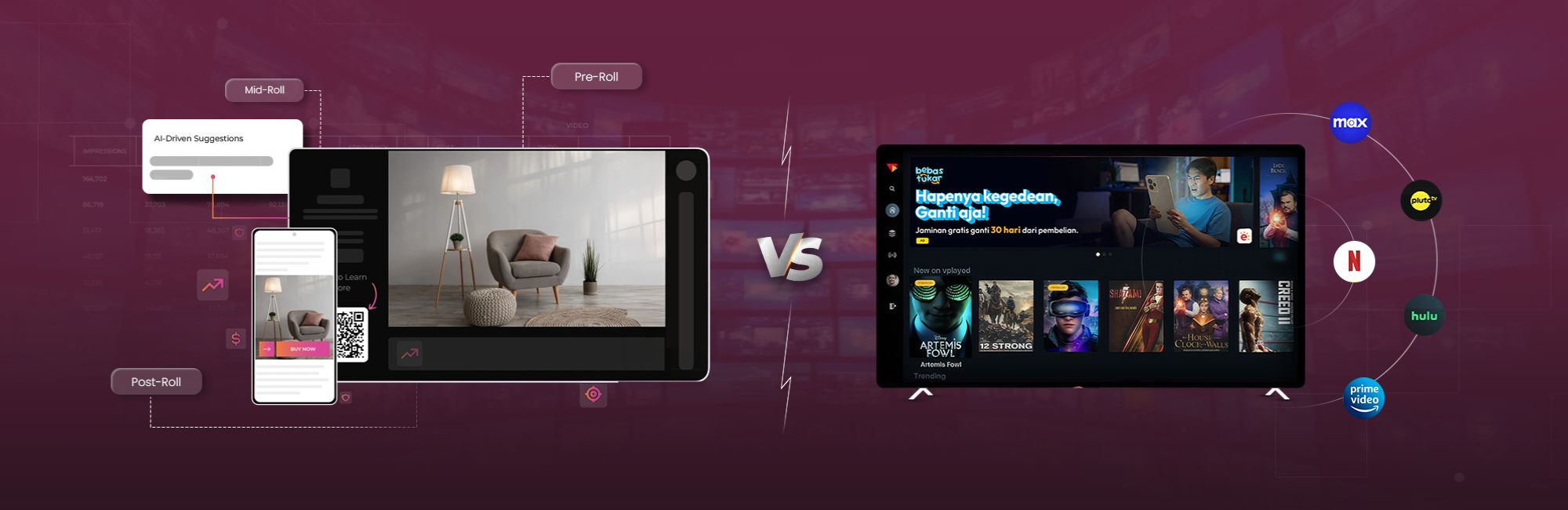
Here is a truth most media plans get wrong: CTV and OTT are not the same thing.
These two terms appear interchangeably in agency decks, vendor pitches, and planning meetings every day. That confusion costs real money. It leads to wrong inventory buys, bloated CPMs, campaigns that miss the right screens, and attribution that does not add up.
According to eMarketer’s December 2025 CTV forecast, US CTV ad spending will increase nearly 14.5% in 2026 to reach $37.95 billion. When budgets this large move into streaming video, knowing the difference stops being a vocabulary lesson and becomes a financial priority.
This guide breaks both terms down clearly — how each channel works, what separates them, and how advertisers and media planners should use each one inside a real media plan, including targeting, measurement, pricing, and a decision framework built specifically for the planning stage.

What is OTT Advertising?
The simple definition of OTT
OTT stands for Over-The-Top. The name comes from how content travels. Instead of moving through a cable or satellite pipe, OTT content rides over the top of the open internet to reach the viewer’s device.
This is the key point: OTT is a delivery method, not a device. Any internet-connected screen can receive OTT content, such as a phone, tablet, laptop, smart TV, or gaming console. The device does not determine whether something is OTT. The delivery path does.
Netflix, Disney+, Hulu, Amazon Prime Video, Peacock, Tubi, and YouTube all deliver content this way. What the viewer watches it on is a separate question entirely.
How OTT advertising works
Advertisers place video ads inside streaming content on OTT platforms. The ad runs before the content starts (pre-roll), during it (mid-roll), or after it ends (post-roll). OTT inventory spans every connected device type simultaneously — mobile phones, tablets, laptops, and television screens all fall under the same umbrella.
Programmatic buying gives advertisers automated access to this inventory across publishers. Demand-side platforms run real-time auctions for each impression. Advertisers define their targeting parameters upfront. The system handles the rest, matching ads to audiences automatically at scale.
The real challenge with OTT is device diversity. The same streaming platform delivers content to a small phone screen and a 65-inch living room TV. These are fundamentally different ad environments. CPMs, completion rates, and brand impact vary widely depending on which device the impression actually lands on — and that distinction matters when evaluating campaign performance.
OTT streaming models advertisers must understand
Not all streaming content runs ads. Before investing in OTT, advertisers need clarity on which streaming models actually provide ad inventory.
SVOD (Subscription Video on Demand) runs on viewer subscriptions. These platforms have historically offered no ads. Netflix premium tier and the original Disney+ tier are examples. The ad-free SVOD model provides zero advertising access.
AVOD (Advertising Video on Demand) monetizes free content through ads. Tubi, Pluto TV, and Peacock Free operate here. AVOD delivers strong reach at lower CPMs — a practical option for scale-focused campaigns.
FAST (Free Ad-Supported Streaming TV) replicates the traditional linear TV experience over the internet. Samsung TV Plus and The Roku Channel are well-known examples. FAST inventory combines programmatic buying with the lean-back TV viewing habit.
TVOD (Transactional Video on Demand) charges per title or rental. Ad inventory here is almost nonexistent. This model rarely appears in media plans for good reason.
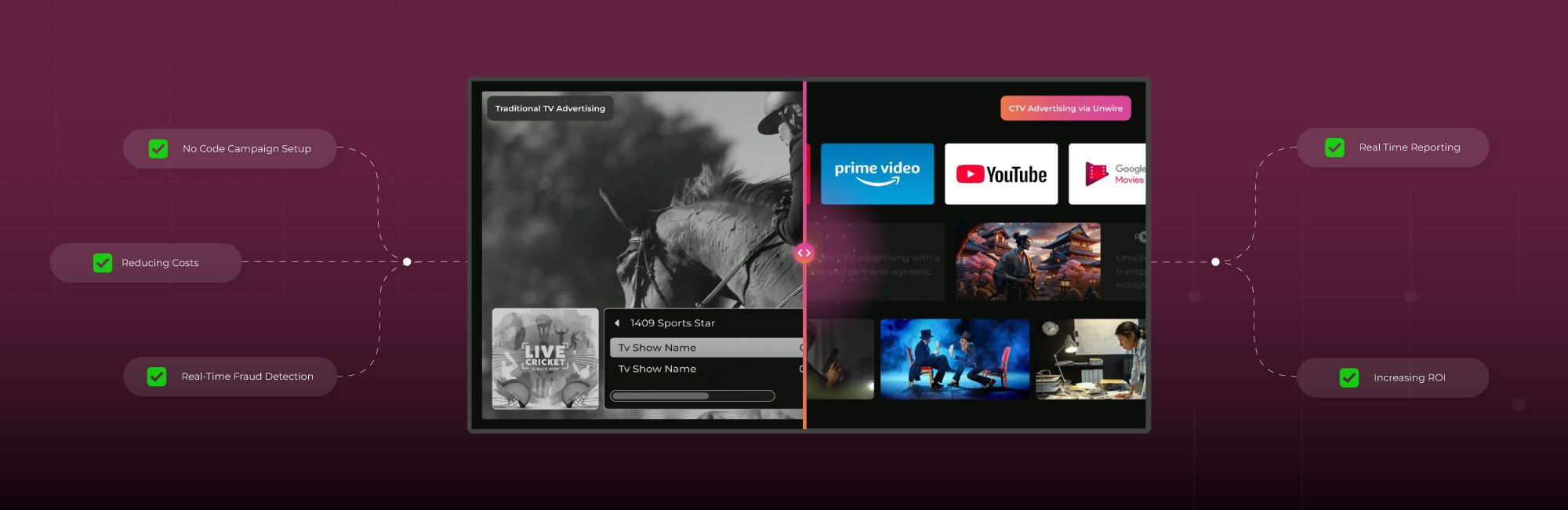
What is CTV Advertising?
The simple definition of CTV
CTV stands for Connected TV. Unlike OTT, CTV refers to the device — specifically, the television itself.
Any TV set that connects to the internet is a CTV device. Smart TVs with built-in apps qualify. Regular TVs with a Roku stick, Apple TV box, Amazon Fire TV, or Chromecast attached also qualify. Gaming consoles like PlayStation and Xbox count too.
CTV is where OTT content lands on the biggest, best screen in the household. Every ad that runs on a streaming service viewed through a connected TV is a CTV ad. The television screen defines the channel. The internet delivery makes it OTT underneath.
How CTV advertising works
Advertisers deliver video ads to viewers watching streaming content on TV screens. The underlying technology is Server-Side Ad Insertion, or SSAI. The platform stitches the ad directly into the video stream before it reaches the device. Viewers have no skip button in most premium environments. Traditional browser-based ad blockers do not apply in CTV environments.
CTV campaigns reach audiences programmatically at scale using real-time bidding (RTB) and Private Marketplace (PMP) deals. RTB automates the auction for individual impressions. PMP deals give brands access to pre-vetted, premium inventory with guaranteed placement quality.
Unwire.tv, the dedicated CTV advertising platform by Xapads Media, uses OTT header bidding: a unified auction model connecting leading video supply-side platforms and direct demand partners in a single real-time environment. This gives advertisers both scale and full transparency in one place.
What actually makes CTV different from every other OTT screen
CTV commands a premium CPM, and that premium reflects real structural differences in the ad environment.
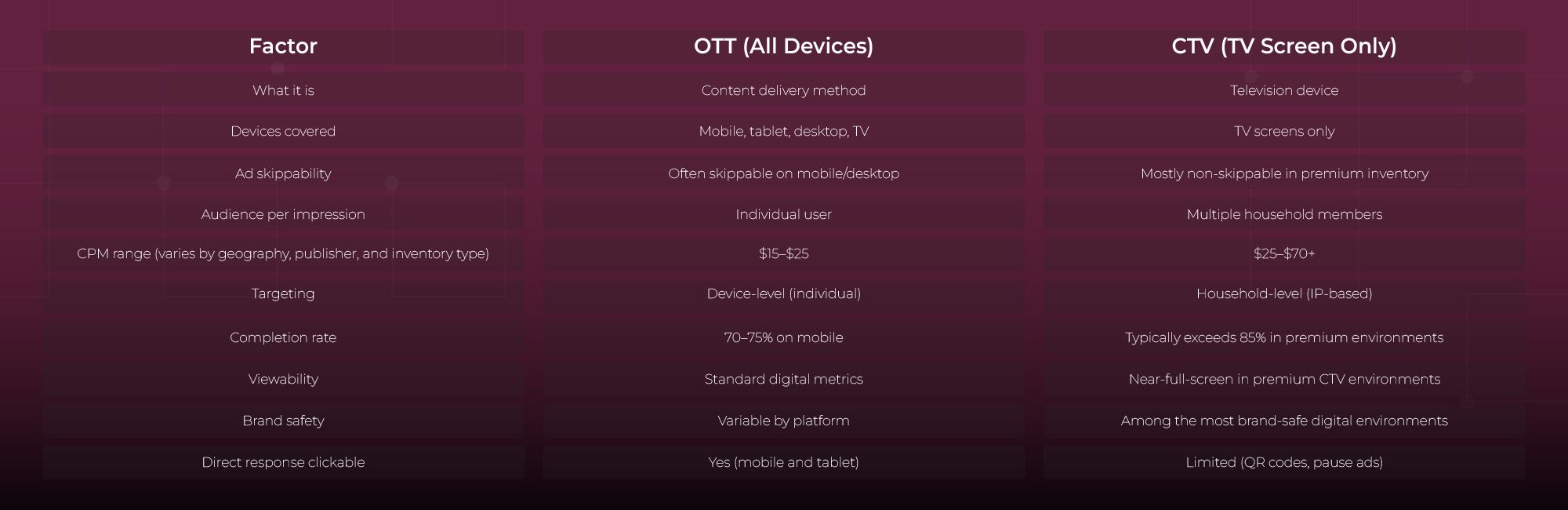
Non-skippable, full-screen delivery is the first factor. Most premium CTV inventory runs through SSAI, where ads are stitched directly into the content stream. Skip buttons are typically unavailable in premium environments. As a result, completion rates in premium CTV regularly exceed 85%, with Unwire.tv recording 85%+ view-through rates across its non-blockable CTV inventory. Mobile video completion rates typically range between 70%–75% by comparison. More of the brand message lands per impression compared to mobile and desktop video environments.
Co-viewing increases the effective reach of every impression. Television remains a shared screen. Industry estimates place the average number of simultaneous viewers per CTV household session between 2.0 and 2.5. One impression reaches everyone in the room — a natural reach multiplier that personal mobile devices cannot replicate.
Lean-back viewing improves attention quality. CTV viewers watch long-form content on the largest screen in the home, in a relaxed and settled environment. Mobile viewing regularly involves multitasking — app switching, notifications, and scrolling on the same device. Multiple attention studies consistently show higher ad recall and stronger brand lift in big-screen lean-back environments compared to small-screen digital video.
The format limits passive ad avoidance. On CTV, viewers cannot open a new browser tab, scroll past the ad, or minimize the screen during playback. While a viewer can leave the room or switch content, the format itself reduces the passive avoidance behaviour that weakens effectiveness across web and mobile video. The ad runs full-screen within premium content, increasing the probability of message retention.
Together, higher completion, co-viewing reach, lean-back attention, and reduced avoidance, these four factors explain why CTV inventory commands higher CPMs than mobile or desktop OTT video.
CTV vs OTT: The Differences Every Advertiser Must Understand
Start with the most important concept in modern video advertising: all CTV is OTT, but not all OTT is CTV.
Think of OTT as the highway. CTV is the premium lane on that highway — the highest-quality, highest-attention slice of the broader OTT ecosystem. Every CTV ad is technically an OTT ad. Most OTT ads are not CTV ads.
The Inventory Quality trap every media planner needs to know about
Some inventory sellers bundle OTT mobile and tablet impressions together with CTV TV screen impressions. Then they price the entire package at CTV CPMs. Advertisers end up paying $30–$50 CPMs for smartphone impressions that deliver a fraction of the brand impact of a true TV screen placement.
This is one of the most common and costly mistakes in programmatic video buying today. Media planners must demand device-level transparency in every CTV or OTT proposal. The one question that exposes the problem: what exact percentage of these impressions will deliver on a TV screen versus a phone or tablet?
Unwire.tv addresses this directly. The platform delivers 99%+ fraud-free inventory verified by both HUMAN and Pixalate — giving advertisers clear, auditable proof of where every impression lands.
OTT and CTV ad Formats: What Runs Where in 2026
The standard video formats that run across both channels
Pre-roll plays before content starts. Mid-roll runs during the content and drives higher completion and stronger brand recall. Post-roll runs after the content ends and typically sees the lowest engagement. Ad pods bundle multiple ads back-to-back inside a single commercial break — standard on CTV, mirroring the traditional TV advertising experience viewers already know.
CTV-specific formats worth knowing in 2026
Pause ads appear when a viewer pauses content. The moment is quiet, unrushed, and highly attentive. The ad sits on screen until viewing resumes. According to eMarketer’s FAQ on CTV advertising formats, pause ads deliver a 34% lift in unaided recall per BrightLine research data. There is no skip option.
Shoppable CTV ads display QR codes directly on the TV screen. Viewers scan with their phone to visit a website or complete a purchase. This format connects big-screen brand building directly to mobile commerce — turning a passive TV moment into a measurable direct-response action.
Interactive overlays let viewers engage using their remote control. Advertisers capture first-party interest signals from the interaction. Engagement data feeds back into campaign optimisation. According to eMarketer’s three forces shaping CTV growth in 2026, interactive ads increase unaided recall by 36%, foot traffic by 13%, and brand affinity by 33% per BrightLine data. 41.8% of advertisers now incorporate interactive and shoppable formats into their CTV strategies.
Home screen placements run on the smart TV home screen before the viewer selects any content. This is a high-intent moment — the viewer has just turned the TV on and has not yet committed to watching anything.
Special ad tabs are branded content sections embedded into the streaming platform interface. They give brands visibility beyond the standard ad break and maintain brand presence throughout the viewing session.
Unwire.tv supports pause screen advertising, home page banner placements, in-stream video ads— covering the full range of premium CTV inventory from a single platform.
OTT formats across mobile, tablet, and desktop
Clickable video ads on phones and tablets send traffic directly to websites or app download pages. Display overlay banners run alongside content without interrupting playback. Interactive mobile video with CTA buttons turns a passive view into an immediate action. FAST channel sponsorships give brands a category-exclusive presence across an entire streaming channel’s content.
CTV vs OTT Targeting: How Advertisers Reach the Right Audiences
What OTT targeting makes possible
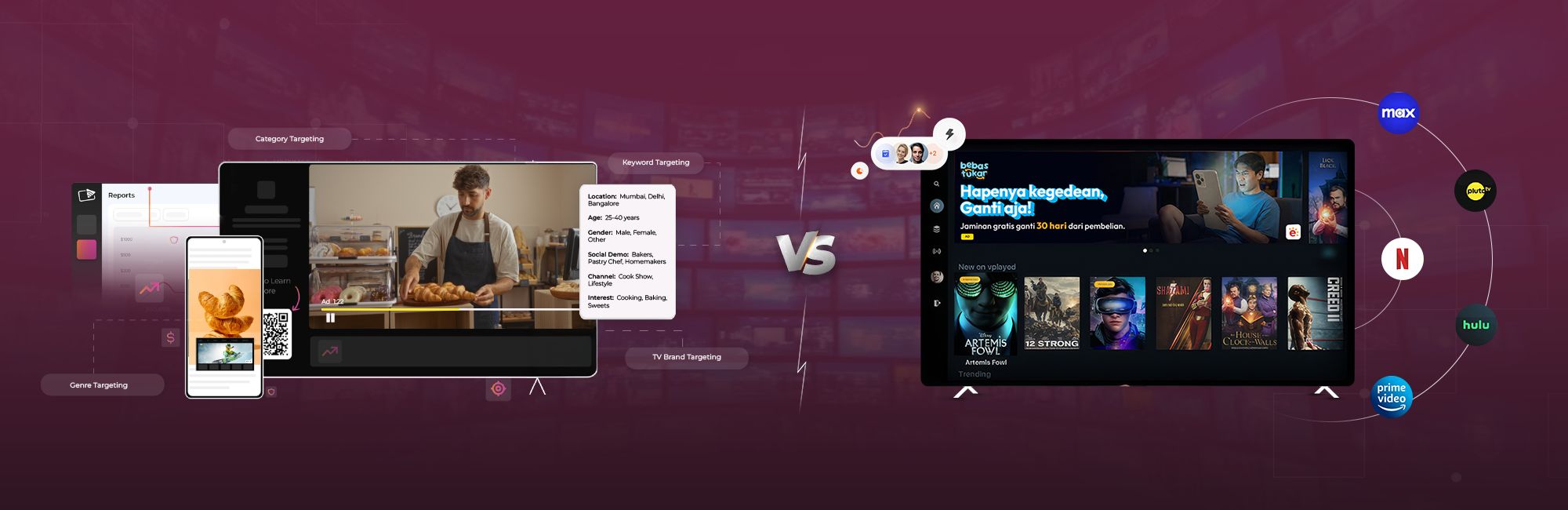
OTT’s strength in targeting comes from device-level data. Advertisers reach specific individuals based on who their device says they are. Demographic targeting covers age, gender, income, and household makeup. Behavioural targeting layers in purchase intent signals and browsing patterns. Geographic targeting drills down to the city and the relevant area level. Retargeting reconnects with users who previously visited a brand’s website or engaged with an app.
What CTV targeting looks like in practice
CTV targeting works at the household level rather than the individual. IP-based signals help platforms recognise devices connected within the same home and treat the household as the audience unit. Advertisers deliver consistent messaging across the primary screen in the household.
Cross-device targeting extends this approach further. Advertisers start with exposure on the TV screen, then reach the same household across phones and tablets. The campaign message appears across screens TV exposure first, followed by reinforcement on mobile devices.
Why contextual targeting is the most important CTV tool in 2026
Traditional cookie-based targeting is becoming less reliable across the broader digital advertising ecosystem. In CTV environments, where browser cookies are not used, contextual targeting provides a privacy-friendly way to match ads with the content viewers are watching.
CTV contextual targeting does not track individual viewers. Instead, it analyses the content itself. Platforms examine genre, programme type, narrative themes, and emotional tone to determine the most relevant ad placement. Ads match the environment the viewer is currently in, not who they were based on past browsing behaviour. A viewer watching a sports programme sees different messaging than one watching a crime documentary. According to Wurl’s CTV statistics report, contextually targeted CTV ads with AI capture four times more attention from viewers than standard placements.
Despite this performance advantage, most advertisers have not made the shift. According to a October 2025 Gracenote report cited by eMarketer, nearly 30% of US marketers prioritise demographic targeting for CTV almost three times more than contextual approaches. Only 11% currently prioritise programme-level contextual targeting. More striking still, over half of advertisers 54.8% report being unfamiliar with contextual advertising entirely, according to eMarketer’s October 2025 CTV targeting research. That gap between performance data and actual adoption represents one of the largest untapped opportunities in programmatic advertising today.
Unwire.tv applies context-based targeting across 20 content categories — Romance, Anime, Crime and Investigation, Family and Kids, Action and Adventure, Sports and Fitness, Documentary, Thriller, Historical Drama, and more. This genre-level precision improves ad relevance and drives stronger brand recall through content intelligence alone.
CTV vs OTT Measurement: How Advertisers Track What Actually Happened
Why CTV measurement works differently
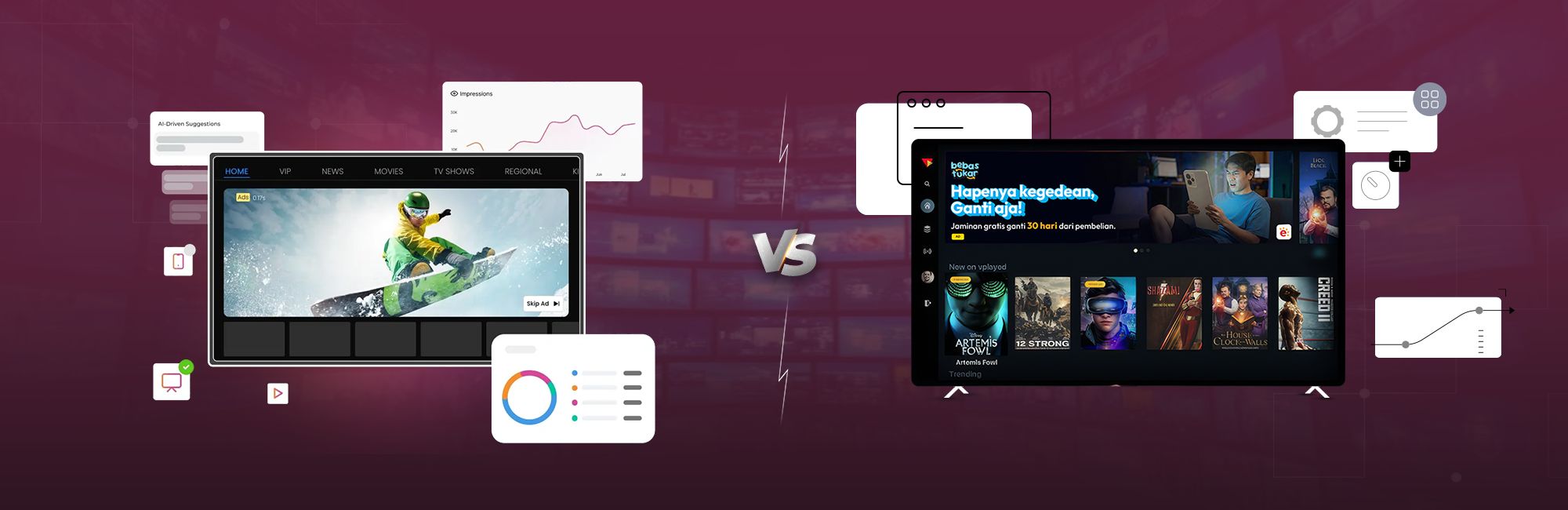
CTV does not behave like standard digital advertising. There is no cursor, no browser tab, and no traditional web conversion pixel on a TV screen. Measurement focuses on reach, frequency, completion, brand recall, and household-level lift — not click-through rates.
In CTV environments, platforms infer viewability through playback confirmation signals. Because the video player renders ads in a full-screen, non-scrollable environment during content playback, premium CTV inventory delivers near-full-screen exposure per impression — eliminating the below-the-fold issues common in web environments.
Completion is tracked through quartile milestones (25%, 50%, 75%, 100%) and full-playback confirmation. Premium CTV environments typically deliver completion rates exceeding 85%, significantly higher than mobile video averages of roughly 70%–75%. That difference in engagement quality is a primary reason CTV commands higher CPMs than other digital video formats.
The metrics that matter on CTV
Reach counts unique households that saw an ad. Frequency tracks how many times each household saw it. View-Through Rate (VTR) captures the percentage of viewers who watched the ad to completion. Brand lift measures the actual change in awareness, recall, or purchase intent among exposed households versus those not exposed. Cross-device attribution connects a TV exposure to a later mobile search, website visit, or app install.
Frequency capping: Why it works differently on CTV versus OTT
OTT frequency capping works at the device level. The platform tracks a specific device ID and limits how many times that device sees the same ad. CTV frequency capping works at the household level. All connected devices sharing the same home IP address count toward the cap together.
When advertisers run campaigns across multiple CTV and OTT publishers without unified cross-publisher frequency management, the same household can see the same creative 10+ times in a single week. Ad fatigue at that level damages brand perception and destroys ROI simultaneously.
Unwire.tv provides real-time reporting dashboards giving media planners live visibility and direct control over frequency across campaigns. Planners see how often each household receives an exposure and adjust caps immediately — no need to wait for end-of-campaign reports.
Where OTT measurement has the advantage
OTT’s click-enabled formats on mobile and tablet generate direct, individual-level attribution data. Advertisers measure click-through rates, app install events, website visits, and completed purchases. Device IDs enable retargeting sequences from campaign data. Programmatic platforms surface all of these metrics in real time — making OTT mobile easier to connect to direct-response KPIs than CTV.
CTV vs OTT Pricing: What Advertisers Pay in 2026
CPM benchmarks across channel types
CPM ranges vary by geography, publisher, platform, and inventory type. The benchmarks below represent general market reference points.
Cable TV delivers a broad reach, typically in the $15–$20 CPM range. National broadcast primetime inventory sits significantly higher, averaging $40–$50+ CPM, though targeting flexibility remains minimal across both. According to Marketing Dive’s August 2025 upfront analysis, cable CPMs averaged $19.35 and broadcast prime-time averaged $43.50 in the 2025 upfront season. OTT across mobile, tablet, and desktop inventory typically prices between $15–$25 CPM, with FAST channels at the lower end of that range. Premium CTV inventory on major streaming platforms generally runs $25–$40 CPM for programmatic buys, with premium direct and PMP deals on top-tier supply commanding $40–$65+ CPM, according to Keynes Digital’s CTV rate analysis.
Why CTV’s Premium CPM reflects real value
Most premium CTV impressions play through without a skip option, resulting in near-complete exposure under normal viewing conditions. Near-full-screen delivery removes the viewability concerns common in web environments. Co-viewing means one CPM impression can reach multiple household members simultaneously. Premium content adjacency delivers brand safety among the highest levels available in digital advertising. Higher completion rates mean each dollar of CTV spend delivers more brand message per impression than other comparable video formats.
According to eMarketer’s CTV ad spending research, US CTV ad spending will reach $46.89 billion by 2028, surpassing traditional TV ad spending for the first time. The growth trajectory reflects increasing advertiser confidence in the channel’s measurable performance.
When OTT’s lower CPM makes more strategic sense
Lower CPMs on OTT mobile and desktop inventory enable brand awareness reach at scale when campaign budgets are limited. Retargeting individual users after CTV brand exposure costs significantly less on mobile OTT. Direct-response campaigns that require clickable formats depend on mobile and tablet OTT. Testing creative on OTT mobile inventory before committing to premium CTV placements is a practical way to reduce financial risk before scaling.
Where CTV and OTT sit inside the Marketing Funnel in 2026
CTV: One of the strongest digital channels for brand awareness
CTV sits at the top of the marketing funnel. Non-skippable format, near-full-screen environment, and household-level reach make it one of the strongest digital channels for building brand awareness at scale. CTV creates the mental availability that shapes purchase consideration days, weeks, and sometimes months after the initial exposure.
According to eMarketer’s CTV viewing time forecast, average time spent per day with CTV will increase to nearly three hours in 2026, while time spent with traditional TV continues falling toward just two hours. For brand advertisers, the audience migration is already well underway.
OTT: The bridge between awareness and action
OTT’s multi-device footprint lets it serve multiple funnel positions at once. At the top, it extends the CTV brand reach to additional screens and additional individuals. In the middle, it reinforces consideration with targeted messaging. At the bottom, clickable formats on mobile and tablet drive direct-response actions.
Sequential messaging brings both channels together effectively. Campaigns start with CTV brand awareness on the big screen. Mobile OTT retargeting follows for the same households. The combined sequence moves audiences from first exposure to measurable conversion — consistently outperforming either channel used in isolation.
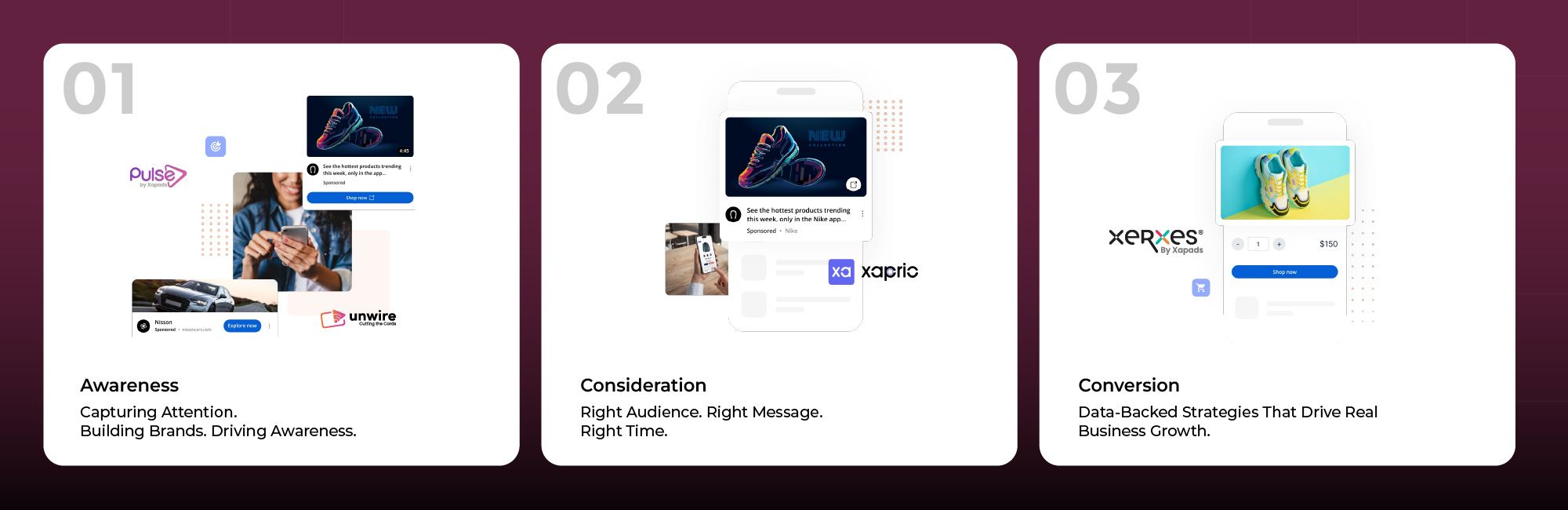
How a Full-Funnel Advertising Ecosystem Looks in Practice
Understanding the difference between CTV and OTT solves only part of the streaming challenge. The larger question is how to connect these channels inside a single campaign structure. Many streaming campaigns underperform not because the channels are wrong, but because they operate independently.
CTV delivers large-screen brand exposure inside premium streaming environments. OTT extends that message across mobile, tablet, and desktop screens. When these channels run without coordination, campaigns lose continuity. A household sees the brand on their TV screen one day. A disconnected mobile ad appears days later with no link to what came before. The impression is wasted.
Advertisers running full-funnel streaming campaigns treat CTV and OTT as connected stages not separate line items. Television screens build initial awareness. Additional digital channels reinforce brand exposure and drive measurable performance outcomes. This connected structure is what turns streaming investment into business results.
Xapads Media built a complete advertising ecosystem across 1.9B+ audiences in 245+ countries. The platform portfolio maps directly onto the funnel structure media planners need.
Awareness — CTV: Unwire.tv delivers programmatic CTV campaigns with 120M+ global reach and 85%+ view-through rates with non-blockable video ads. Full-screen playback environments and inferred viewability confirmation support every campaign. Context-based targeting by content genre and programme type makes every impression relevant to what viewers are watching in that moment.
Awareness — YouTube: PulseVid.ai handles YouTube-specific contextual targeting and brand safety. The platform analyses YouTube content at the frame level, scanning for keywords, themes, visuals, and sentiment. This process ensures brand-safe placements that meet GARM standards.
Consideration — Omnichannel Branding: Xaprio runs omnichannel branding campaigns across CTV, OEM, Native, Display, and Video — all from a single platform. Xaprio delivers 2x brand recall lift through 50+ rich media ad formats. Average engagement runs 7.4 seconds per session, 3.2x longer than static banner formats.
Conversion — Mobile Performance: Xerxes powers mobile performance campaigns, app installs, CPI, and CPA. The platform connects to 18K+ websites, 25K+ mobile apps, and 50+ SSPs. Xerxes reaches 472M+ monthly active users in India, 212M+ in Southeast Asia, 122M+ in the Americas, and 105M+ in Europe.
Each platform handles a distinct role. Awareness builds on the largest screen. Consideration reinforces across channels. Conversion drives action on mobile.
The Future of CTV vs OTT Advertising: 2026 to 2030
Interactive and shoppable CTV formats move from optional to standard
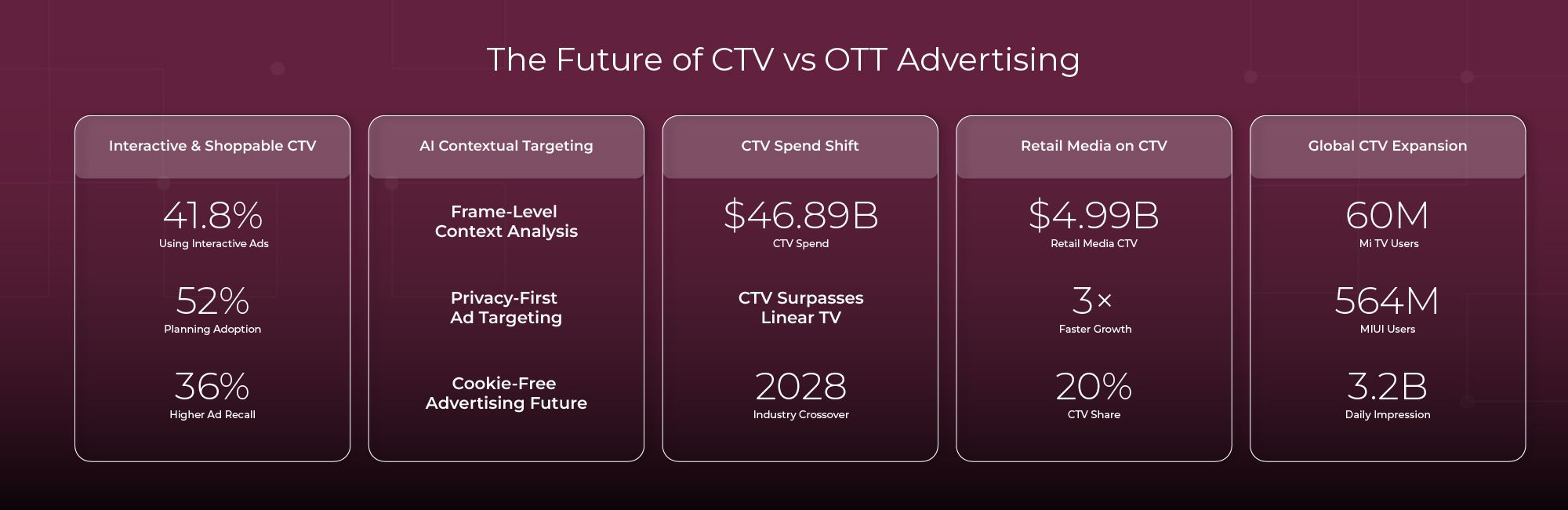
Shoppable overlays, QR code integrations, and pause-screen purchase flows transform CTV from a pure awareness channel into a full-funnel performance medium. According to eMarketer’s three forces shaping CTV growth, 41.8% of advertisers already incorporate interactive and shoppable formats into their CTV strategies, with 52% expecting to use them. Interactive ads increase unaided recall by 36% and brand affinity by 33% per BrightLine research. Media planners who develop familiarity with these formats in 2026 gain a real lead over competitors still treating them as experimental.
AI-powered contextual targeting replaces cookie-based systems
Privacy regulation continues eroding the reliability of third-party cookie data. AI-powered Zcontextual targeting is the most sustainable replacement. AI tools analyse video content at the frame level — detecting genre, emotional arc, visual context, dialogue themes, and audio sentiment. Ads match what viewers are currently watching, not who they were based on last month’s browsing data. The approach delivers privacy compliance and advertising effectiveness simultaneously.
Unwire.tv already operates this model in production. Context-based targeting by programme type and content genre places brands in environments that match their audience’s current mindset — with zero reliance on personal tracking data.
CTV ad spend crosses linear TV before 2028
According to eMarketer’s CTV ad spending forecast, US CTV ad spend will reach $46.89 billion by 2028 — surpassing traditional TV advertising’s projected $45.10 billion that same year, for the first time in history. The transfer of TV budgets from broadcast to digital is actively happening in every media planning conversation today.
Media planners who build CTV expertise and platform relationships in 2026 arrive at that crossover with structural advantages. Brands that delay face higher CPMs, tighter inventory availability, and a steeper learning curve.
Streaming consolidation simplifies CTV buying
Major streaming platforms continue consolidating. According to eMarketer’s FAQ on CTV advertising trends, the Disney+/Hulu integration in 2026 will combine two of the largest ad-supported streaming audiences. Fewer primary destinations reduce the fragmentation that has historically made CTV media planning complicated. Programmatic buying platforms and header bidding solutions grow more important as the primary aggregation layer — the infrastructure Unwire.tv provides through its unified OTT header bidding model.
Retail media turns CTV into a closed-loop attribution channel
According to eMarketer’s retail media CTV research, retail media CTV ad spend stood at $4.99 billion in 2025 and is growing roughly three times faster than retail media search. According to eMarketer’s retail media forecast chart, retail media is on track to make up one-fifth of total CTV ad spending by 2028. Retailers connect streaming ad exposure directly to verified purchase data — creating television advertising’s first real closed-loop attribution. Advertisers who enter retail media CTV early gain measurement advantages that late arrivals cannot recreate retroactively.
Global CTV growth accelerates beyond the US
Most content on this topic focuses exclusively on the US market. Global CTV reality tells a different story.
CTV adoption accelerates across Southeast Asia, India, the Middle East, and Latin America. Smart TV device prices fall steadily. Affordable broadband expands the connected TV audience in markets that traditional advertising infrastructure largely missed.
OEM TV advertising opens CTV-adjacent inventory at scale in these regions. Mi.Xapads reaches 60M+ monthly unique digital users on Mi TV across 106 countries, delivering big-screen inventory in markets where mi.xapads.com dedicated CTV platforms still have a limited footprint. The broader Mi.Xapads ecosystem reaches 564M MIUI monthly active users across 272 countries and regions, with 3.2 billion average daily impressions. Regional audiences include 133M in India, 104M in Europe, 59M in Southeast Asia, 56M in Latin America, and 23M in the Middle East. Advertisers who invest in global CTV and OEM TV today can reach audiences that many media plans still overlook.
When to use CTV vs OTT: A practical decision guide for media planners
When CTV is the right channel
Brand awareness is the primary campaign objective. The target audience is household-based. Automotive, financial services, home improvement, family products, and consumer packaged goods all fit naturally here. Campaign budgets support premium CPM levels. The brief requires non-skippable, high-completion formats that reliably deliver the full message. Content adjacency and brand safety certification are non-negotiable requirements. The campaign targets cord-cutters who no longer watch traditional linear TV.
When OTT Multi-device is the right channel
Budget efficiency takes priority over premium environmental quality. The campaign needs clickable, attributable direct-response actions from individual users. Retargeting existing website visitors or app users at lower CPMs makes economic sense for the brief. Individual-level targeting delivers more value than household-level reach for this specific objective. Creative needs testing before committing to premium CTV CPMs. The strategy centres on mobile-first formats.
When Both Channels Work Best Together
Some campaigns require both channels to work in sequence. CTV builds brand awareness on the television screen first. OTT placements then reinforce that message across phones and tablets within the same household.
Advertisers combine both channels when the campaign needs big-screen visibility and measurable digital response together. The strategy starts with TV-level reach and continues across personal devices where action happens.
Common Mistakes Advertisers Must Stop Making in 2026
Paying CTV prices for OTT mobile inventory. Demand device-level reporting on every proposal. Ask specifically what percentage of impressions will land on TV screens versus phones and tablets. Any vendor that cannot answer clearly is likely bundling inventory at inflated prices.
Ignoring frequency management across publishers. Without unified cross-publisher caps, the same household can see the same creative 10+ times inside a single campaign window. Ad fatigue at that level damages brand perception and ROI simultaneously. Use platforms with unified frequency controls across all publishers from one dashboard.
Treating CTV as a standalone channel. CTV awareness campaigns generate stronger outcomes when connected to downstream digital channels. CTV exposure combined with mobile retargeting sequences produces attributable results that CTV alone cannot show.
Relying on demographics and skipping contextual targeting. Demographics reach the right person. Context reaches that person in the right mindset at the right moment. Both together outperform either alone. Genre-level contextual targeting on CTV drives stronger brand recall because the ad fits naturally into the viewing moment.
Measuring CTV with linear TV metrics. CTV is digital television, not broadcast. Gross Rating Points and reach-and-frequency models built for broadcast miss most of what makes CTV valuable. Measure it with digital KPIs: unique household reach, view-through rate, brand lift, and cross-device attribution.
Conclusion
OTT is the delivery method. CTV is the premium television screen that receives OTT content. These two things are related, but they are not interchangeable. Every media plan that treats them as the same thing decreases their true potential.
The framework for 2026 is clear. CTV builds brand awareness and household-level impact. OTT multi-device drives direct response and individual retargeting. Together in sequence, they move audiences from first exposure to measurable action across every screen.
According to eMarketer’s December 2025 CTV spending forecast, US CTV ad spending reaches $37.95 billion in 2026, on track to cross linear TV total spend before 2028. The growth trajectory reflects increasing advertiser confidence in the channel’s measurable effectiveness.
The next five years bring interactive CTV at scale, AI-powered contextual targeting, retail media attribution, and rapid global adoption across emerging markets. Advertisers who treat CTV and OTT as distinct strategic tools, not synonyms, are already ahead of those who do not.
Related Post