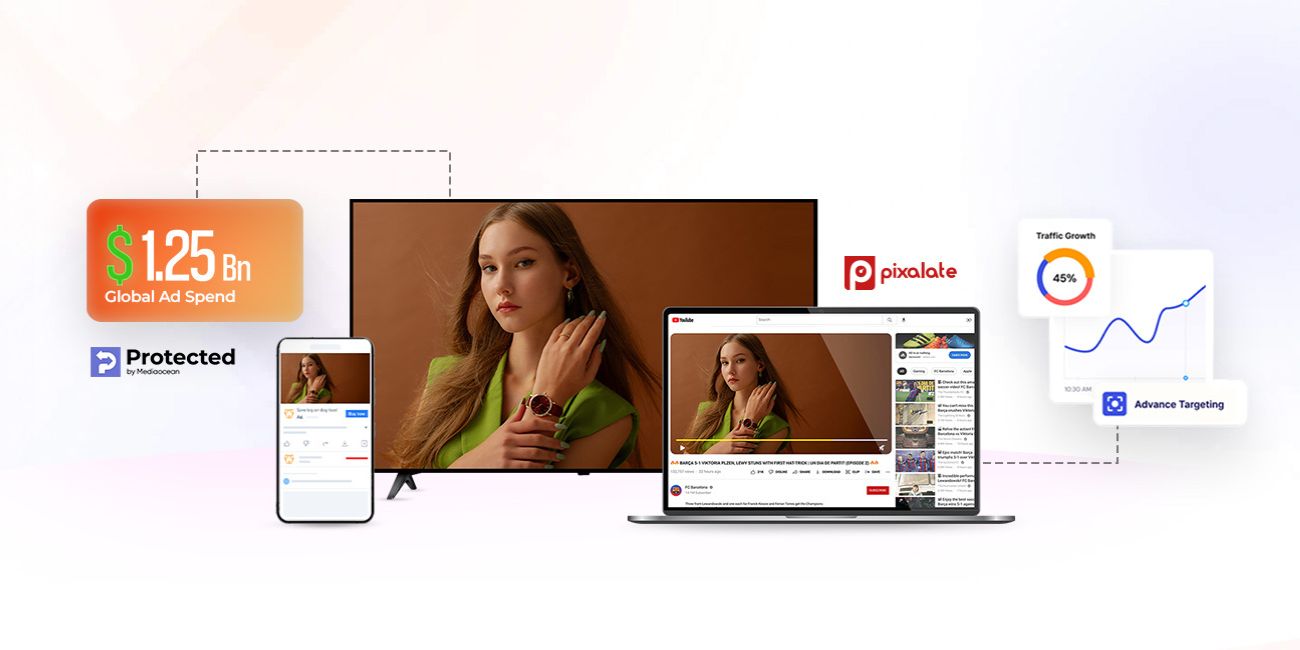
Programmatic ad buying now runs thousands of auctions per second across websites, apps, streaming services, and connected TVs. Every auction decides which ad gets served, at what price, to which audience, in real time. In 2026, this automated buying method accounts for roughly 90% of all digital display ad budgets globally. The global programmatic display market stands at USD 106.4 billion in 2026 and is projected to reach USD 959.7 billion by 2036, growing at a CAGR of 24.6%. Mobile programmatic commands 62.20% of all programmatic impressions, and CTV programmatic spend in the US is tracking toward $38 billion this year, up 14% year over year.
Most setup guides explain what programmatic advertising is, but leave out the hard parts. They skip the step-by-step process, the channel-specific setup requirements, brand safety configuration, and what to do after a campaign goes live. This guide closes those gaps. It covers the full setup process from goal definition to post-launch optimization, with channel-by-channel guidance for CTV, mobile, YouTube, and omnichannel campaigns. It also covers where the industry is heading from 2026 to 2030.
What Is Programmatic Ad Buying? The Simple Version
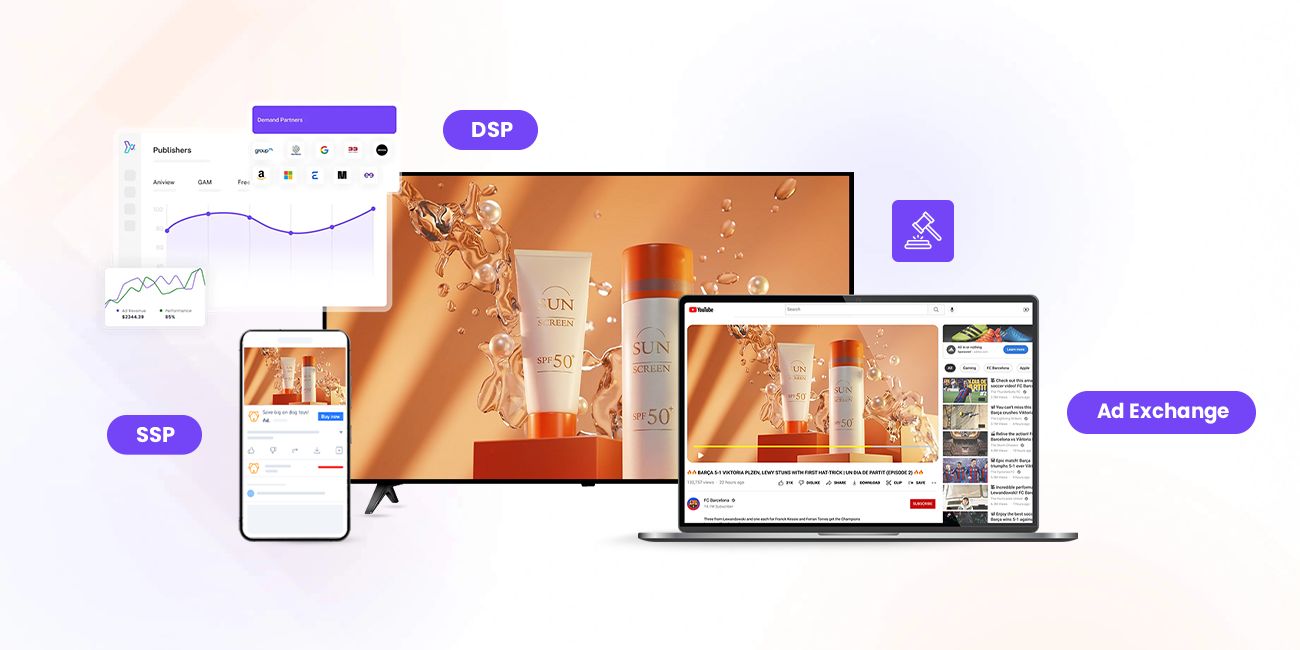
Programmatic ad buying is the automated process of purchasing digital advertising inventory. Instead of negotiating rates manually with publishers, advertisers use a demand-side platform (DSP) to bid on ad impressions in real time. Software handles bid evaluation, targeting, and creative delivery. Campaigns run simultaneously across thousands of websites, apps, streaming services, and connected TVs without manual transactions.
Programmatic buying gives advertisers scale and precision that direct media buying cannot match. Campaigns reach defined audience segments at the right moment and price, automatically, across every digital channel.
How a Programmatic Auction Works in Under 100 Milliseconds
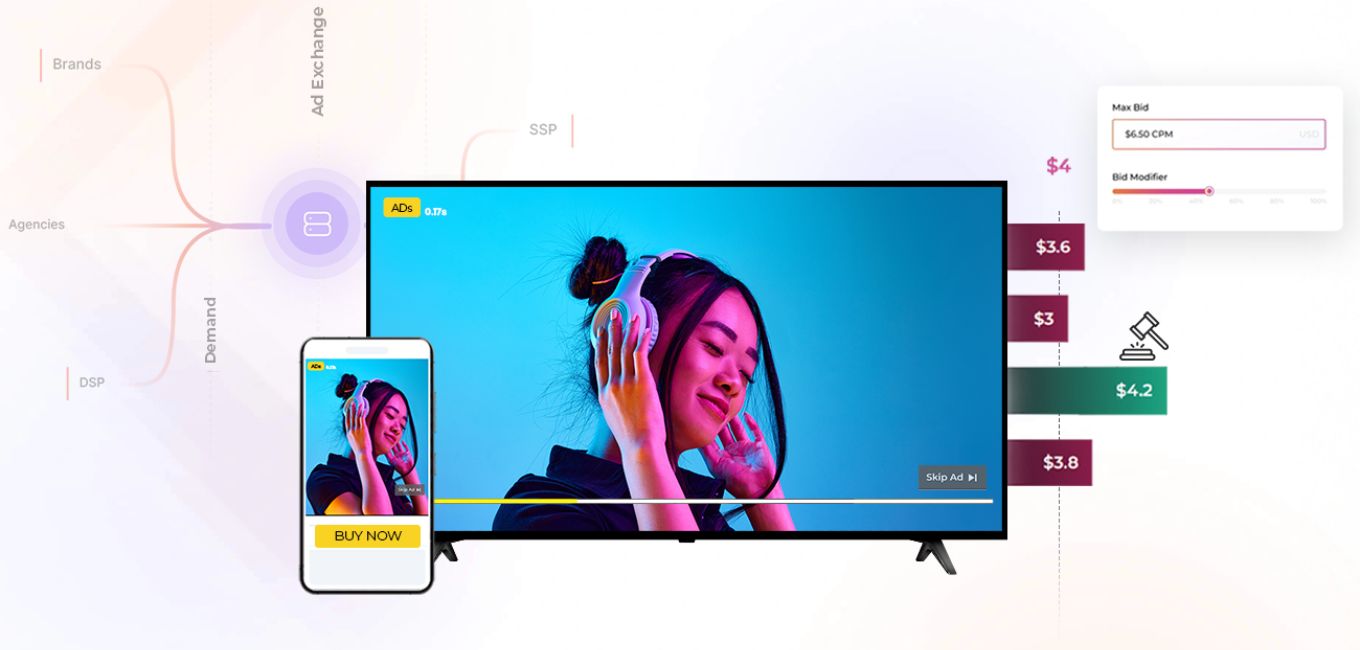
When an ad opportunity is identified on a webpage, app, or streaming service, an auction runs in the background. The full process completes in 50 to 100 milliseconds:
- The publisher’s supply-side platform (SSP) identifies available inventory and sends a bid request to connected ad exchanges.
- Ad exchanges broadcast the impression opportunity to all connected DSPs.
- Each DSP evaluates the impression using audience data, contextual signals, and campaign targeting rules.
- DSPs return bids. Th98
e exchange runs the auction and selects the highest valid bid.
- The winning ad creative is delivered to the placement. The campaign impression is recorded.
The process completes before the page finishes loading. This speed is why programmatic systems process millions of ad opportunities every second across global inventory.
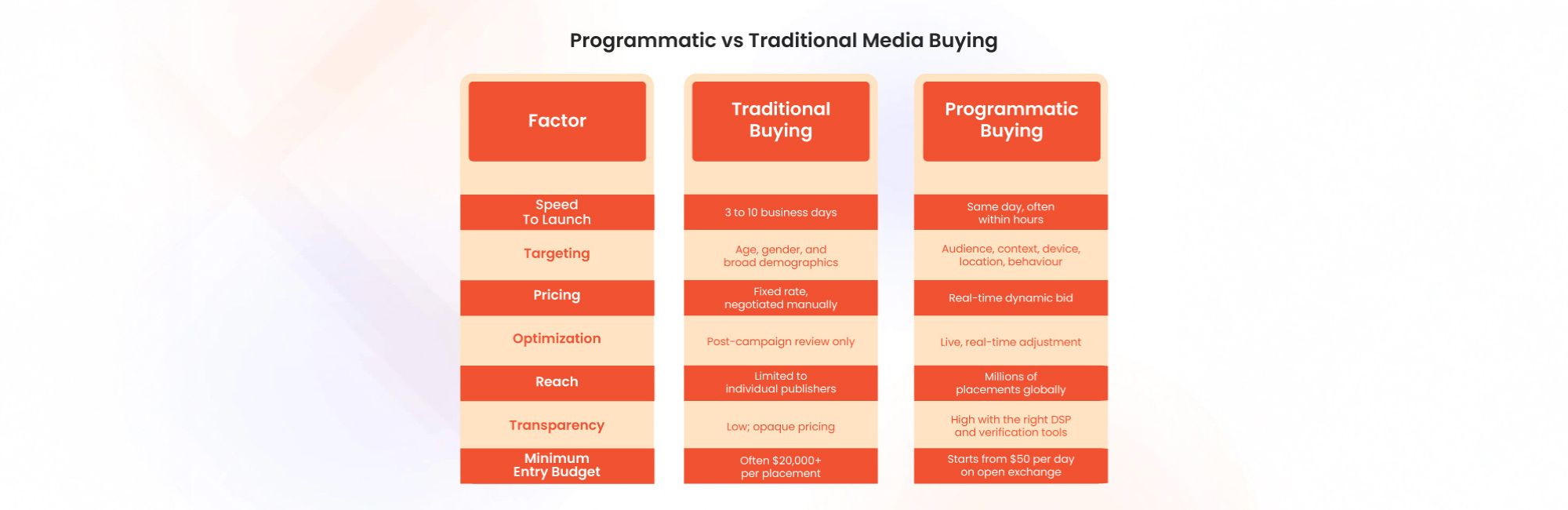
Programmatic vs Traditional Media Buying
Why Programmatic Buying Matters More in 2026
Key Market Numbers
The programmatic market in 2026 reflects a significant structural shift in how advertising budgets are allocated. According to eMarketer, US programmatic ad spend has crossed $200 billion for the first time. The overall global programmatic advertising market is estimated at USD 0.72 trillion in 2026 according to Mordor Intelligence, and is projected to reach USD 1.17 trillion by 2031 at a CAGR of 10.34%. Real-time bidding holds 41.30% of that market share. Programmatic Guaranteed is the fastest-growing segment at a CAGR of 24.15% through 2031.
- Mobile programmatic accounts for 62.20% of all programmatic impressions worldwide. Mobile video contributes 55% of total programmatic display revenue.
- CTV programmatic spend in the US is estimated at $38 billion in 2026, growing 14% year over year, and is forecast to surpass traditional TV ad spending by 2028.
- Programmatic now accounts for nine out of every ten dollars spent on digital display advertising globally.

Why Advertisers Are Shifting Budgets to Programmatic
Programmatic buying delivers measurable outcomes at a scale that direct media buying cannot match. Campaigns reach defined audience segments across display, video, CTV, mobile, and OEM inventory simultaneously from a single platform interface. Underperforming placements are cut automatically. Reporting is instant and transparent. Budget waste decreases with every optimization cycle.
The second driver is cookieless readiness. Third-party cookies are declining across major browser platforms in 2026. Programmatic platforms built on contextual intelligence, publisher-provided identifiers, and owned audience data are gaining share over those that relied on cross-site tracking. Advertisers who build the right stack now will carry a structural targeting advantage into 2030.
The third driver is channel expansion. Programmatic has moved well beyond web display. CTV, mobile OEM, digital audio, and digital out-of-home (DOOH) all transact programmatically today. Advertisers running a unified programmatic strategy across channels gain better frequency control, stronger audience consistency, and cleaner attribution than those managing channels in isolation.
The 5 Key Players in the Programmatic Ecosystem

Every programmatic transaction passes through a defined set of technology layers. Understanding each role helps advertisers select the right partners, eliminate tech overlap, and reduce fraud exposure.
DSP: The Buyer’s Control Room
A demand-side platform (DSP) is where advertisers manage and optimize campaigns. DSPs connect to multiple ad exchanges and SSPs simultaneously, giving buyers access to inventory across thousands of publishers in one interface. Targeting rules, bid strategies, budget pacing, creative trafficking, and frequency caps all operate inside the DSP. Campaign optimization decisions happen here. Specialized DSPs built for specific channels consistently outperform generalist platforms because their bidding logic, inventory connections, and data signals are tuned to that environment.
SSP: The Publisher’s Revenue Engine
A supply-side platform (SSP) manages the publisher side of the transaction. SSPs collect available ad inventory, set price floors, and send bid requests to ad exchanges. Publishers use SSPs to control which buyers access their inventory, configure deal structures including private marketplace and programmatic guaranteed, and maximize revenue per impression. The quality of an SSP’s publisher relationships directly determines the quality of inventory available to buyers on that exchange.
Ad Exchange: Where Bids Are Decided
An ad exchange is the neutral marketplace connecting DSPs and SSPs. When inventory becomes available, the SSP sends it to the exchange. The exchange broadcasts it to connected DSPs. Each DSP evaluates and places a bid. The exchange runs the auction, identifies the winner, and triggers delivery. The exchange does not hold inventory; it only facilitates the real-time transaction between buyer and seller.
DMP and CDP: The Data Intelligence Layer
A data management platform (DMP) organizes audience data from multiple sources into targetable segments. A customer data platform (CDP) connects owned data sources including CRM records, app behavioral data, and transaction history into unified audience profiles. In 2026, CDPs carry more strategic value than DMPs because they activate audience intelligence built from owned data rather than third-party identifiers. Advertisers who connect a CDP to their DSP build deterministic audience segments that consistently outperform probabilistic third-party data on every programmatic channel.
Ad Verification and Brand Safety Tools
Brand safety tools filter fraudulent, low-quality, and contextually unsafe placements before a bid is placed. Verification providers such as HUMAN and Pixalate check impressions for bot traffic, domain spoofing, ad stacking, and invalid inventory at the signal level. This verification layer applies to every programmatic channel. On CTV campaigns, platform-native verification delivers fraud-free inventory without requiring separate third-party tools on every campaign.
Types of Programmatic Buying: Which Model Fits the Campaign Goal?
Programmatic buying is not a single transaction type. Advertisers select from four distinct models depending on campaign objectives, budget, and required inventory quality. Choosing the wrong model wastes budget even when targeting is precise.
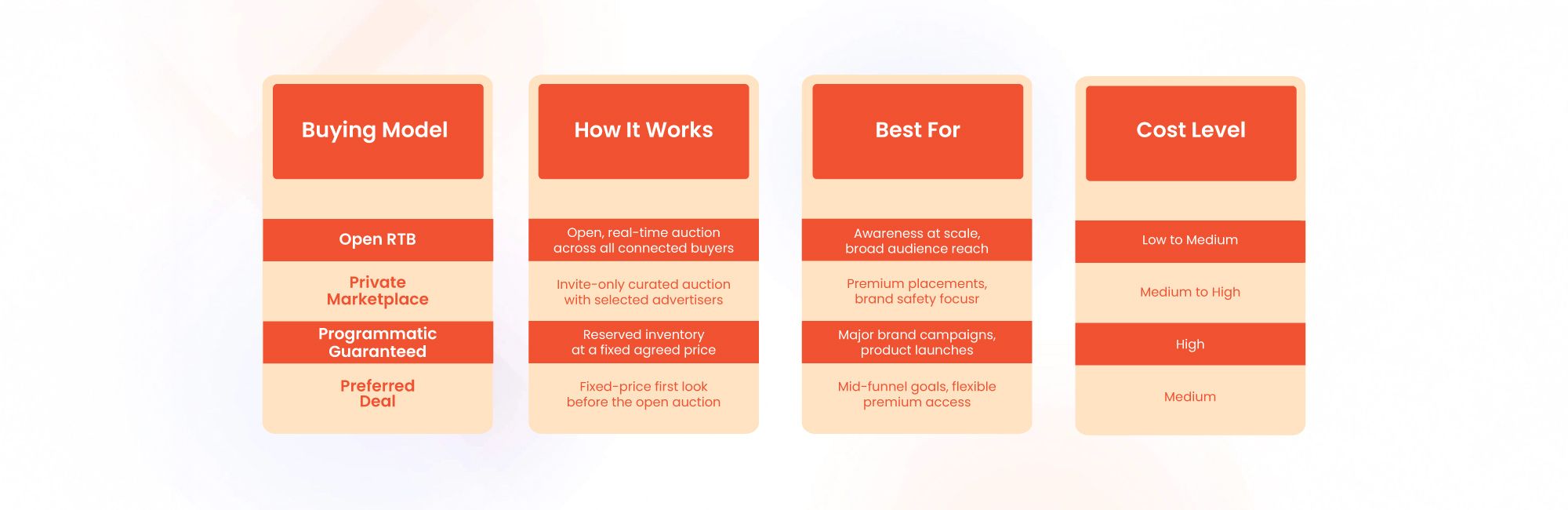
Open RTB: Open Auctions
Open RTB is the foundation of programmatic buying. Inventory sells on an open exchange to the highest bidder in real time. Open RTB offers the widest reach, lowest average CPMs, and broadest access to global inventory. The tradeoff is limited placement quality control. Open RTB suits awareness and prospecting campaigns where scale and cost efficiency matter more than placement exclusivity.
Private Marketplace: Invite-Only Premium
A PMP is a curated auction where publishers invite selected advertisers to bid on premium inventory before it reaches the open exchange. PMPs deliver better brand safety, higher viewability, and more control over ad placement context. CPMs run higher than open RTB, but impression quality and performance consistency are significantly better. PMPs suit mid-funnel brand campaigns and storytelling formats where placement environment directly affects recall.
Programmatic Guaranteed: Reserved Premium
Programmatic Guaranteed combines the commercial certainty of traditional direct buying with the delivery efficiency of programmatic infrastructure. Advertisers and publishers agree on a fixed CPM and reserved inventory volume. Delivery runs programmatically but the deal terms are locked. PG suits major product launches, seasonal activations, and brand campaigns where inventory certainty is non-negotiable.
Preferred Deal: Fixed Price, First Right
A preferred deal gives one advertiser first look at publisher inventory at a fixed CPM. The advertiser accepts or passes the impression. Unsold inventory flows to a PMP or open exchange. Preferred deals balance premium access with flexibility because there is no volume commitment required. They work well for advertisers who need reliable access to specific publisher environments without a full inventory reservation.
Step-by-Step Programmatic Ad Buying Setup Guide
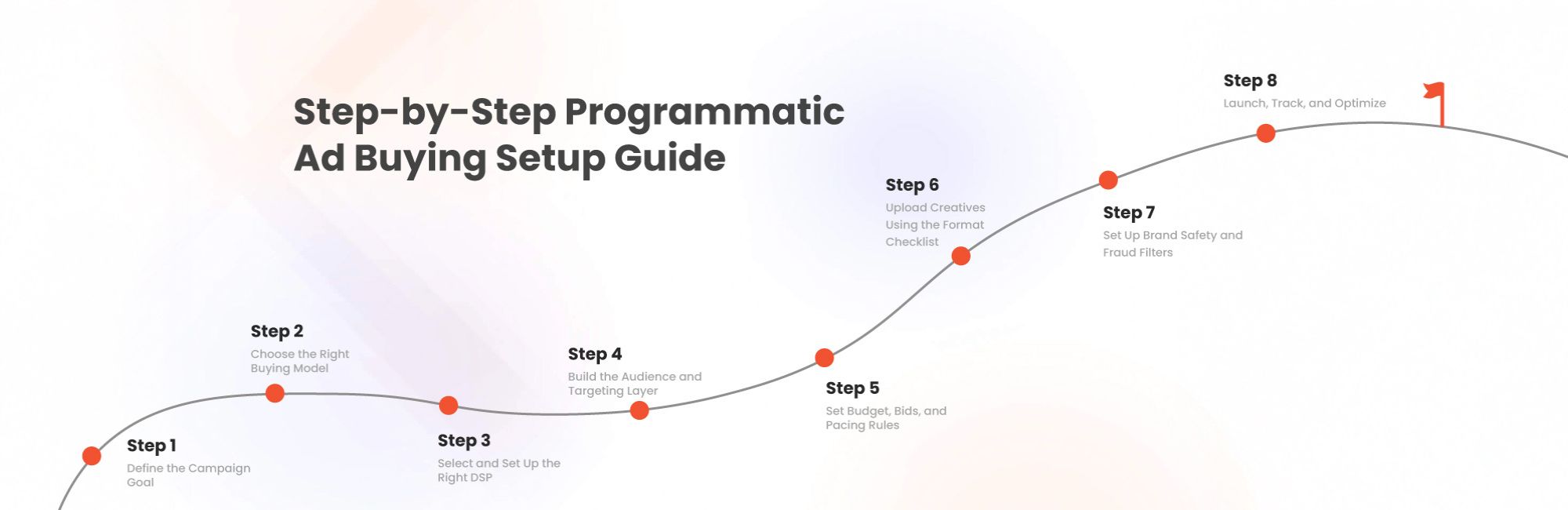
The following eight steps cover the complete campaign setup process. Each step includes the specific decisions and actions that determine whether a programmatic campaign delivers results or wastes budget.
Step 1: Define the Campaign Goal
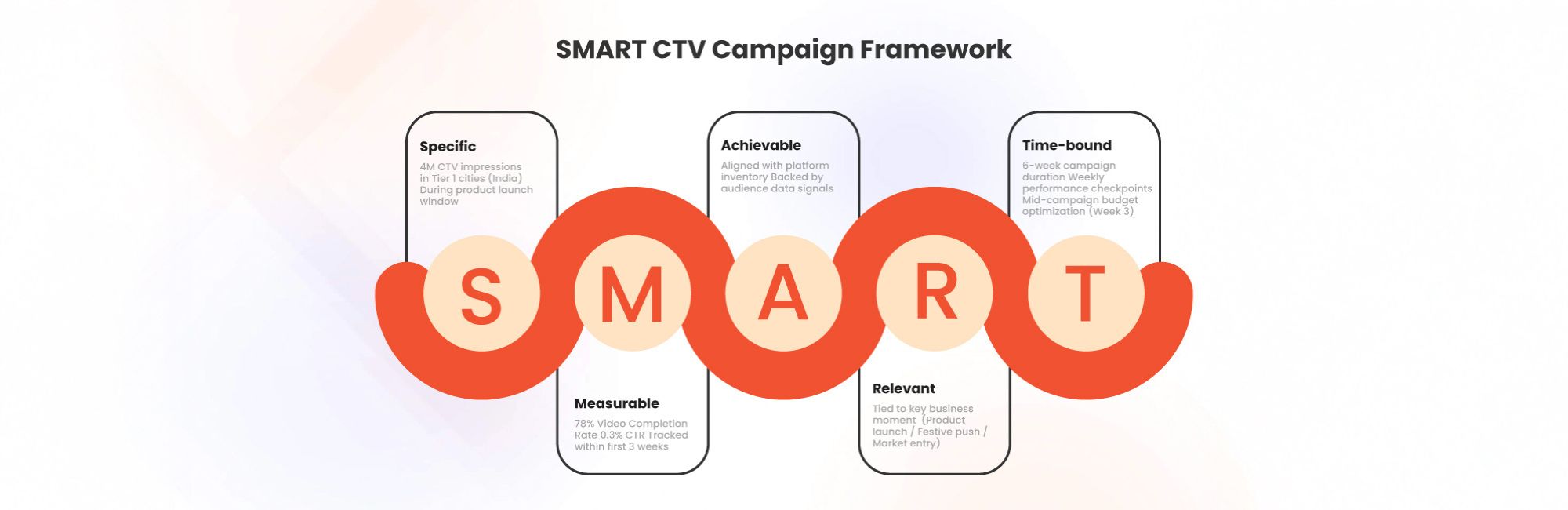
Every programmatic campaign needs a specific, measurable goal before any platform is configured. Vague objectives produce unmeasurable outcomes and poor optimization signals. Apply the SMART format: Specific, Measurable, Achievable, Relevant, and Time-bound.
- Specific: Reach 4 million CTV ad impressions in Tier 1 cities in India during a product launch window
- Measurable: Achieve a 78% video completion rate and 0.3% CTR within the first three weeks
- Achievable: Align the goal with available inventory volume and audience data on the chosen platform
- Relevant: Connect the campaign goal to a business event such as a product launch, festive season, or new market entry
- Time-bound: Run for six weeks with weekly performance checkpoints and a budget reallocation review at week three
The campaign goal also determines the right buying model. Awareness campaigns suit RTB or PMP. App install and conversion campaigns suit CPI or CPA buying on mobile performance DSPs. Brand recall campaigns suit PMP deals with rich media formats that extend dwell time.
Step 2: Choose the Right Buying Model
Buying model selection should follow the campaign objective, not just the budget level. App install campaigns need CPI or CPA buying with real-time bid optimization on mobile DSPs. CTV brand awareness campaigns need PMP or programmatic guaranteed deals for viewability assurance and fraud control. Omnichannel branding campaigns that span CTV, native, and display benefit from a unified DSP managing all placements in one interface to prevent frequency overlap and audience fatigue.
Step 3: Select and Set Up the Right DSP
DSP selection depends on the channel, audience, and campaign type. A generalist DSP stretched across every channel delivers average performance in each. Specialized platforms consistently outperform generalist tools because their bidding algorithms, inventory connections, and audience data are all built for that specific channel environment.
| Platform-to-Channel Matching
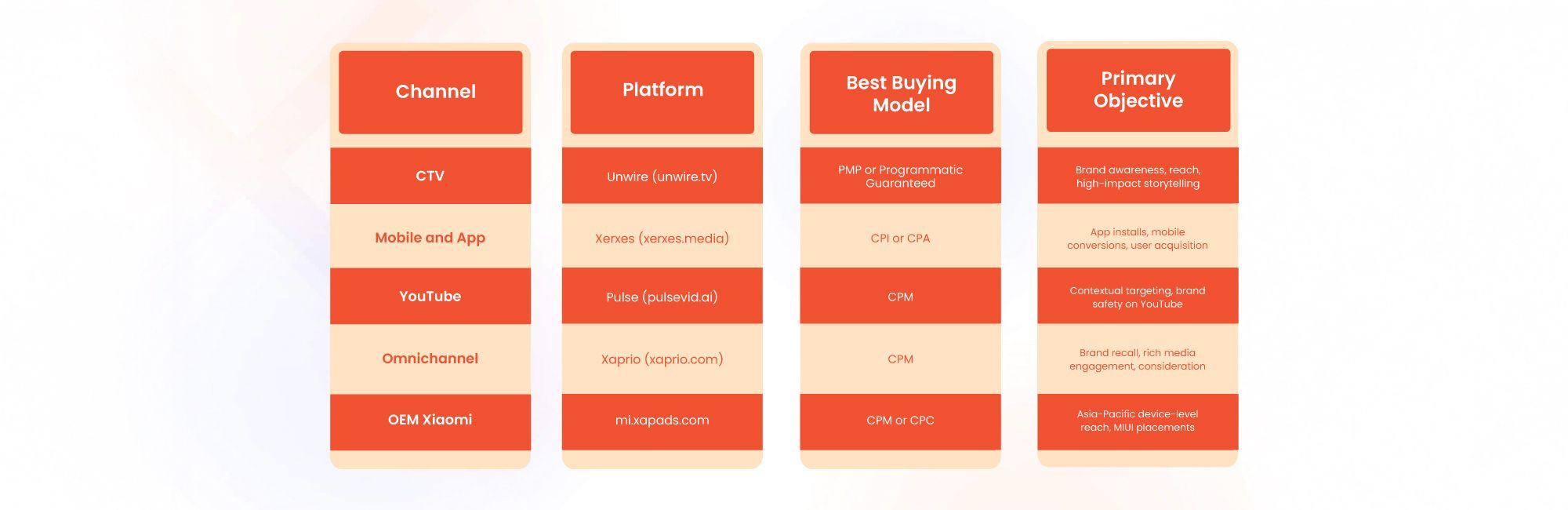
CTV brand awareness: Unwire (unwire.tv) | Mobile app performance: Xerxes (xerxes.media) | YouTube contextual targeting: Pulse (pulsevid.ai) | Omnichannel branding: Xaprio (xaprio.com) | Xiaomi OEM campaigns in Asia-Pacific: mi.xapads.com |
During DSP setup, complete these actions before launching any campaign:
- Create the advertiser account and verify billing and payment method.
- Install the platform conversion pixel or SDK for conversion event tracking.
- Connect the CDP or audience data source for audience segment activation.
- Verify ads.txt and app-ads.txt authorization for supply chain transparency.
- Configure brand safety defaults: category exclusions, viewability thresholds, and fraud pre-bid filters.
Step 4: Build the Audience and Targeting Layer
Targeting determines where programmatic budgets perform efficiently or get wasted at scale. A well-structured 2026 targeting strategy runs three layers simultaneously.
Contextual Targeting: Ads match content rather than tracked user identities. The system reads the page, video, or app content and serves ads aligned with the topic, keywords, and sentiment. This is the primary compliant targeting method in cookieless environments. It performs well for brand safety because ad placements appear only in editorially relevant content.
Audience Targeting: Behavioral and interest segments identify users most likely to take a specific action. Audience data covers app usage patterns, browsing intent, purchase signals, device type, location, and demographic profile. These segments allow advertisers to reach high-intent audiences across channels at scale.
Retargeting: Campaigns re-engage users who previously interacted with a brand’s digital touchpoints. App page visits without installs, partial video completions, and abandoned cart sessions are all retargetable signals. Retargeting consistently delivers lower CPAs than prospecting campaigns because the audience has already moved past initial awareness.
Step 5: Set Budget, Bids, and Pacing Rules
Budget setup directly affects how quickly the DSP algorithm collects data and optimizes performance. Starting too low produces insufficient data. Starting too aggressively burns budget on suboptimal placements before the algorithm identifies the best inventory.
Practical starting budget benchmarks for 2026:
- Open exchange RTB display: $50 to $500 per day to collect statistically valid performance data within 7 to 10 days
- CTV programmatic campaigns: $2,000 to $10,000 per month for adequate reach on premium streaming inventory
- Mobile CPI campaigns: $500 to $2,000 per month to build install volume and cost-per-install data
- YouTube contextual campaigns: $500 to $3,000 per month depending on audience size and geographic scope
Set pacing to even delivery during the first two weeks. Front-loading burns budget before the algorithm builds performance data. Set frequency caps at 3 to 5 impressions per campaign per day for most awareness campaigns. Higher caps apply to retargeting. Lower caps apply to broad awareness campaigns where ad fatigue is a risk.
Step 6: Upload Creatives Using the Format Checklist
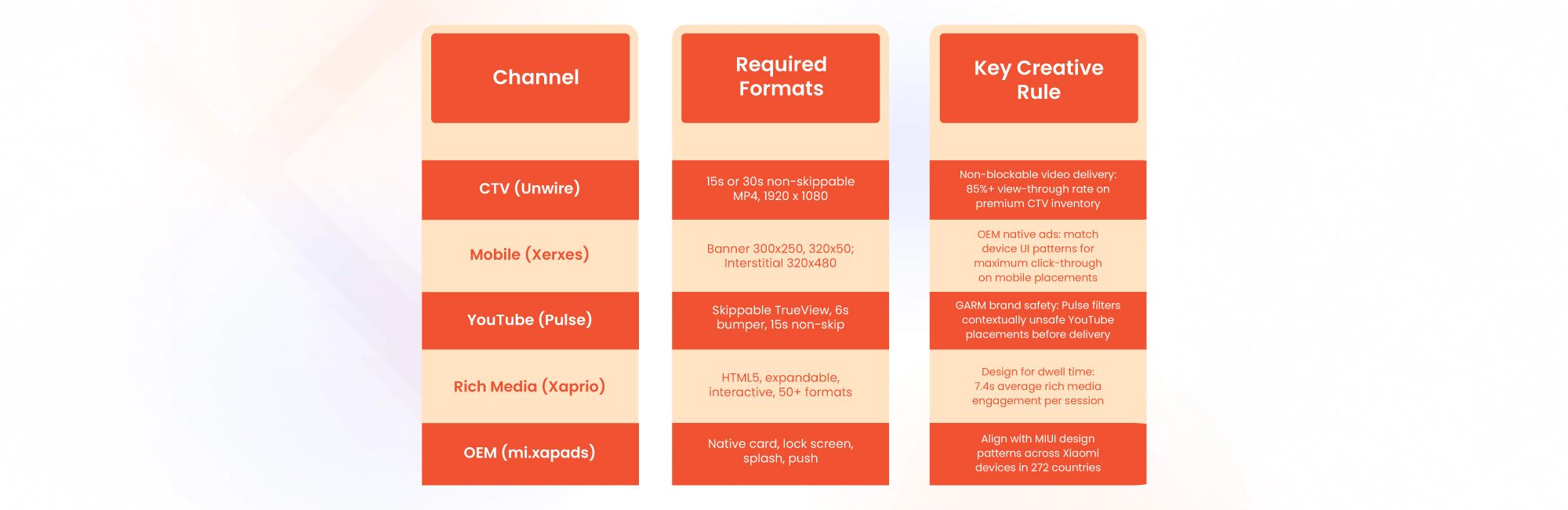
Creative quality determines how well targeting converts into measurable results. The best audience segment paired with a weak creative delivers weak results. Use this checklist before uploading creatives to any channel:
Step 7: Set Up Brand Safety and Fraud Filters
Brand safety configuration must be completed before the campaign goes live, not after a brand safety incident. This is the most frequently skipped step in programmatic setup and the most expensive mistake to fix after the fact.
Apply these filters in every campaign across every channel:
- Activate ads.txt and app-ads.txt verification to block unauthorized inventory reselling and domain spoofing
- Set category exclusions: violence, adult content, hate speech, and any user-generated content categories outside brand guidelines
- Enable pre-bid filtering through a third-party verification provider such as HUMAN or Pixalate
- Build keyword blocklists relevant to the brand’s category and campaign context
- Apply a publisher allowlist for CTV campaigns to restrict inventory to verified premium streaming sources
Step 8: Launch, Track, and Optimize
After launch, optimization runs in two phases. The first 72 hours establish baseline data. Making major changes before this baseline forms disrupts algorithm learning and extends the time to efficient optimization.
After 72 hours, review these performance dimensions:
- Creative performance: which formats and messaging combinations produce the highest completion rates and click-through rates
- Placement quality: which publishers, apps, or streaming channels deliver the lowest cost per result at the highest viewability
- Audience efficiency: which segments convert at the lowest CPA or highest return on ad spend
- Device and geo distribution: where budget concentrates without producing proportional results
Weekly reviews should cover frequency, pacing, and budget allocation per channel. Monthly reviews should evaluate the full channel mix and shift budget toward the strongest-performing environments.
Channel-Specific Setup: CTV, Mobile, YouTube, and Omnichannel
Programmatic runs across four distinct environments in 2026. Each has its own setup requirements, performance benchmarks, and optimal buying models. Running all channels through a single generalist DSP means accepting average performance across every environment. The correct approach uses purpose-built platforms for each channel.
Setting Up Programmatic CTV Campaigns
CTV programmatic buying runs through dedicated CTV platforms that connect advertisers to premium streaming and broadcast inventory at scale. Unwire is a dedicated CTV advertising platform that enables programmatic buying across premium connected TV inventory with contextual targeting, PMP, and programmatic guaranteed deal support.
Unwire delivers these benchmarks across all CTV campaigns:
- 120M+ global reach across premium channels
- 100% viewability across all premium placements
- 85%+ view-through rate with non-blockable video ad formats
- Approximately 10 contextual ads per minute, targeted by content type, programme genre, and language
- 99%+ fraud-free CTV delivery through native HUMAN and Pixalate integration
CTV campaign setup steps on Unwire:
- Register at unwire.tv and access the campaign management dashboard.
- Use the Smart Media Planner to build the media plan with AI-driven inventory suggestions.
- Configure the deal type: PMP for curated premium inventory, Programmatic Guaranteed for fixed reserved impressions.
- Set contextual targeting parameters: content genre, programme type, language, region, and device.
- Upload 15s or 30s non-skippable video creatives at 1920×1080 MP4 resolution.
- Activate real-time reporting for live performance monitoring across all active placements.
Unwire supports cross-device targeting, extending CTV campaigns to mobile for sequential messaging. An ad impression served on a connected TV can be followed by a mobile campaign impression, creating a consistent brand message across both screens.
Setting Up Programmatic Mobile Performance Campaigns
Xerxes is a self-serve mobile performance DSP with AI and ML-driven bidding across global mobile inventory. Xerxes connects to 18,000+ websites, 25,000+ mobile apps, and 50+ SSPs, supporting CPM, CPC, CPI, and CPA buying models.
Xerxes mobile audience coverage by region:
- India: 472M+ Monthly Active Users
- Southeast Asia: 212M+ Monthly Active Users
- Americas: 122M+ Monthly Active Users
- Europe: 105M+ Monthly Active Users
Mobile performance campaign setup on Xerxes:
- Create a new campaign and select the performance objective: app install (CPI), in-app action (CPA), or traffic (CPC).
- Connect the mobile measurement partner, such as AppsFlyer or Adjust, for conversion tracking.
- Set audience targeting by interests, device model, operating system version, ISP, and geographic parameters.
- Upload OEM native ads, banner creatives, video formats, and interactive ad units.
- Set daily budget and bid floor; activate automated bid optimization for the target KPI.
- Monitor install volume, cost-per-install, and in-app event rates in the real-time performance dashboard.
Setting Up Xiaomi OEM Campaigns
mi.xapads.com provides exclusive access to Xiaomi OEM ad placements through a dedicated partnership with Xiaomi Ads. This inventory operates separately from mobile web and in-app programmatic buying and requires a distinct setup approach.
Xiaomi OEM inventory coverage:
- 564M MIUI Monthly Active Users across 272 countries and regions
- 3.2 billion average daily impressions
- India: 133M, Europe: 104M, Southeast Asia: 59M, Latin America: 56M, Middle East: 23M
- Mi TV: 60M+ monthly unique digital users in 106 countries
- Wallpaper Carousel: 7B+ daily exposures, 100M users
OEM campaigns through mi.xapads.com cover factory preload, user acquisition ads, retargeting ads, air preload, and new device transmission placements. These formats sit inside the Xiaomi device ecosystem and are unavailable through standard open exchange or mobile DSP buying.
Setting Up YouTube Contextual Campaigns
Pulse by Xapads is an AI-powered YouTube ad targeting engine. Pulse analyzes video content signals including on-screen text, audio cues, visible brands, celebrity recognition, and overall sentiment to ensure ad placements appear only in contextually relevant, brand-safe moments.
Pulse follows GARM brand safety standards and filters categories including violence, adult content, and hate speech before any placement is executed. Advertisers receive smarter placement visibility, precision beyond standard keyword targeting, and real-time AI optimization aligned with YouTube’s content ecosystem.
YouTube campaign setup on Pulse:
- Book a demo at pulsevid.ai, start your account and connect the YouTube advertising account.
- Define content categories, topic alignment, and brand safety parameters for the campaign.
- Set keyword allowlists for contextual inclusion and blocklists for exclusion.
- Upload skippable TrueView ads, 6-second bumper creatives, or 15-second non-skippable formats.
- Activate placement quality scoring and real-time contextual performance monitoring.
- Review category-level placement reports weekly to refine contextual targeting parameters.
Setting Up Omnichannel Branding Campaigns
Xaprio is an omnichannel branding DSP built for rich media storytelling, brand recall campaigns, and moment marketing across CTV, OEM, native, display, and video from a single platform interface.
Xaprio platform benchmarks:
- 2x brand recall lift compared to standard display
- 50+ ad formats including interactive, expandable, and sensor-powered rich media
- 7.4 seconds average rich media engagement per session
- 3.2x time spent compared to static banner formats
- 100% transparent buying across 70+ global OEM and premium supply partners
The Full-Funnel Programmatic Architecture
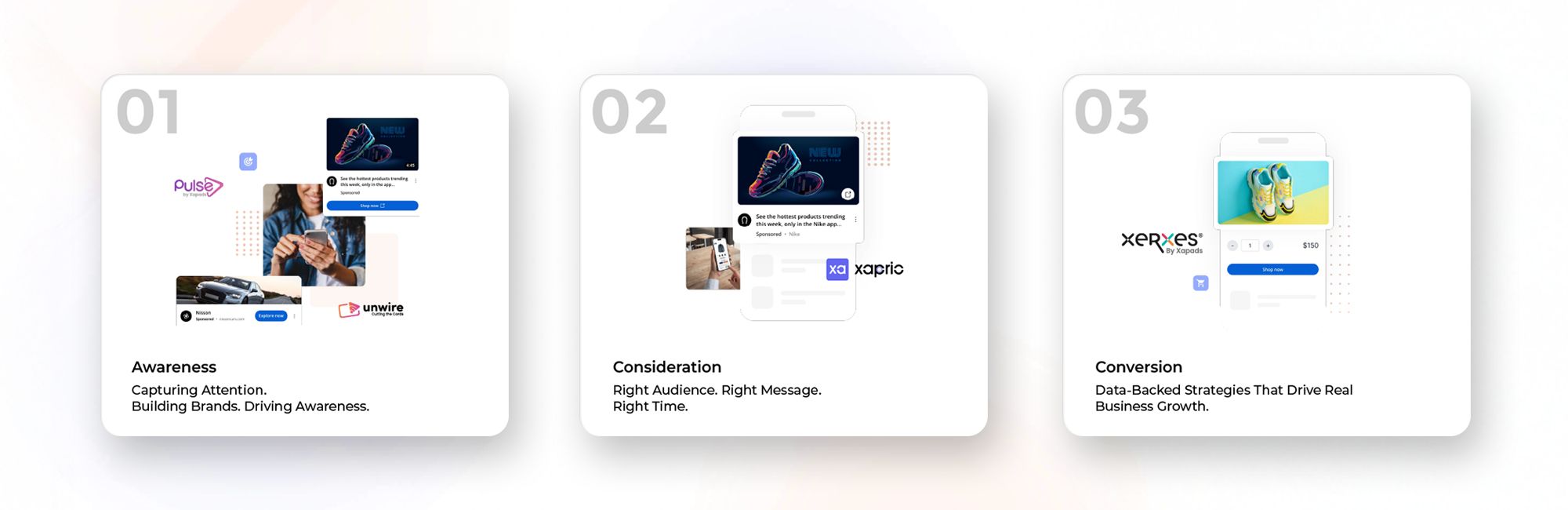
Xapads Media operates a full-funnel programmatic ecosystem covering 1.9B+ total audience reach across 245+ countries served through 9 offices worldwide and over 100 industry awards. Each stage of the marketing funnel maps to a specific platform with clear channel assignments.
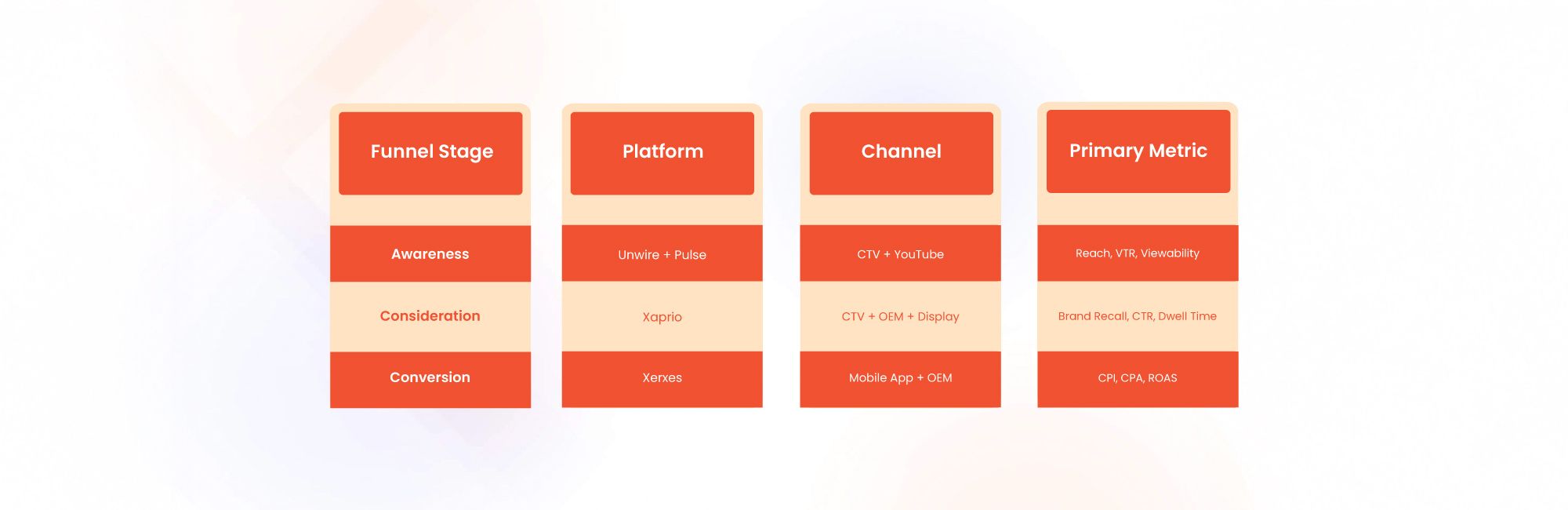
This funnel structure means advertisers do not need to stitch together separate vendor relationships for awareness, consideration, and conversion. One ecosystem covers the complete funnel with consistent audience data flowing through each stage.
Programmatic Targeting Types Explained
Contextual Targeting
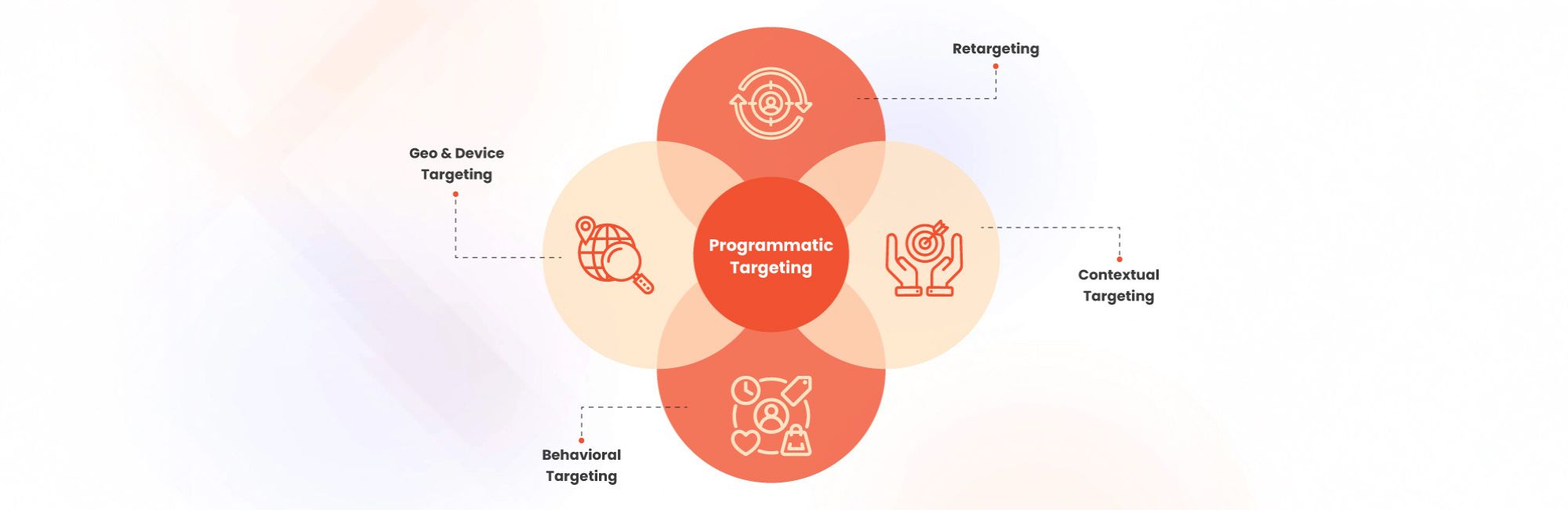
Contextual targeting matches ads to content rather than to tracked user identities. The system reads the page, video, or app content and serves ads that align with the topic, theme, and sentiment. This method requires no personal data and performs particularly well for brand safety because placements appear only in editorially aligned content. In 2026, contextual targeting is the primary compliant targeting method on every programmatic channel, not only a fallback option for cookieless environments.
Behavioral and Audience Targeting
Behavioral targeting uses historical engagement signals to identify users most likely to take a specific action. Segments built from app usage, browsing intent, purchase patterns, and demographic data let advertisers reach high-intent audiences across channels. These segments work best when built from owned data sources rather than third-party identifiers, which have declined significantly in reliability across programmatic buying since 2024.
Geo and Device Targeting
Geo targeting narrows campaigns to specific countries, cities, or hyperlocal radii. Device targeting filters by operating system, device model, screen type, and carrier. These two layers work together to eliminate wasted impressions. A mobile OEM campaign in India uses geo targeting to focus on priority metro areas and device targeting to reach Xiaomi MIUI users specifically, a combination that is only possible through OEM-level inventory access.
Retargeting
Retargeting reconnects brands with users who have already interacted with digital touchpoints. Partial app install flows, page visits without conversions, and incomplete video views are all retargetable signals. Retargeting consistently delivers lower CPAs than prospecting campaigns because the audience has already demonstrated intent. Sequential retargeting adds progressive creative logic, showing a different message at each touchpoint to move users closer to conversion.
Targeting in the Declining Cookie Environment
Third-party cookies are declining across major browser platforms and are no longer a reliable signal for programmatic audience targeting in 2026. Chrome has progressively restricted third-party cookie use, and industry data from eMarketer shows that advertisers have increasingly shifted toward contextual signals, publisher-provided identifiers, and owned audience data as the primary targeting inputs. Brands that connected their CRM data, app behavioral records, and loyalty information to their DSP during this transition now hold a structural targeting advantage over competitors who have not yet made this shift.
Programmatic Advertising: Pros and Cons
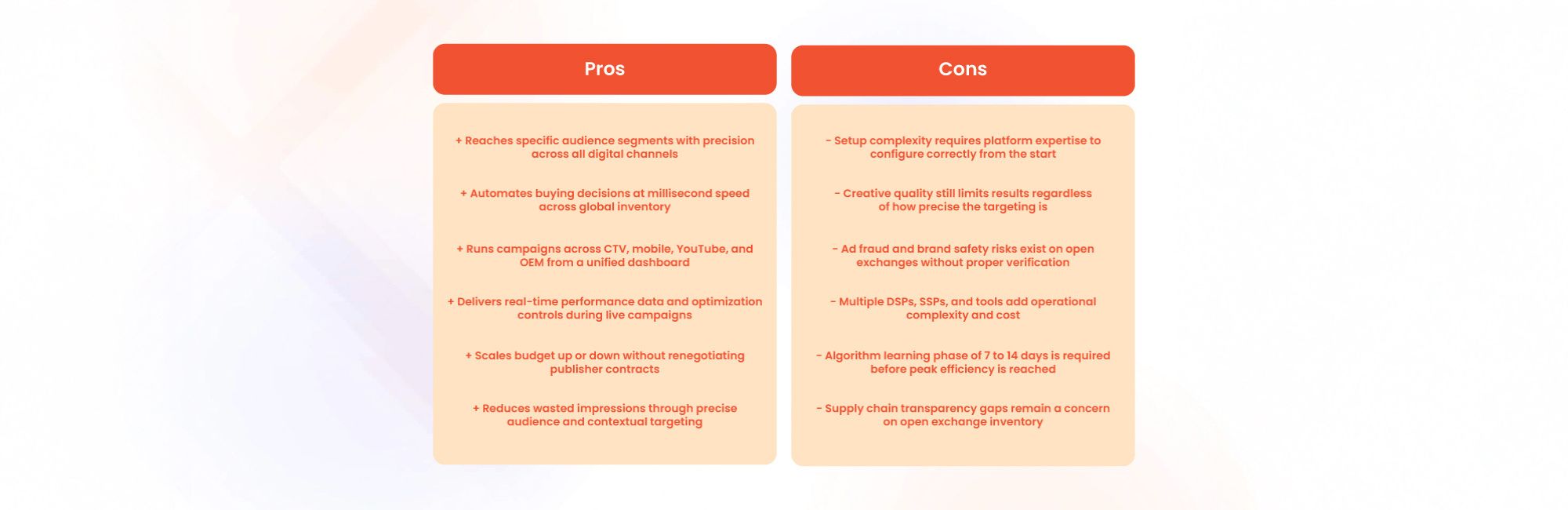
The cons listed here are manageable with correct setup. Platform complexity reduces when channel-specialized DSPs are used for their intended environments. Ad fraud approaches zero with platform-native verification tools. Creative weakness improves with format diversity and dynamic creative optimization. The key is building the right stack from the beginning rather than adding fixes after problems appear.
Common Mistakes in Programmatic Setup and How to Fix Them
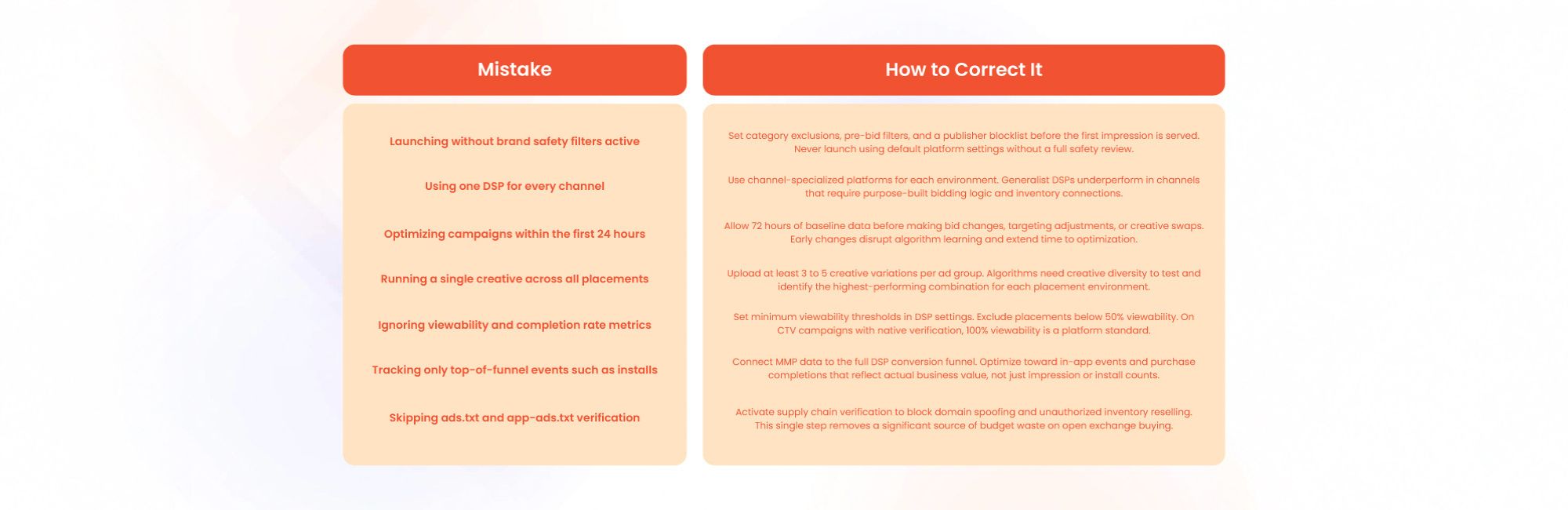
These are the specific errors that consistently reduce programmatic campaign performance. Most are preventable with the right setup process.
What Programmatic Ad Buying Looks Like From 2026 to 2030
The next four years will reshape programmatic buying more than the previous decade. Four structural shifts define this period.
AI Bidding and Predictive Optimization
AI bidding is already the dominant optimization method in 2026. Platform algorithms predict which impressions are most likely to convert, adjust bids in real time, and shift budget toward the highest-value audience segments automatically. According to Mordor Intelligence, the global programmatic market is growing at a CAGR of 10.34%, with AI-driven automation accelerating both spend efficiency and campaign performance simultaneously.
Between 2026 and 2030, agentic AI systems will take this further by autonomously building campaign structures, testing creative variations, reallocating budgets across channels, and generating performance reports without manual execution. Human media planners will shift from hands-on campaign management toward strategic goal-setting and outcome interpretation.
CTV and DOOH Programmatic Growth
US CTV programmatic ad spend is projected to reach $46.89 billion by 2028 and surpass traditional TV ad spending for the first time. By 2030, CTV will be the dominant video ad format in the US. Digital out-of-home programmatic is expanding alongside CTV as advertisers extend campaigns to outdoor screens, transit networks, and retail environments using the same audience data and buying infrastructure as their digital channels.
Declining Cookies and Identity-First Buying
Third-party cookies are declining as a reliable programmatic signal. Contextual targeting, publisher-provided identifiers, and owned audience data are becoming the primary inputs for programmatic campaigns in 2026 and beyond. Platforms built for this environment deliver compliant, effective targeting without relying on cross-site tracking. Between 2026 and 2030, universal identity frameworks and publisher-provided ID systems will mature, giving advertisers cross-platform audience matching that does not depend on personal identifiers.
Sustainable and Green Supply Path Optimization
Supply path optimization (SPO) is now both an efficiency priority and an ESG concern. Every programmatic impression that passes through unnecessary intermediary layers adds latency, cost, and carbon output. Platforms that use direct, optimized supply routes reduce these layers, improving transparency and lowering the environmental cost of programmatic buying. Between 2026 and 2030, sustainability reporting will become a standard requirement in programmatic buying for brands with public ESG commitments. Advertisers that build clean supply paths now will have the reporting data ready when clients and auditors begin requesting it. Xaprio’s Green Supply Path is one example of this approach in practice.
Frequently Asked Questions
What is the minimum budget to start programmatic advertising in 2026?
Programmatic campaigns can start from $50 per day on open exchange display. For meaningful performance data, most campaigns allocate $500 to $1,000 per month as a minimum to collect statistically valid signals within 7 to 14 days. CTV campaigns benefit from a starting budget of $2,000 to $5,000 per month for adequate reach on premium inventory. Mobile CPI campaigns can begin at $500 per month and scale based on install cost efficiency data.
What is the difference between programmatic advertising and display advertising?
Display advertising refers to the format: banner, video, rich media, or native ads placed on websites and apps. Programmatic advertising refers to the buying method: automated, real-time bidding through a DSP. Most display advertising today is bought programmatically. However, programmatic extends well beyond display. CTV, mobile in-app video, OEM native, digital audio, and digital out-of-home are all programmatic channels that are not traditional display formats.
How long does it take to see meaningful results from a programmatic campaign?
Initial performance signals appear within 24 to 72 hours of launch. Meaningful optimization typically requires 7 to 14 days of consistent data collection. Brand awareness campaigns show measurable recall lift after 4 to 6 weeks. Mobile performance campaigns targeting app installs can show CPI efficiency improvements within the first 2 to 3 weeks. Campaigns with larger daily budgets and multiple creative variations optimize faster because the algorithm has more data to learn from.
Is programmatic advertising suitable for brands with smaller budgets?
Programmatic buying is accessible at any budget level in 2026. Geographic and device targeting ensures advertisers pay only for impressions within their target area and audience. Self-serve DSPs provide the same targeting precision and real-time reporting that large agencies use, making programmatic viable for local, regional, and mid-sized brands that previously lacked access to premium inventory at manageable entry costs.
Final Thoughts
Programmatic ad buying is the infrastructure that runs almost every digital advertising channel in 2026. It accounts for 90% of all display ad budgets globally, spans CTV, mobile, YouTube, OEM, and digital out-of-home, and processes millions of auctions per second in real time. The question is no longer whether to use programmatic. The question is whether the right platforms, targeting layers, and safety controls are in place to make it perform.
The setup process covered in this guide provides the foundation for campaigns that perform in 2026 and scale toward 2030. Defining clear goals, selecting channel-appropriate platforms, building layered targeting, activating brand safety before launch, and optimizing based on real data are the steps that separate high-performing campaigns from those that waste budget.
For deeper coverage of CTV advertising strategy, mobile performance campaigns, YouTube contextual targeting, and omnichannel planning, additional articles are available on the Xapads blog at blog.xapads.com.
Related Post